
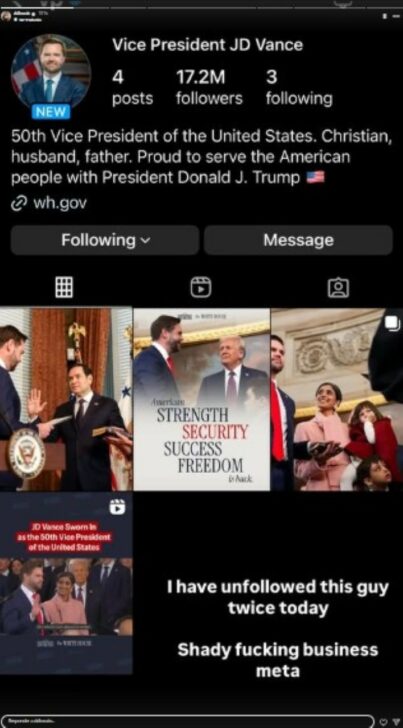
On the morning of January 22, 2025, a wave of criticism flooded social media following reports of compulsory following of official accounts linked to U.S. President Donald Trump and his Vice President, JD Vance. Among the complainants were Demi Lovato and Cara Delevingne, who used their platforms to alert their followers about the incident. Lovato reported that she had unfollowed Vance’s official account twice but was automatically reconnected. Delevingne posted screenshots confirming the situation, increasing the pressure on Meta, the company responsible for Instagram and Facebook.
In addition to celebrities, ordinary users also noticed that they were following political accounts without permission, even without any history of interest or interaction with such profiles. Meta explained that this process is part of a policy to maintain followers on official accounts during government transitions. However, the explanation was met with skepticism, fueling discussions about platform control and transparency.
The outrage intensified when some users claimed they could not search for terms related to the Democratic Party on Instagram. This technical failure was seen as further evidence of political bias on Meta’s platforms. The company assured that it is working to resolve the issues, but the impact on public trust was evident.
History of social media controversies
The mechanisms for transferring followers during government changes are not new. In 2016, during the transition from Barack Obama to Donald Trump, followers of official administration accounts were automatically transferred to the new ones, which also generated controversy. At the time, users questioned the lack of consent in the process, but the incident was overshadowed by the novelty of the administration.
The recent criticism reflects a growing concern over the lack of user autonomy on social media. Although Meta has stated that the goal is to simplify the continuity of official accounts, the fact that some personal accounts, such as JD Vance’s, were also involved in compulsory following raises suspicions of political manipulation. Experts argue that the practice does not directly violate laws but challenges ethical principles of digital consent.
Technical aspects and Meta’s position
Katie Harbath, a former member of Facebook’s elections team, explained that Meta’s system retains followers on official accounts to facilitate the transition and preserve the audience of the new officeholders. However, the policy becomes problematic when users lose the ability to choose whether to follow the new leaders.
Meta confirmed that the system was not designed to follow personal accounts without permission, but cases such as JD Vance’s contradict this claim. Meta spokesperson Andy Stone defended that the mentioned personal accounts might have been followed accidentally due to glitches in the reconnection algorithm. However, this explanation did not convince critics, who pointed to a recurring pattern of controversial decisions involving the platform.
Details of Meta’s recent changes
In recent months, Meta has implemented significant adjustments that influence how users interact with political and social content. These changes include:
- The dissolution of teams dedicated to Diversity, Equity, and Inclusion.
- The replacement of the fact-checking program with a system similar to Community Notes, used by the X platform (formerly Twitter).
- Changes in conduct guidelines, allowing posts describing LGBTQ+ individuals as “mentally ill,” causing public outrage.
These measures have contributed to the growing distrust of users regarding the platform’s impartiality and reinforced accusations of political bias, mainly favoring conservative groups.
Reports of blocked searches on Instagram
Users also reported difficulties when searching for terms associated with the Democratic Party on Instagram. Some claimed that related hashtags simply did not yield results, while others displayed error messages. Meta classified the issue as a technical failure, unrelated to political bias, and assured that it is investigating the situation to resolve it.
These technical problems coincide with the expanded use of algorithms to filter content on Instagram and Facebook, generating criticism about the lack of transparency in content moderation and feed personalization.
Consequences for Meta’s reputation
The automatic following of political accounts and the search problems for Democratic terms have placed Meta in a delicate position. While the company tries to balance its internal policies with user demands, the perception of excessive control and lack of transparency grows. Experts highlight that incidents like these can seriously compromise Meta’s credibility at a time of increasing scrutiny regarding the role of social media in influencing political decisions and social behaviors.
Meta is already facing legal and regulatory challenges in several countries, and the current situation in the United States reinforces arguments that platforms need stricter regulations to protect users’ rights.
Relevant data on Meta and social impact
- Facebook and Instagram have more than 3 billion active users globally, making them the most influential platforms in the digital world.
- In 2024, Meta reported revenue of $150 billion, mostly from targeted advertising, emphasizing the importance of personalization algorithms.
- More than 40% of American users believe social media has a political bias, according to recent surveys.
These numbers highlight Meta’s significant influence in contemporary society and the need for greater transparency in its operations.
Debate on digital ethics
Recent events reignite the debate on digital ethics and the role of technology companies in preserving user autonomy. The lack of consent in follower transfer processes and technical search failures raise questions about the limits of social media platforms’ power and the protection of digital rights.
Experts suggest that more robust regulations could be the solution to ensure companies like Meta act ethically and transparently. Proposed laws requiring greater clarity in terms of use and stricter controls over algorithm functioning are being discussed in various countries but face resistance from major technology corporations.
Impact on public trust
Public trust in platforms like Facebook and Instagram is in decline, especially among young adults, who make up the majority of users. Incidents such as the automatic following of political accounts and changes in moderation policies reinforce the perception that users’ interests are being ignored in favor of corporate or political interests.
Surveys indicate that 60% of Americans prefer greater regulation of social media, especially concerning privacy and transparency. These numbers serve as a warning to companies like Meta, which need to demonstrate a stronger commitment to ethics and user rights to regain public trust.
Future trends and pending issues
As Meta tries to mitigate the impacts of recent criticisms, the future of social platforms depends on companies’ ability to balance technological innovation with ethical responsibility. The upcoming elections in the United States and other countries will be a crucial test to assess whether Meta’s promised changes are enough to prevent new controversial episodes.
Users, in turn, continue to demand greater control over their accounts and a digital experience that respects their autonomy and preferences. The pressure for changes is increasing, and the outcome of this clash between corporations and the public will define the next chapter of the digital era.
