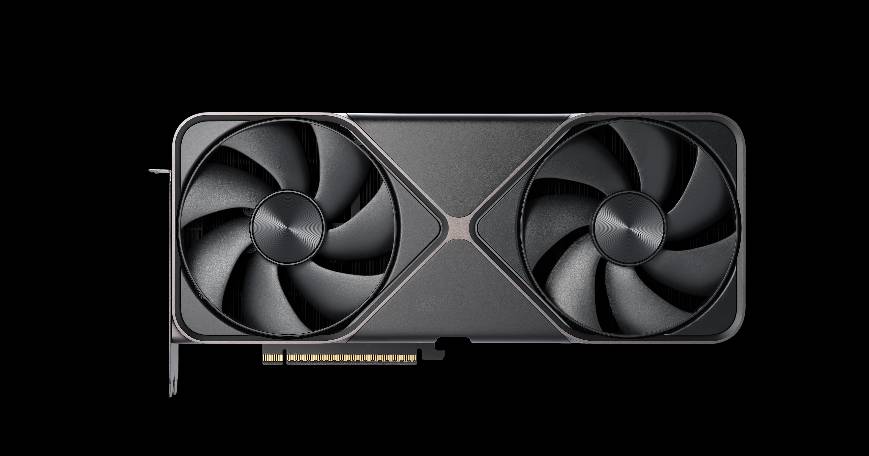
NVIDIA has officially announced its latest RTX 50 series graphics cards, the GeForce RTX 5090 and RTX 5080, which enter the market promising a significant leap in graphics rendering, artificial intelligence, and frame generation. The new Blackwell architecture, combined with DLSS 4 with Multi Frame Generation, takes performance to unprecedented levels, doubling frame rates and enhancing visual quality in modern games. The launch took place on January 30, 2025, with GPUs available in major retailers and pre-built systems from top manufacturers.
The RTX 5090 and RTX 5080 are designed to meet the demands of hardcore gamers, content creators, and professionals. The RTX 5090, positioned as the most powerful GPU of the generation, offers 4K rendering with up to 2.3 times the performance of the RTX 4090. Meanwhile, the RTX 5080 provides a balance between cost and high performance, making it a strong contender for those seeking an upgrade without investing in the most expensive model.
These GPUs are priced at $1,999 for the RTX 5090 and $999 for the RTX 5080, with prices varying based on location and manufacturer. Due to high demand, limited stock availability is expected in the first few weeks following the launch.
Performance breakthroughs and AI-driven innovation
With the introduction of the Blackwell architecture, NVIDIA brings major improvements in energy efficiency and graphics performance. The RTX 5090 features an astounding 21,760 CUDA cores and 32GB of GDDR7 memory, while the RTX 5080 comes with 16GB of GDDR7 and 16,384 CUDA cores. These specifications make the new GPUs up to 40% faster than their predecessors in most modern games.
The most revolutionary feature of this generation is DLSS 4, which uses AI to generate additional frames, improving smoothness without overloading the GPU. DLSS 4 allows titles like Cyberpunk 2077, Alan Wake 2, and Star Wars Outlaws to run in 4K at over 200 FPS. In comparison, the RTX 4090 could reach approximately 150 FPS in similar settings.
AI also plays a crucial role in creative applications, offering significant improvements in 3D rendering, video editing, and streaming. NVIDIA’s latest Tensor Cores support FP4, delivering double the performance of FP8 from the previous generation while reducing VRAM consumption when running AI models.
RTX 5090 and RTX 5080 technical specifications
The new NVIDIA GPUs introduce significant improvements in Ray Tracing, memory speed, and power efficiency.
- RTX 5090
- Architecture: Blackwell
- CUDA Cores: 21,760
- Memory: 32GB GDDR7
- Memory Speed: 28Gbps
- Power Consumption: 575W
- Performance: Up to 40% faster than RTX 4090
- Supports DLSS 4 and Next-Gen Ray Tracing
- RTX 5080
- Architecture: Blackwell
- CUDA Cores: 16,384
- Memory: 16GB GDDR7
- Memory Speed: 24Gbps
- Power Consumption: 375W
- Supports DLSS 4 and Optimized Ray Tracing
The GPUs also support PCIe 5.0, HDMI 2.1, and DisplayPort 2.1, ensuring compatibility with high-resolution monitors and ultra-high refresh rates.
DLSS 4 and Multi Frame Generation impact
DLSS 4 technology is one of NVIDIA’s biggest advancements in years, allowing AI to generate multiple frames between GPU-rendered ones, drastically reducing processing load and enabling higher frame rates without sacrificing visual fidelity.
Some key benefits of DLSS 4 include:
- Up to 8x higher frame rates compared to native rendering.
- Reduced latency and improved stability, eliminating issues like ghosting and tearing.
- Lower power consumption, allowing longer gaming sessions without overheating.
- Over 75 compatible games at launch, including major AAA titles.
Additionally, AI-powered image reconstruction and Ray Tracing improvements make reflections and shadows more realistic without compromising performance.
Power consumption and system requirements
With higher performance comes greater power demand. The RTX 5090 requires a minimum 1,000W power supply, while the RTX 5080 requires at least 750W. Both GPUs use the latest PCIe Gen5 16-pin power connectors, meaning modern power supplies are required for full compatibility.
Initial benchmarks reveal that despite high power consumption, the RTX 5090’s cooling system efficiently maintains temperatures below 75°C under full load.
Benefits for content creators
Beyond gaming, content creators also benefit from RTX 50 series advancements. The updated Tensor Cores and NVENC encoders significantly improve video editing and 3D rendering. Key advantages include:
- 4:2:2 color format support, essential for professional video production.
- AV1 compression improvements, reducing file sizes by up to 20% without loss of quality.
- Video exports up to 60% faster than previous generations.
- Enhanced 3D rendering speeds, reducing the time required for complex projects.
NVIDIA Broadcast has also been updated, introducing Studio Voice, which improves microphone quality, and Virtual Key Light, which enhances lighting in live streams.
Initial reviews and public reception
Early reviews of the RTX 5090 and RTX 5080 indicate that these GPUs represent a major leap forward. Some of the main highlights include:
- Significant performance improvements in Ray Tracing-enabled games.
- Noticeable visual enhancements with DLSS 4.
- Top-tier performance without requiring overclocking.
However, some criticisms have emerged regarding high pricing, particularly considering that the RTX 4090 remains a competitive alternative. Additionally, some users question whether the DLSS 4-based FPS improvements truly reflect native performance gains.
Future outlook for the GPU market
The RTX 50 series launch solidifies NVIDIA’s dominance in the high-end GPU market, but competition remains fierce. AMD and Intel are expected to unveil their next-generation GPUs in the coming months, and the role of AI in graphics rendering will be a key differentiator.
Price remains a major deciding factor, especially as demand for high-end GPUs continues to surge among gamers and creators. NVIDIA is expected to expand the RTX 50 lineup with mid-range models such as the RTX 5070 and RTX 5060 in the coming months.
