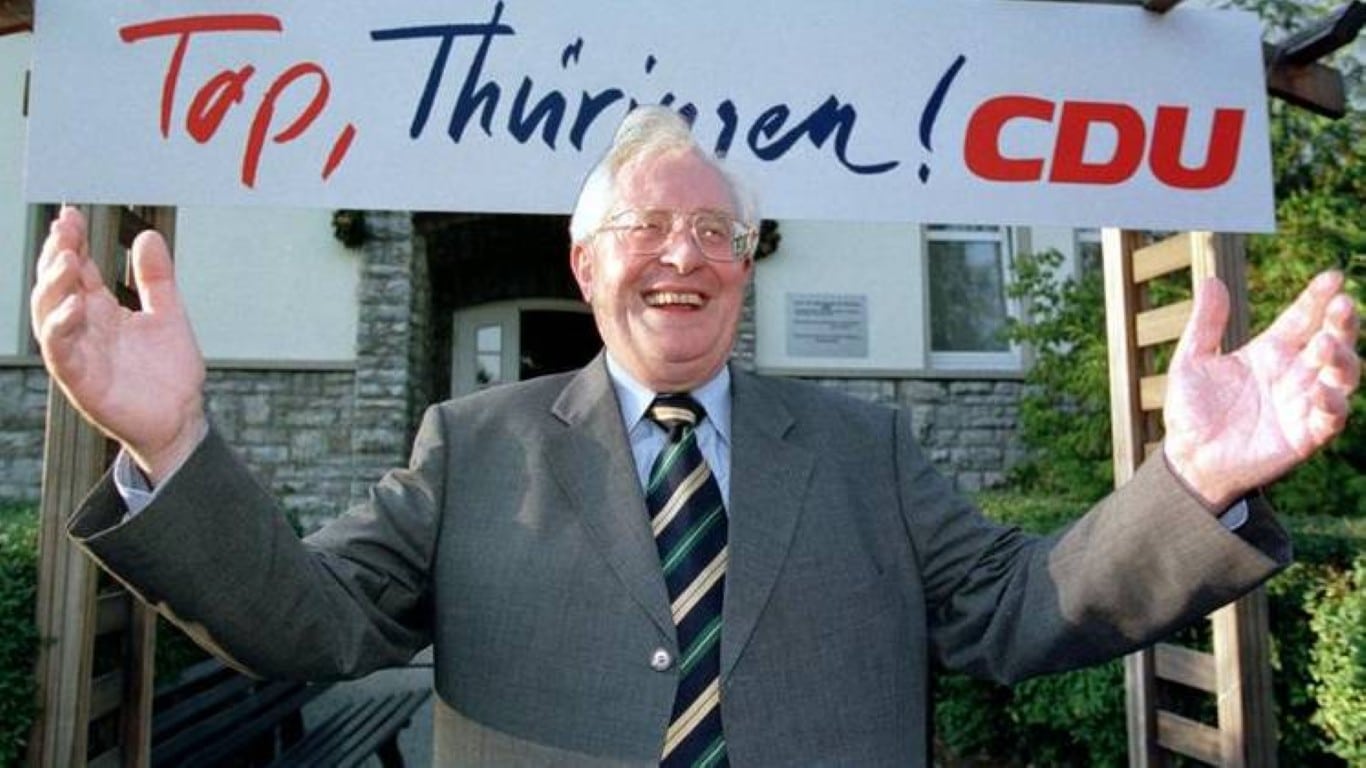
Bernhard Vogel, one of Germany’s most influential post-war politicians, passed away at the age of 92, leaving behind a profound legacy as the former minister-president of Thuringia and Rhineland-Palatinate. His death was confirmed on the morning of March 3, marking the end of a remarkable career dedicated to the Christian Democratic Union (CDU) and the political rebuilding of key German regions. Vogel, renowned for his ability to bridge diverse political factions and his pivotal role in Germany’s reunification, had been out of the public eye for years, yet his impact continued to resonate among leaders and citizens alike. Spanning over four decades, his career shaped Thuringia’s political landscape, particularly after the fall of the Berlin Wall, when he took the helm of the state during a historic period of transition.
Born on December 19, 1932, in Göttingen, Lower Saxony, Vogel entered politics in the 1960s, quickly rising as a sharp strategist and advocate for Christian democratic values. Before leading Thuringia, he governed Rhineland-Palatinate for nearly two decades, from 1976 to 1988, implementing policies that modernized the state and bolstered its economy. His tenure in Thuringia, from 1992 to 2003, came at a critical juncture: as part of the former East Germany, the state grappled with infrastructure deficits, unemployment, and integration into the Western capitalist system. Under his leadership, the region saw significant progress, including industrial investments and the revitalization of Erfurt as a thriving capital.
The announcement of his passing prompted immediate responses from public figures across Germany. Thuringia’s current Minister-President Bodo Ramelow mourned the loss, emphasizing Vogel’s contributions to the state’s political stability. CDU leaders, whose party Vogel helped solidify in eastern Germany, also paid tribute, recalling his pragmatic approach and commitment to democratic principles. While the cause of death has not been officially disclosed, it is known that Vogel had been dealing with health issues for some time, living quietly in retirement.
Bernhard Vogel’s journey in German politics
Bernhard Vogel’s political career stands as a cornerstone in Germany’s postwar history, defined by his leadership in two distinct states during pivotal times. After earning degrees in political science and history, he joined the CDU in the 1950s, inspired by the ideals of Konrad Adenauer, Germany’s first postwar chancellor. His ascent began in 1967 when he became Rhineland-Palatinate’s Minister of Education and Culture, a role he held until taking over as minister-president in 1976. Over his 12-year tenure, Vogel prioritized education, introducing reforms that expanded access to higher education and modernized the state’s school system.
Leaving the post in 1988, he had already established a reputation as an effective administrator. His greatest challenge came in 1992, post-reunification, when he took charge of Thuringia, one of the five new eastern states integrated into West Germany. Elected in a historic vote, Vogel assumed office on February 5, 1992, becoming Thuringia’s first democratic minister-president. Over his 11-year term, ending in 2003, he tackled unemployment rates that peaked at 17%, attracting companies like Siemens and Opel, which set up factories in the region, creating thousands of jobs.
Beyond his executive roles, Vogel served as the CDU’s national chairman from 1971 to 1980, a period when the party solidified its dominance in German politics. His knack for mediating internal disputes and expanding the party’s foothold in the east after 1990 proved vital to its growth. Even after stepping down from Thuringia’s leadership, he remained a respected voice, often sought out by younger CDU leaders for guidance.
Vogel’s legacy in Germany’s reunification
Bernhard Vogel’s role in Germany’s reunification stands out as a cornerstone of his legacy. When the Berlin Wall fell in 1989, Thuringia, part of the former East Germany, faced economic and social collapse after decades under communist rule. Vogel arrived in 1992 tasked with integrating the state into the political and economic framework of the west, a process demanding sweeping reforms. Under his stewardship, Erfurt transformed into a modern administrative hub, with historic buildings restored and infrastructure upgraded to meet the needs of a unified state.
Key achievements during his tenure included investments in highways and railways, linking Thuringia to cities like Frankfurt and Berlin, boosting trade and mobility. He also championed cultural preservation, supporting the restoration of sites like Erfurt Cathedral and Wartburg Castle, UNESCO World Heritage landmarks that now draw millions of tourists. Economic data from the period show Thuringia’s per capita GDP rising by about 40% between 1992 and 2003 under his watch, though it still lagged behind western regions in social metrics.
His departure in 2003, at age 70, marked the end of an era in local politics. Choosing not to seek re-election, Vogel handed the reins to his successor, Dieter Althaus, also of the CDU. In the years that followed, he turned to academic and charitable pursuits, staying out of the spotlight but never forgotten by those who valued his efforts to stabilize Thuringia during turbulent times.
Key milestones in Bernhard Vogel’s career
Vogel’s political life is dotted with defining moments that shaped his path. Here are some highlights:
- 1967: Becomes Rhineland-Palatinate’s Minister of Education, launching his executive career.
- 1976: Assumes the role of minister-president of Rhineland-Palatinate, serving until 1988.
- 1992: Elected Thuringia’s first post-reunification minister-president, leading until 2003.
- 1971-1980: Chairs the CDU nationally, strengthening its political standing.
These milestones reflect his adaptability and leadership across varied historical contexts.
Reactions to Vogel’s death across Germany
Bernhard Vogel’s passing sparked a wave of tributes throughout Germany. Bodo Ramelow, Thuringia’s current leader from The Left party, called him an “architect of democracy” in the state, underscoring his role in bridging east and west. In Rhineland-Palatinate, Minister-President Malu Dreyer of the SPD praised his forward-thinking educational vision, which left a lasting imprint on the region’s school system.
CDU members, including national leader Friedrich Merz, hailed Vogel’s dedication to the party and nation, recalling his steadfastness during reunification. Politicians from other parties, such as the Greens and FDP, also expressed admiration for his conciliatory stance and crisis management skills. In Erfurt, residents laid flowers outside the state government building in a spontaneous gesture honoring a leader who shaped Thuringia’s modern identity.
Though Vogel stepped back from active politics in 2003, his death reignited discussions about the role of reunification-era leaders in German history. Many view him as a symbol of resilience and pragmatism, qualities essential to overcoming the challenges of a nation divided for decades.
Timeline of Bernhard Vogel’s life
Vogel’s journey can be traced through key dates:
- 1932: Born in Göttingen, Lower Saxony, on December 19.
- 1950: Joins the CDU, beginning his political activism.
- 1976-1988: Governs Rhineland-Palatinate as minister-president.
- 1992-2003: Leads Thuringia as its first post-reunification minister-president.
- March 3, 2025: Dies at 92, leaving a 40-year political legacy.
This timeline encapsulates a life devoted to public service and German unity.
Vogel’s impact on post-reunification Thuringia
Bernhard Vogel’s tenure in Thuringia was pivotal to the state’s development after 1990. Taking office amid the socialist legacy of closed factories, high unemployment, and outdated infrastructure, he pursued partnerships with private industry to revive the economy. Companies like BMW established operations in cities such as Jena, a hub for optics and technology, thanks to his efforts.
Transportation modernization was another focus. During his term, the A71 highway, dubbed the “Unity Autobahn,” was completed, linking Erfurt to other German regions and symbolizing eastern integration. Unemployment, which hit 17% in 1992, dropped to around 10% by the end of his leadership, though disparities with the west persisted. These strides cemented Thuringia’s viability in a reunified Germany despite structural hurdles.
Vogel also left a cultural mark, backing projects that restored the region’s heritage. Wartburg Castle, for instance, was refurbished and promoted as a tourist draw, boosting revenue and jobs. His balanced approach to economic progress and cultural preservation remains a highlight of his administration.
Tributes and memory of Bernhard Vogel
Following news of his death, tributes to Vogel poured in. In Erfurt, flags were lowered to half-mast at the state government building, with local leaders planning a memorial in his honor. In Rhineland-Palatinate, schools he helped modernize held moments of silence, acknowledging his educational impact.
Politicians across generations shared personal anecdotes about Vogel, praising his accessibility and humor even in tense times. His influence transcended the CDU, earning respect from rivals who admired his integrity. In Jena, where he spurred technological growth, local businesses voiced gratitude for his role in turning the city into an innovation hub.
Vogel’s death closes a significant chapter in German politics, but his legacy endures in the structures he helped build. His years in Thuringia and Rhineland-Palatinate stand as testaments to leadership through change, reflecting his commitment to democracy and national unity.
