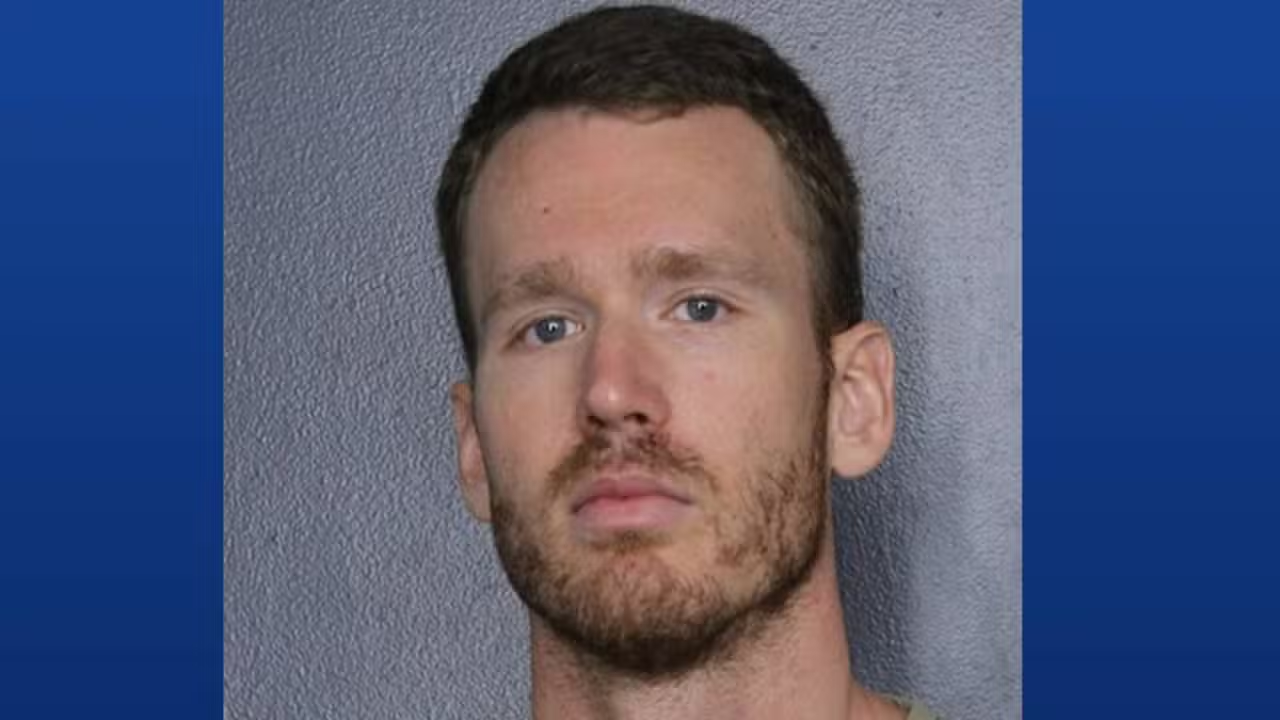
In an unexpected turn of events, Robert Crimo III, accused of opening fire during the 2022 Highland Park 4th of July parade in Illinois, changed his stance and pleaded guilty to 69 charges, including 21 counts of first-degree murder and 48 counts of attempted murder. The announcement came on the morning of March 3 in the Waukegan courtroom, just before opening statements were set to begin in a trial anticipated for over two years. This decision marks the end of a process riddled with twists and delays, bringing relief to a community shattered by a tragedy that left seven dead and dozens injured.
The hearing, overseen by Judge Victoria Rossetti, began with expectations of a lengthy trial but shifted abruptly when Crimo’s attorneys revealed his intent to change his plea. Having previously maintained a not guilty stance, he responded with terse yes-or-no answers to the judge’s questions about his decision, affirming he understood the consequences, such as the seven mandatory life sentences he faces for the murders. His formal sentencing is scheduled for April 23 at 9 a.m., when the final details of his punishment will be determined.
Ashley Beasley, a survivor who attended the parade with her son, voiced the sentiment of many by describing the news as “a huge collective relief.” She emphasized that the Highland Park community, still scarred by the trauma, had been seeking justice since the attack turned a festive celebration into a scene of horror. The sudden plea change spares the community a trial that could have reopened wounds by exposing testimonies and evidence detailing the massacre.
Planned attack disrupts traditional celebration
The July 4, 2022, shooting in Highland Park remains one of the darkest chapters in recent Illinois history. Robert Crimo III, then 21, climbed onto the roof of a commercial building at the corner of Central Avenue and 2nd Street, accessing it via a fire escape. Armed with a Smith & Wesson M&P 15 semiautomatic rifle, he fired over 80 rounds into the crowd watching the Independence Day parade, an annual tradition in the town of about 30,000 residents near Lake Michigan. Prosecutors say the attack was meticulously planned for weeks, possibly months, underscoring the premeditation involved.
After the massacre, Crimo fled disguised in women’s clothing and a red, white, and blue neck covering to hide his facial tattoos, attempting to blend into the chaos he had caused. He was apprehended hours later while driving his mother’s car, following an intense police manhunt. During a seven-hour interrogation captured on video, he confessed to the crime, detailing how he selected the location and carried out the attack. The prosecution had prepared thousands of pages of evidence, including surveillance footage showing him moving to and from the rooftop, alongside statements from dozens of survivors.
Among the fatalities were Katherine Goldstein, 64, Irina McCarthy, 35, Kevin McCarthy, 37, Jacquelyn Sundheim, 63, Stephen Straus, 88, Nicolas Toledo-Zaragoza, 78, and Eduardo Uvaldo, 69. The tragedy also left a trail of wounded, including Cooper Roberts, an 8-year-old boy paralyzed from the waist down after a bullet severed his spine. The victims’ ages, ranging from 8 to 88, reflect the broad impact of the attack on a tight-knit community united by such events.
Twists define judicial journey
Robert Crimo III’s path through the justice system was as unpredictable as the attack itself. Initially indicted on 117 charges in August 2022, he pleaded not guilty and rejected a plea deal in June of the previous year, dashing hopes of victims and families for a swift resolution. At that time, Judge Rossetti asked if he accepted the terms that would sentence him to life without parole, but he paused, glanced at the packed gallery, and declined after a brief discussion with his attorneys.
That wasn’t the only hurdle. Crimo fired his public defenders and announced he would represent himself in court, only to reverse that decision later. He also skipped multiple hearings, refusing to leave his cell at Lake County jail, prompting the judge to warn him repeatedly that the trial would proceed regardless of his presence. The prosecution, led by Eric Rinehart, was prepared to present a robust case, with testimony from 48 survivors and evidence including the rifle abandoned near the crime scene and records of its legal purchase, facilitated by his father, Robert Crimo Jr.
Last-minute decision stuns courtroom
When the trial finally began, with jury selection completed the previous week, no one anticipated the March 3 bombshell. Twelve jurors and six alternates had been chosen for a process expected to last three to five weeks, but Crimo’s plea change abruptly ended that phase. Dressed in a dark suit, he appeared in court flanked by three deputies and maintained a stoic demeanor as Judge Rossetti conducted the proceedings. The prosecution read a lengthy factual narrative of the attack, detailing how he fired on spectators, while the gallery, partially filled with victims’ families and his own parents, watched in silence.
A tense moment arose when Denise Pesina, Crimo’s mother, attempted to disrupt the process, shouting from the gallery that “he can’t” change his plea, citing a supposed federal court order. The judge quickly reprimanded her, allowing her to approach to avoid public embarrassment, but kept the focus on the defendant’s decision. Crimo confirmed he was not coerced and understood the implications, including the life sentences without parole he faces. Assistant State’s Attorney Ben Dillon stressed that, had the trial proceeded, Crimo’s guilt would have been proven beyond reasonable doubt.
The sentence, though pending formalization in April, is clear under Illinois law: each first-degree murder charge carries a mandatory life sentence, to be served consecutively. The 48 attempted murder charges will add decades more, ensuring Crimo, now 24, never leaves prison. The last-minute decision spared Highland Park from reliving the trauma in detail but left some questions unanswered about what prompted his shift.
Case timeline in key dates
The Robert Crimo III case has been marked by significant events tracing his journey from the attack to his guilty plea. Below is a summary of the most relevant dates:
- July 4, 2022: Crimo carries out the Highland Park shooting, killing seven and injuring dozens.
- August 2022: He is indicted on 117 charges, including murder and attempted murder, and pleads not guilty.
- June 2024: Crimo rejects a plea deal that would sentence him to life, opting for trial.
- February 24: Jury selection begins for the trial, completed the following week with 12 jurors and six alternates.
- March 3: Crimo changes his plea to guilty minutes before opening statements, ending the judicial process.
These milestones highlight the case’s erratic nature, keeping the community and authorities on edge for over two years.
Impact on victims and community
The aftermath of the Highland Park attack extends beyond the immediate losses. Families were shattered, like that of Irina and Kevin McCarthy, whose deaths left their 2-year-old son, Aiden, an orphan. The boy was found wandering alone amid the chaos and handed to a stranger, who passed him to Greg Ring, a father sheltering with his family behind a deli. Stories like these capture the terror of that day, while others, like Leah Sundheim, daughter of Jacquelyn Sundheim, expressed a desire to close the judicial chapter to grieve in peace.
Cooper Roberts, the 8-year-old paralyzed boy, represents the wounded whose lives were forever altered. Of the more than 50 hit by bullets, fragments, or shrapnel, many still face physical and emotional scars. The town, known for its tranquility and community events, resumed its 4th of July celebrations last year, including a memorial walk for the victims, signaling a collective effort to heal. Crimo’s guilty plea is seen as a step toward justice, but the trauma lingers, especially for those who hoped to confront him in court.
Crime details in numbers
The Highland Park attack is defined by statistics that underscore its severity and scope. Here are some concrete figures:
- 7 fatalities: Katherine Goldstein, Irina McCarthy, Kevin McCarthy, Jacquelyn Sundheim, Stephen Straus, Nicolas Toledo-Zaragoza, and Eduardo Uvaldo.
- Over 50 injured: Including an 8-year-old paralyzed child and victims up to 88 years old.
- 80 shots fired: From a semiautomatic rifle in mere minutes.
- 69 charges: 21 counts of first-degree murder and 48 counts of attempted murder accepted by Crimo.
- 8 hours: Time between the attack and Crimo’s capture by police.
These numbers emphasize the scale of the violence and its lasting impact on the community.
Family’s role in the case
Robert Crimo III’s responsibility for the attack also spotlighted his family’s involvement. His father, Robert Crimo Jr., signed his son’s firearm license application in 2019, when Crimo was 19 and too young to obtain it independently in Illinois, where those under 21 need a guardian’s approval. This occurred despite a prior report from a relative to police that Crimo had threatened to “kill everyone,” months before the legal purchase of the rifle used in the massacre.
Crimo Jr. faced his own charges and, in November 2023, pleaded guilty to seven misdemeanors for reckless conduct, one for each fatal victim. He was sentenced to 60 days in jail, serving about a month before release for good behavior. During the March 3 hearing, he was present in the gallery, as was Denise Pesina, who tried to intervene in her son’s plea. The family’s role in Crimo’s access to weapons has sparked debates about parental accountability in mass shootings, a rare precedent in the state.