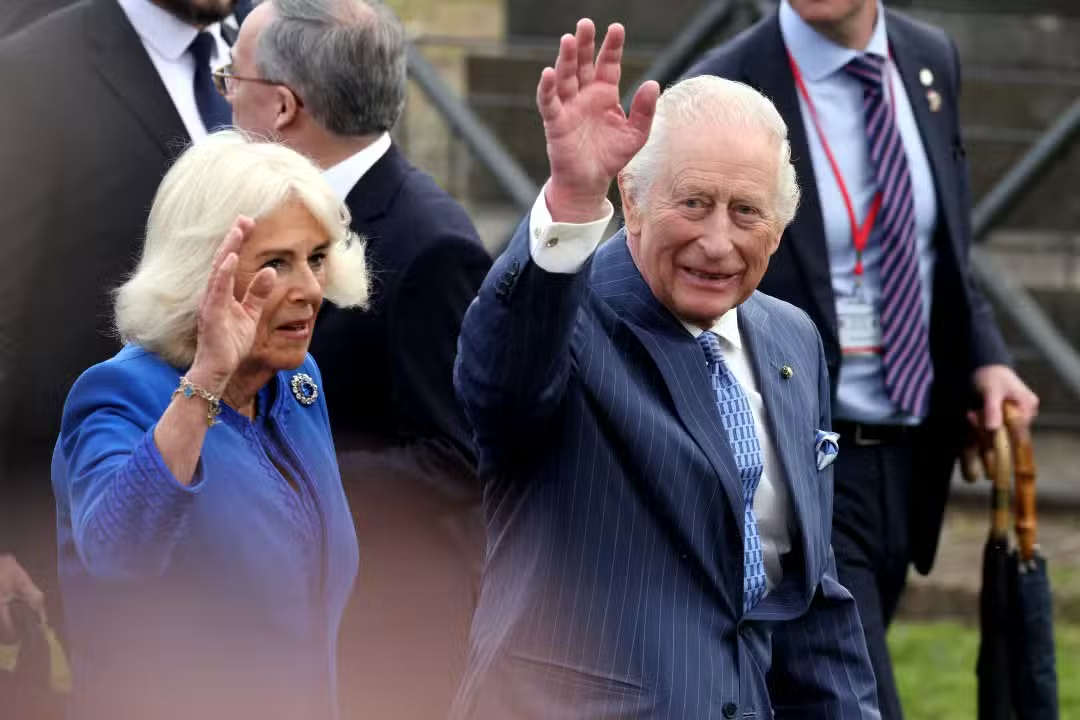
The British monarchy finds itself at a crossroads in April 2025, with King Charles III, aged 76, grappling with a worsening cancer diagnosis first revealed in February 2024. Ascending the throne in September 2022 following the death of his mother, Queen Elizabeth II, Charles now contends with a health battle that has severely curtailed his public appearances and accelerated succession planning. As the king fights the effects of ongoing treatment, Prince William, 42, and Kate Middleton, also 42, have emerged as the central figures poised to steer the Crown forward. On March 27, Charles was briefly hospitalized in London due to temporary side effects from his therapy, forcing the cancellation of official engagements the next day. Now back at Clarence House, he resumes work at a reduced pace, but the spotlight increasingly falls on his heirs. This situation, compounded by Kate’s own cancer struggle in 2024, places unprecedented pressure on the couple as Buckingham Palace shifts focus to ensure the stability of an institution contributing £1.8 billion annually to the UK economy.
William has ramped up his role, handling roughly 80% of the king’s duties in 2025, from diplomatic events to overseeing the Duchy of Cornwall, which generated £23 million last year. Kate, having completed chemotherapy in September 2024, has cautiously returned to public life, prioritizing causes like early childhood development and mental health. What was once envisioned as a gradual transition has turned urgent, with the couple logging over 300 royal engagements in 2024—a 20% jump from the prior year. Their public approval rating, hovering at 75%, outstrips the royal average by 20 points, cementing their status as the monarchy’s bedrock during this turbulent time.
Charles III’s health, though addressed with partial transparency, fuels speculation about the throne’s future. In 2025, he managed only 50 public appearances by January, down from over 200 in 2024, underscoring the toll of his illness. Queen Camilla, 77, has taken on extra duties, such as hosting receptions at Buckingham, while the king focuses on administrative tasks. The scenario reflects a collective push to keep the Crown relevant, even as six Commonwealth nations debate independence in 2025, challenging William and Kate to prove the monarchy’s global worth.
- Charles III’s hospitalization: March 27, due to treatment side effects.
- Cancer diagnosis: February 2024, post-prostate procedure.
- William and Kate’s engagements: Over 300 in 2024, up from 250 in 2023.
Charles III’s cancer struggle
King Charles III confronts one of his reign’s toughest tests as his cancer, detected over a year ago, progresses. The illness emerged after surgery for a benign prostate enlargement, though Buckingham Palace has not disclosed its type or stage. In 2025, his international trips plummeted from 25 in 2023 to under 10, and his public schedule shrank by 75%, per official records. The March hospitalization, though short-lived, was a turning point, prompting the cancellation of events like an investiture ceremony set for March 28.
Despite his frailty, Charles III clings to a minimal workload, prioritizing private meetings and paperwork. His appearance in Windsor in early April for an investiture signaled resolve, though he appeared noticeably weaker. Queen Camilla has been a steadfast presence, accompanying him and soloing at events like a February Hollywood star reception at Buckingham. The monarchy, reliant on its image of resilience, now balances the king’s human side with the need for continuity.
William rises to the challenge
Prince William has become the monarchy’s public face in 2025, shouldering his father’s responsibilities. With Charles sidelined, he stood in for the king at global events, such as the Notre-Dame Cathedral reopening in Paris in December 2024, and spearheaded efforts like the Earthshot Prize, raising £15 million for environmental causes last year. His stewardship of the Duchy of Cornwall also shone, boosting revenue by 5% from 2023.
Groomed for the throne since childhood, William blends practical experience—honed as an RAF pilot—with a modern focus on mental health and sustainability. In 2024, he notched a personal record of 10 overseas trips, lifting his approval rating to 78%, compared to the king’s 65%. Yet, the rapid transition poses hurdles: he juggles royal duties with supporting Kate, who faced her own health scare in 2024, and raising their children—George, Charlotte, and Louis—who are starting to join public events.
Kate Middleton’s comeback after cancer
Kate Middleton, sidelined by a cancer diagnosis in January 2024, has eased back into her role in 2025 with a measured schedule. Her abdominal surgery uncovered the illness, leading to chemotherapy that wrapped up in September. She managed just 40 engagements in 2024, down from 120 the previous year, but aims for 20 this year, including visits to child-focused charities.
Admired by 70% of Britons for her grit, Kate leverages her ordeal to spotlight mental health awareness. A September 2024 video announcing her treatment’s end reached millions, bolstering her image as a future queen consort. William praised her resilience publicly, cementing their partnership as a monarchy asset amid the crisis.
- Kate’s diagnosis: January 2024, post-abdominal surgery.
- Gradual return: 20 engagements planned for 2025.
- Public approval: 70%, versus Charles III’s 55% in 2025.
Strain on the monarchy and Commonwealth
Charles III’s health woes hit as the monarchy faces a shaky Commonwealth, with rising republican sentiment. Barbados ditched the Crown in 2021, and Jamaica and Australia eye independence debates in 2025. William and Kate, with approval 20% above the royal norm, strive to shore up ties, visiting nations like Canada and New Zealand last year.
At home, the monarchy’s £100 million yearly cost draws scrutiny from 40% of Britons, though it pumps £1.8 billion into the economy, including £500 million from tourism. The shift to William and Kate, seen as relatable, aims to validate this value, with William raising £20 million for mental health in 2024.
A historic shift unfolds
British history offers context for this transition. Edward VIII’s 1936 abdication thrust George VI onto the throne, and George VI’s sudden 1952 death crowned Elizabeth II at 25. Charles III, 73 at his ascension, may have the shortest reign since Edward VIII, with his health hastening succession. William, versed in diplomacy and management, and Kate, with her humanitarian bent, gear up to lead amid global and domestic trials.
Prince George, 11, joined five public events in 2024, like charity visits, mirroring Elizabeth II’s early training. Charlotte and Louis, next in line, also debut publicly, securing the lineage as uncertainty looms.
Timeline of the royal crisis
Key events shape the shift:
- February 2024: Charles III diagnosed with cancer.
- January 2024: Kate begins cancer treatment.
- December 2024: William represents king in Paris.
- March 2025: Charles hospitalized for treatment effects.
Balancing personal trials and royal duty
Kate Middleton endured a grueling 2024, stepping back for months during treatment. Her limited return has reassured the public, with 80% of 18-34-year-olds backing her efforts, per recent polls. William has played a dual role, supporting his family while expanding his royal load.
Charles III’s March hospitalization highlights his condition’s severity. Though back at work, his pace hinges on health, with Camilla covering events like an April 7 Italy trip. The monarchy leans on William and Kate’s strength to weather this storm.