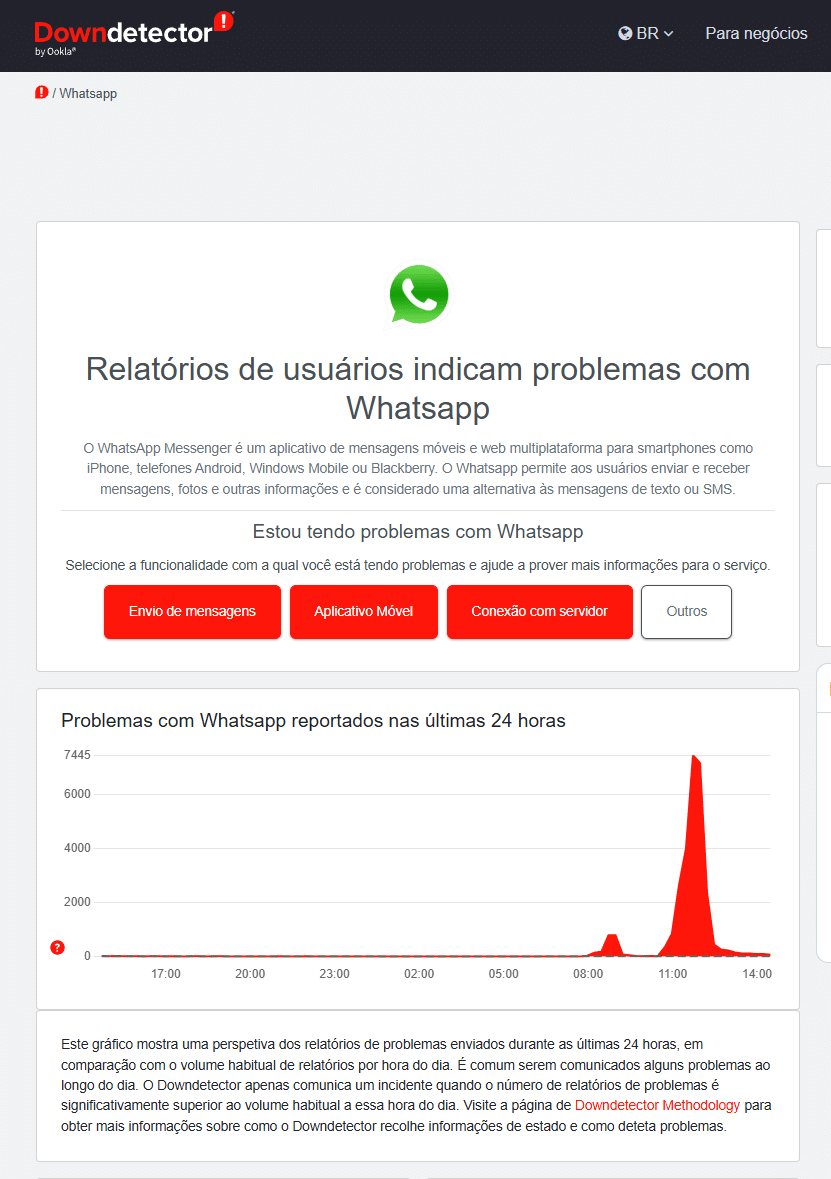
A major disruption struck WhatsApp on the evening of April 12, impacting millions of users in at least 50 countries, including Singapore, Brazil, India, Indonesia, and Malaysia. The platform, a cornerstone for personal and professional communication, faced issues with sending messages and updating statuses, sparking a flood of complaints on social media. In Singapore, reports peaked at 10:50 p.m., with 1,964 notifications logged on Downdetector, a site tracking digital service outages.
The outage wasn’t confined to one region. In Indonesia, 1,743 users reported problems by 10:37 p.m., while Malaysia saw 944 complaints shortly after. In Brazil, users encountered stalled messages, marked by clock icons or red exclamation points signaling delivery failures. Globally, Downdetector recorded 3,291 reports at 10:52 p.m., underscoring the issue’s vast scope.
The disruption hit hard in countries where WhatsApp is a lifeline for daily interactions and business operations. As of now, Meta, the app’s parent company, has not released details about the cause or when full service might resume.
Scale of the disruption
The global reach of the outage caught even seasoned users off guard. In Singapore, complaints began rising at 7:50 p.m., with 398 reports, before surging hours later. Google Trends noted a spike in searches for “WhatsApp down” starting at 7:52 p.m., with another wave between 10 p.m. and 11 p.m.
In India, home to over 500 million WhatsApp users, the inability to send messages or post status updates triggered widespread frustration. Screenshots shared online showed chats stuck with error indicators. Similar issues surfaced in Vietnam and the Philippines, where the app is equally critical.
Businesses relying on WhatsApp for customer service, sales, and logistics took a hit. Small enterprises, in particular, reported challenges in reaching clients, potentially leading to financial losses in some areas.
Key issues reported
The outage manifested in distinct ways, helping map its severity.
- Messages not sent: Users saw clock icons or red exclamation marks, signaling delivery failures.
- Status updates stalled: Posting or viewing statuses became impossible.
- Unstable connections: Some experienced intermittent functionality, with partial service.
These signs point to a server-side issue, though Meta has yet to confirm the technical root of the problem.
History of outages
WhatsApp outages aren’t unheard of, but this one’s scale stands out. In March, Meta’s other platforms, Facebook and Instagram, faced a two-hour global disruption caused by an erroneous command during routine maintenance. Users were logged out and couldn’t reconnect.
With nearly 3 billion users worldwide, WhatsApp has seen similar issues before. In 2021, a six-hour outage crippled Meta’s entire ecosystem—WhatsApp, Facebook, and Instagram—due to a server configuration error. These events highlight the fragility of centralized platforms, capable of disrupting millions in moments.
Unlike past incidents, this April outage appeared intermittent, with some users managing to send messages after repeated tries. Still, Meta’s silence on the matter fueled uncertainty about when services would stabilize.
Social media reactions
With WhatsApp down, users flocked to other platforms to vent. On X, hashtags like #WhatsAppDown trended, with posts from India, Indonesia, Brazil, and Vietnam. A Brazilian user wrote: “Tried messaging my family group—nothing. WhatsApp’s down again!”
In Singapore, blogger Lee Kin Mun, known as mrbrown, took to Facebook with a lighthearted jab, suggesting “good night” posts would have to wait until morning. Screenshots of stalled chats, showing unsent messages, reinforced the sense of a widespread issue.
Businesses also turned to alternatives to update customers. In Brazil, restaurants and online stores posted on Instagram about WhatsApp delays, asking for patience until service returned.
Impact on businesses
WhatsApp is more than a messaging app for many—it’s a business lifeline. In countries like Brazil and India, the outage disrupted sales, bookings, and supplier communications, especially for small and medium-sized enterprises.
In Brazil, where WhatsApp Business boasts over 10 million active users, companies reported delays in order confirmations. A São Paulo vendor shared on X that he lost sales because clients didn’t get timely replies. Similar stories emerged from Malaysia and Indonesia, where the app drives deliveries and client negotiations.
Larger firms, with more robust systems, shifted to email or Telegram temporarily. But for smaller businesses, WhatsApp’s centrality made the outage particularly costly.
Alternatives during the outage
With WhatsApp offline, users scrambled for workarounds to stay connected.
- Telegram: A popular choice, it saw a spike in downloads during the outage.
- Signal: Favored for privacy, it gained traction as a backup.
- SMS: Some reverted to traditional texting for urgent messages.
- Email: Businesses leaned on email for formal communications.
These options, however, couldn’t fully replace WhatsApp’s simplicity and reach, which keep it unmatched for billions.
Global reliance on WhatsApp
The outage laid bare the world’s dependence on WhatsApp. With nearly 3 billion users, it dominates in places like Brazil, India, Indonesia, and South Africa. In Brazil, over 90% of smartphones run WhatsApp, used for everything from family chats to banking.
In India, the app is so vital that government services, like health appointment scheduling, run through it. In Africa, it supports remote education and awareness campaigns. This ubiquity makes any downtime a major event, rippling through economies and daily life.
Meta has poured resources into bolstering WhatsApp’s infrastructure, but outages like this show that challenges remain. The concentration of services under one company also sparks calls for diversifying communication tools.
Fallout in Singapore
In tech-savvy Singapore, the outage came as a shock. The city-state, known for its cutting-edge digital infrastructure, wasn’t spared. Users reported issues in work groups and personal chats, with complaints peaking between 10 p.m. and 11 p.m.
Downdetector’s Singapore portal confirmed the scale, logging nearly 2,000 reports in minutes. Google Trends data showed “WhatsApp down” dominating searches that night, reflecting the issue’s grip on public attention.
Delivery services and financial firms, reliant on WhatsApp for quick confirmations, faced delays. A ride-hailing driver in Singapore posted on X that he couldn’t verify trips with clients, cutting into his earnings for the night.
Effects in India and Southeast Asia
India, with its massive user base, felt the outage acutely. News outlets reported disruptions in cities like New Delhi and Mumbai, where WhatsApp powers everything from food orders to medical consultations.
In Indonesia and Malaysia, the story was similar. Small vendors, who use the app to promote products and close deals, reported losses. A Jakarta merchant noted that clients abandoned purchases when replies didn’t come through.
The outage also underscored WhatsApp’s role in rural Southeast Asia, where alternatives like email are less practical. Many resorted to phone calls, racking up costs on prepaid plans.
Lessons from past disruptions
March’s Facebook and Instagram outage showed Meta’s ongoing struggle to keep its platforms airtight. The 2021 six-hour blackout, which took down all Meta services, prompted major investments in server redundancy.
Yet, intermittent outages like April’s suggest not all issues are resolved. Experts note that systems serving billions are inherently complex, making total reliability elusive. Frequent updates and rigorous testing help, but surprises still slip through.
Meta’s lack of real-time updates during the April outage drew criticism. Users demanded clearer communication about causes and timelines for fixes.
Steps to minimize disruption
While outages can’t always be avoided, some strategies can soften the blow.
- Use backup apps: Keep Telegram or Signal ready as alternatives.
- Save key contacts: Store important numbers outside WhatsApp.
- Plan critical communications: Avoid relying solely on the app for urgent matters.
- Check social media: Platforms like X can confirm if issues are widespread.
These habits help keep communication flowing during unexpected downtimes.
WhatsApp’s economic weight
The April 12 outage highlighted WhatsApp’s economic clout. In Brazil, the app drives billions in annual transactions, from direct sales to delivery services. In India, it cuts costs for startups and corporations alike through customer support tools.
Small businesses, the bulk of WhatsApp Business users, are hit hardest by outages. A few hours offline can mean lost customers in competitive sectors like food and retail.
Meta has pushed WhatsApp as a commercial hub, adding features like catalogs and payments. But incidents like this emphasize that reliability is as critical as functionality.
Global tech landscape
The WhatsApp outage comes amid growing reliance on digital platforms. With remote work and e-commerce booming, messaging apps are now critical infrastructure, akin to power grids or transit systems.
In places like Singapore, connectivity is a baseline expectation. Even short disruptions prompt scrutiny of digital resilience. In developing nations, where options are fewer, the stakes are higher, hitting communities dependent on apps like WhatsApp.
Meta faces pressure to fortify its systems, especially after acquiring WhatsApp and Instagram, expanding its role in global communications. AI and automation investments may help, but scaling to billions of users demands constant innovation.
Outlook for recovery
As of the latest reports, no official timeline for full WhatsApp restoration has surfaced. Some users in Brazil and Singapore noted improvements after midnight on April 13, but delays persisted elsewhere.
Downdetector continued logging complaints, though at a reduced rate, hinting at a gradual recovery. Meta typically issues post-incident reports, and one is expected soon, detailing the outage’s cause and preventive steps.
Until services stabilize, millions are leaning on alternatives, underscoring the need for diverse communication options in a connected world.
Preparing for future outages
Incidents like April 12 are a wake-up call for users and businesses.
- Regular backups: Save critical chats in other formats.
- Redundancy: Use multiple apps for essential communications.
- Training: Businesses should prep teams to switch channels fast.
- Monitoring: Track platforms like Downdetector to verify outages.
These steps can limit the fallout from disruptions, keeping vital connections intact.