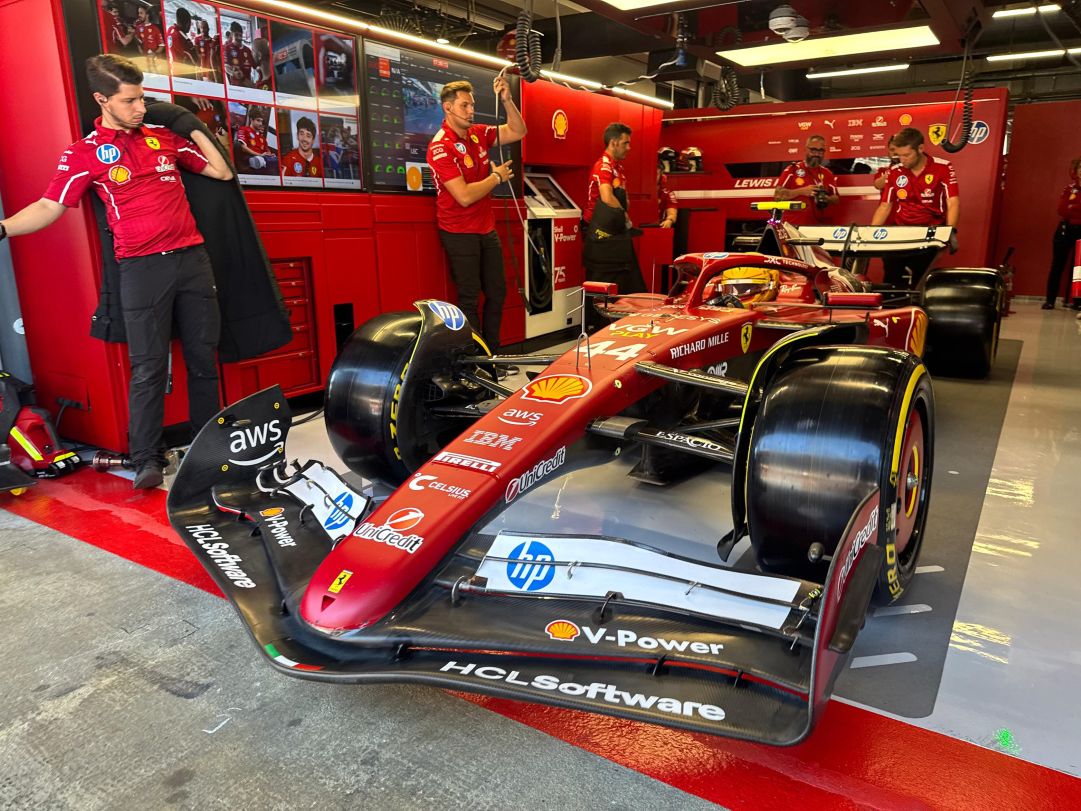
The Ferrari team experienced a day of mixed results at the Circuit de Barcelona-Catalunya, the venue for the Spanish Grand Prix, the ninth round of the 2025 Formula 1 season, held from May 30 to June 1. Team principal Frédéric Vasseur emphasized the satisfactory performance of the SF-25 car during Friday’s free practice sessions, despite Lewis Hamilton’s radio complaints labeling the car’s performance as “horrible.” In the first practice session, Charles Leclerc and Hamilton secured top-4 positions, but the second session posed challenges, with Leclerc finishing fifth and Hamilton dropping to 11th. The Catalan track, renowned for its aerodynamic demands and high-speed corners, tested the Italian team’s limits as they aim for consistency in a championship led by McLaren. The circuit, hosting its final Spanish GP before the event moves to Madrid in 2026, drew attention for the tight competition among teams.
Friday’s practice sessions marked a critical start to a pivotal weekend for Ferrari. The team, with eight wins in Barcelona, faces pressure to close the gap to McLaren in the constructors’ championship. Leclerc, with 79 points, and Hamilton, with 63, hold fifth and sixth places in the drivers’ standings, respectively.
Track conditions, described as “dirty” by Vasseur, impacted performance across the grid. Debris and deviations from the ideal racing line caused significant challenges, particularly in race simulations.
- Morning performance: Ferrari in the top-4, with Hamilton 0.378s off leader Lando Norris.
- Afternoon struggles: Leclerc fifth, Hamilton over 0.7s behind Piastri.
- External factors: Debris on track affected grip and lap times.
Hard work in the heat. On to tomorrow 💪 pic.twitter.com/BF8SuoIRzQ
— Scuderia Ferrari HP (@ScuderiaFerrari) May 30, 2025
Strong start fuels Ferrari’s confidence
The first free practice session brought optimism to Ferrari. Leclerc and Hamilton, driving the SF-25, posted competitive times, trailing McLaren’s Lando Norris by less than 0.4 seconds. The session, held at 8:30 AM Brasília time, showcased the car’s capability in high-speed corners like Turn 3, which demands precision at 280 km/h. The narrow 0.142-second gap between Ferrari’s drivers bolstered team morale for the weekend. Vasseur, speaking to the press, praised the “good pace” in the morning, noting the car’s positive response to initial setups. The session also allowed teams to adapt to new FIA technical directives, which limited front wing flexibility, affecting aerodynamic balance across the grid.
However, consistency remained a hurdle. Leclerc, despite an error at Turn 7 in the second session, showed potential for fast laps. Hamilton struggled to find the optimal line, leading to his drop in the timesheets. Ferrari plans fine-tuning for the third practice session, scheduled for Saturday at 7:30 AM.
Hamilton’s complaints spark rebuttal
Lewis Hamilton, the seven-time world champion, voiced frustration during the second practice session. Over the radio, the British driver called the SF-25’s performance “horrible,” citing issues with grip and pace in race simulations. The comment, broadcast live, stirred immediate attention. Frédéric Vasseur, Ferrari’s team principal, countered, labeling Hamilton’s remarks “exaggerated.” Vasseur pointed out that Hamilton delivered a strong final stint on soft tires, matching the lap times of the frontrunners. The exchange highlights Ferrari’s internal dynamics as the team works to align driver feedback with engineering data.
- Hamilton’s comment: “The car is horrible,” he said over the radio in FP2.
- Vasseur’s response: “Not as horrible as he claimed.”
- Final stint: Hamilton matched leaders’ times on soft tires.
- Debrief focus: Team prioritizes constructive post-session discussions.
The incident is not isolated for Hamilton, who faced challenges adapting to the SF-25, including a crash during January 2025 testing at the same circuit. His relationship with Vasseur remains professional, centered on refining the car for qualifying.
Challenges of the Catalan circuit
The 4.6-km Circuit de Barcelona-Catalunya, with 66 laps in the race, is a technical benchmark in Formula 1. Its mix of high- and medium-speed corners, like the sweeping Turn 3 and the slower final sector, demands aerodynamic efficiency and mechanical grip. In 2025, the track hosts its final Spanish GP, with Madrid set to take over in 2026. Since 1991, the circuit has delivered iconic moments, with Hamilton and Michael Schumacher each securing six wins, the most in its history.
Friday’s track conditions, marked by debris and dust, posed difficulties. Vasseur noted that straying from the ideal line led to significant time losses, a challenge shared by multiple teams. Ferrari focused on optimizing the car for race simulations, aiming for a competitive pace on Sunday.
Tight competition at the top
McLaren set the pace in practice, with Oscar Piastri topping the second session and Lando Norris leading the first. The duo, leading the drivers’ championship with 161 and 158 points, respectively, established a high benchmark in Barcelona. Red Bull’s Max Verstappen, second in FP1, slipped to fifth in FP2, grappling with car balance issues. Mercedes, with George Russell and Andrea Kimi Antonelli, remained competitive, securing top-3 finishes in both sessions. Ferrari, despite a solid showing, requires adjustments to challenge for pole in qualifying, set for Saturday at 11:00 AM.
- McLaren leads: Piastri and Norris topped FP1 and FP2.
- Red Bull struggles: Verstappen fluctuated between second and fifth.
- Mercedes in contention: Russell and Antonelli in the top-3.
- Ferrari’s goal: Leclerc and Hamilton aim for consistency.
Preparations for qualifying
Ferrari plans an aggressive approach for the third practice session, leveraging Friday’s data to refine the SF-25’s setup. Leclerc, fifth in FP2 with a 1:13.260 lap, showed promise for a front-row challenge. Hamilton, despite his 11th-place finish, has a strong Barcelona record, with six poles and six wins. The team is also monitoring weather conditions, which could influence strategy for qualifying and the race. Forecasts indicate high temperatures, increasing tire degradation, particularly for soft compounds.
The qualifying session, broadcast by Band and Bandsports, will be pivotal for the starting grid. Ferrari, fourth in the constructors’ championship with 142 points, aims to close the gap to Red Bull (143 points) and Mercedes (147 points).
Ferrari’s legacy in Barcelona
Ferrari is the most successful team in the Spanish GP, with eight Barcelona victories. Its last win, in 2013 with Fernando Alonso, remains a highlight of the team’s dominance. In 2025, Ferrari carries the weight of its history while navigating a fiercely competitive championship. Leclerc and Hamilton, with contrasting driving styles, give Ferrari a versatile lineup. Hamilton’s experience on technical tracks, paired with Leclerc’s raw speed, positions the team for a strong weekend.
Race preparations
The Spanish Grand Prix, with 66 laps, demands a balance between speed and tire management. Ferrari tested various tire compounds in practice, focusing on long-run simulations. Vasseur noted that the team identified areas for improvement, particularly in tire management under hot track conditions. Pit stop strategies, ranging from one to two stops, will depend on Saturday’s data. The race, set for Sunday at 10:00 AM, will be broadcast by Band, Bandsports, and F1TV.
- Tire compounds: Soft, medium, and hard tested in simulations.
- Pit strategy: One or two stops under consideration.
- Weather impact: Heat may increase tire wear.
- Broadcast: Band, Bandsports, and F1TV live.
Weekend expectations
The Spanish GP concludes the second triple-header of the 2025 season, following Emilia-Romagna and Monaco. Ferrari, buoyed by Leclerc’s second place in Monaco, aims to sustain momentum in Barcelona. The team is focused on minimizing errors, like Leclerc’s Turn 7 mistake, and optimizing the car for qualifying. Hamilton’s resilience in final stints suggests potential for a recovery. The Catalan circuit, with its blend of fast and technical sectors, offers Ferrari a chance to shine.
Team dynamics
The interplay between Hamilton, Leclerc, and Vasseur is a focal point in the paddock. Hamilton’s public criticisms, while notable, are viewed as part of his adjustment to the SF-25. Vasseur, known for his pragmatic leadership, emphasizes post-session debriefs to align strategies. Leclerc remains optimistic, confident in the car’s potential on tracks like Barcelona. The team’s internal discussions, marked by constructive debates, underscore Ferrari’s commitment to maximizing results in 2025.
- Hamilton and Vasseur: Criticism does not disrupt professionalism.
- Leclerc’s confidence: Monegasco trusts the car’s potential.
- Debrief priority: Team focuses on collective adjustments.
- Hamilton’s adaptation: Driver continues to adjust to SF-25.