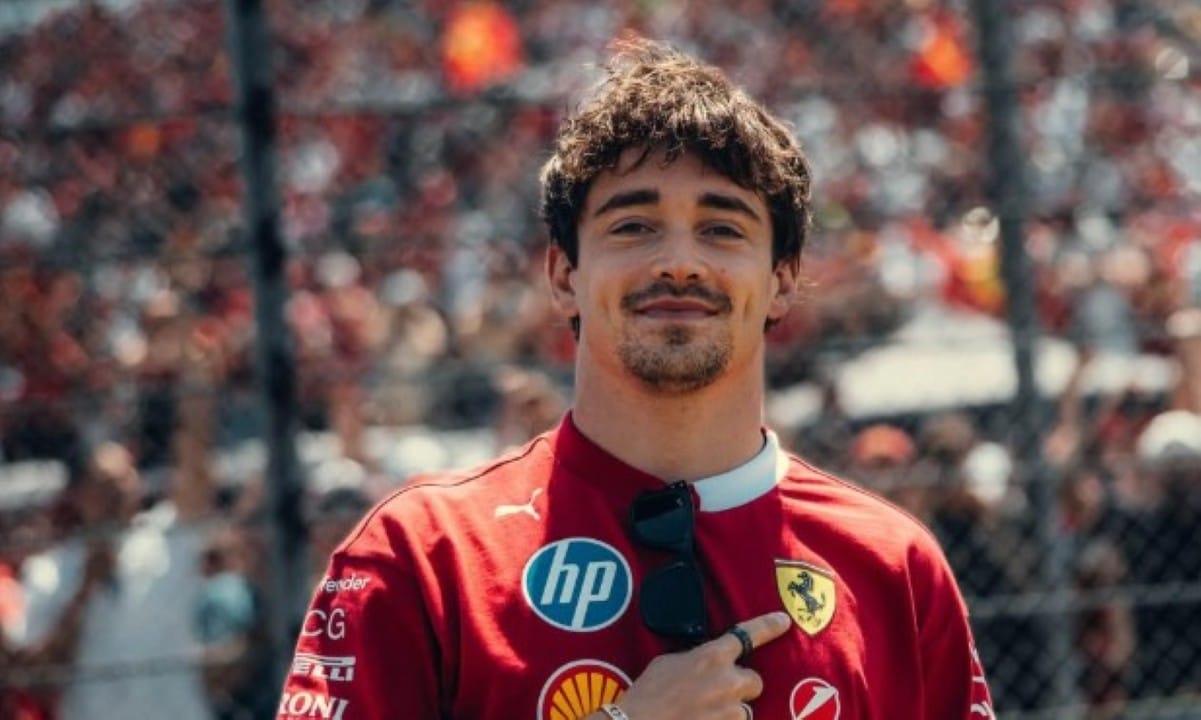
Charles Leclerc, Ferrari’s driver, led the third free practice session for the British Grand Prix in Silverstone on Saturday, July 5, 2025, setting the fastest time in a session marked by unstable weather conditions and a crash involving Brazilian driver Gabriel Bortoleto of Sauber. The session, which preceded qualifying, was interrupted by a red flag after Bortoleto spun and broke his car’s suspension. The circuit, known for its high-speed corners, tested the drivers’ limits, with cooler temperatures and the possibility of rain influencing strategies and performances. The competition was intense, with just 87 milliseconds separating the top three, highlighting the tight battle in the 12th round of Formula 1.
The session began under cloudy skies, altering track conditions compared to Friday’s practice. Leclerc, with a precise lap, outpaced Oscar Piastri of McLaren and Max Verstappen of Red Bull, who finished second and third, respectively. Lando Norris, who led Friday’s sessions, ended in fourth, just 108 milliseconds off the leader. Sauber, Bortoleto’s team, faced challenges, with the Brazilian spinning at Copse corner, resulting in significant car damage. Another incident involved Oliver Bearman, also from Sauber, who spun at the pit entry, capping a tough weekend for the team.
Silverstone’s climatic and technical challenges underscored the need for quick adaptation. The track, with iconic corners like Maggots and Becketts, demands aerodynamic balance and precision, especially in low-grip conditions. Ferrari, surprising after upgrades to the floor and diffuser introduced in Austria, showed competitiveness, while McLaren and Red Bull remained strong but struggled with weather instability.
Team performances at Silverstone
The free practice revealed a balanced scenario among top teams. Ferrari, not considered a favorite after Friday’s sessions, capitalized on cooler conditions to maximize its upgraded car. Leclerc, with a clean lap, showed confidence, while teammate Carlos Sainz finished sixth, reinforcing the Italian team’s consistency. McLaren, led by Piastri and Norris, stayed competitive, but the minimal time gaps suggest qualifying would hinge on details.
Red Bull, despite Verstappen’s third place, faced challenges with grip in high-speed corners, where their car typically excels. Sergio Perez, with a subdued performance, finished outside the top 10, indicating struggles to find the ideal setup. Mercedes, which could benefit from lower temperatures, failed to replicate Friday’s pace, with Lewis Hamilton in seventh and Kimi Antonelli outside the top positions, suggesting adjustments were needed before qualifying.
- Key highlights from free practice:
- Charles Leclerc led with a highly precise lap.
- Oscar Piastri and Max Verstappen were within 0.1 seconds of the leader.
- Gabriel Bortoleto crashed, triggering a red flag.
- Unstable weather conditions affected team strategies.
Bortoleto’s crash and Sauber’s challenges
Gabriel Bortoleto, the 20-year-old Brazilian driver, faced a tough moment in the third free practice. While attempting a fast lap, he lost control at Copse, one of Silverstone’s fastest corners, due to a kerb that destabilized the car. The Sauber’s suspension broke, forcing the team to revert to an older floor, without the upgrades introduced for the weekend. The incident compromised Bortoleto’s qualifying preparation, where he qualified 17th, benefiting from a penalty to Oliver Bearman to start 16th.
Sauber, coming off a promising performance in Austria where Bortoleto scored his first Formula 1 points, faced a setback in Silverstone. The team’s technical director, Iñaki Rueda, noted that the car still struggles with strong winds, a factor that hampers performance on tracks like Silverstone with many low-speed corners. Despite the crash, Bortoleto remained optimistic, acknowledging that the British track would always be a challenge for the team.
Weather conditions and strategies
Silverstone’s weather played a crucial role in free practice. With lower track temperatures and the chance of drizzle, teams had to quickly adjust tire compounds and aerodynamic setups. Pirelli provided C1 (hard), C2 (medium), and C3 (soft) tires, with the front left tire experiencing greater wear due to high-speed corners like Becketts, where drivers face up to 5G forces.
The possibility of rain for qualifying, scheduled for 11 a.m. on Saturday, added uncertainty to strategies. Some teams, like Ferrari, opted for quick laps early in the session, while others, like Red Bull, sought adjustments to improve grip in wet conditions. McLaren, which shone on Friday, struggled to maintain pace with soft tires, potentially impacting Norris and Piastri’s performance.
Silverstone’s history and characteristics
Silverstone, the venue for the first Formula 1 Grand Prix in 1950, is one of motorsport’s most iconic circuits. Originally an RAF airfield, the 5.891 km track combines long straights, like Wellington and Hangar, with challenging corners. The Maggots, Becketts, and Chapel sequence is among the most famous in the calendar, requiring precision and courage from drivers reaching speeds close to 300 km/h.
The track tests tires and engines to their limits. With only 8% of the lap dedicated to braking, the most efficient engines, like those of Red Bull and Ferrari, tend to stand out. Additionally, Silverstone’s 437.1-meter pitlane, the longest of the season, makes pit stops a critical factor in the race, scheduled for 52 laps on Sunday, July 6.
British drivers’ highlights
The British Grand Prix is special for local drivers like Lando Norris and Lewis Hamilton. Norris, racing at home, arrived in Silverstone buoyed by his Austria win but faced a tougher free practice, finishing fourth. Hamilton, who won the race in 2024, led Friday’s first practice but dropped to seventh on Saturday, suggesting Ferrari still needed to fine-tune for qualifying.
The presence of British drivers on the grid enhances Silverstone’s unique atmosphere. From Jim Clark and Nigel Mansell to Hamilton, local drivers have a history of success, with Hamilton holding the record for most wins, with eight victories. The expected large crowd promises to make the weekend a spectacle, despite uncertain weather.
Other incidents and eliminations
Beyond Bortoleto’s crash, free practice saw other tense moments. Oliver Bearman, also from Sauber, spun at the pit entry, capping a challenging session for the team. In Q1 of qualifying, Alpine’s Franco Colapinto lost control at the final corner, causing a brief interruption. Q1 eliminations included Colapinto, Liam Lawson, Lance Stroll, and Nico Hulkenberg, Bortoleto’s teammate, who will start 19th.
Q2 saw the elimination of Esteban Ocon, Alex Albon, Isack Hadjar, Yuki Tsunoda, and Carlos Sainz, indicating that the wet track and strong winds hampered some teams’ performances. Haas, with Bearman, reached Q3, but a ten-place penalty for a prior infraction compromised his grid position.
Preparation for qualifying and race
Qualifying, held at 11 a.m. on Saturday, was fiercely contested, with Max Verstappen securing pole position with a time of 1m24.892, followed by Oscar Piastri and Lando Norris. The tight margins, with just 0.118 seconds separating the top three, signaled an unpredictable race. The chance of rain on Sunday, combined with Silverstone’s technical demands, promises a strategic battle, where tire choice and energy management will be decisive.
Teams also dealt with penalties. Beyond Bearman, Mercedes’ Kimi Antonelli lost three grid positions due to an Austria incident, starting 10th. These penalties opened opportunities for drivers like Charles Leclerc, starting fourth, and George Russell, in fifth, reinforcing the competitiveness at the front of the grid.
Circuit curiosities
Silverstone is not only a historic landmark but also a technical challenge for drivers and engineers. Some unique aspects of the circuit include:
- Becketts corner, where drivers face extreme lateral forces.
- The longest pitlane in Formula 1, impacting pit stop times.
- Curve names like Maggots, inspired by a nearby field, and Becketts, linked to chapel ruins.
- Energy efficiency, critical due to minimal braking zones.
- A tradition of large crowds, with up to 350,000 attendees in some years.
Race expectations
The race, set for 11 a.m. on Sunday, July 6, will be the 12th round of the 2025 season and mark the end of the championship’s first half. With 52 laps, the race will demand well-planned strategies, especially due to tire wear and potential rain. McLaren, led by Piastri and Norris, aims to maintain their championship lead, while Verstappen, third in the standings, seeks to close the gap to the leaders.
Ferrari, with Leclerc in strong form, could surprise, especially if weather conditions favor the Italian car. For Bortoleto, the race is a chance for recovery, but the Brazilian acknowledged the difficulty of scoring points at Silverstone, where Sauber struggles in low-speed corners. The passionate British crowd expects a spectacle worthy of the circuit’s tradition.
