

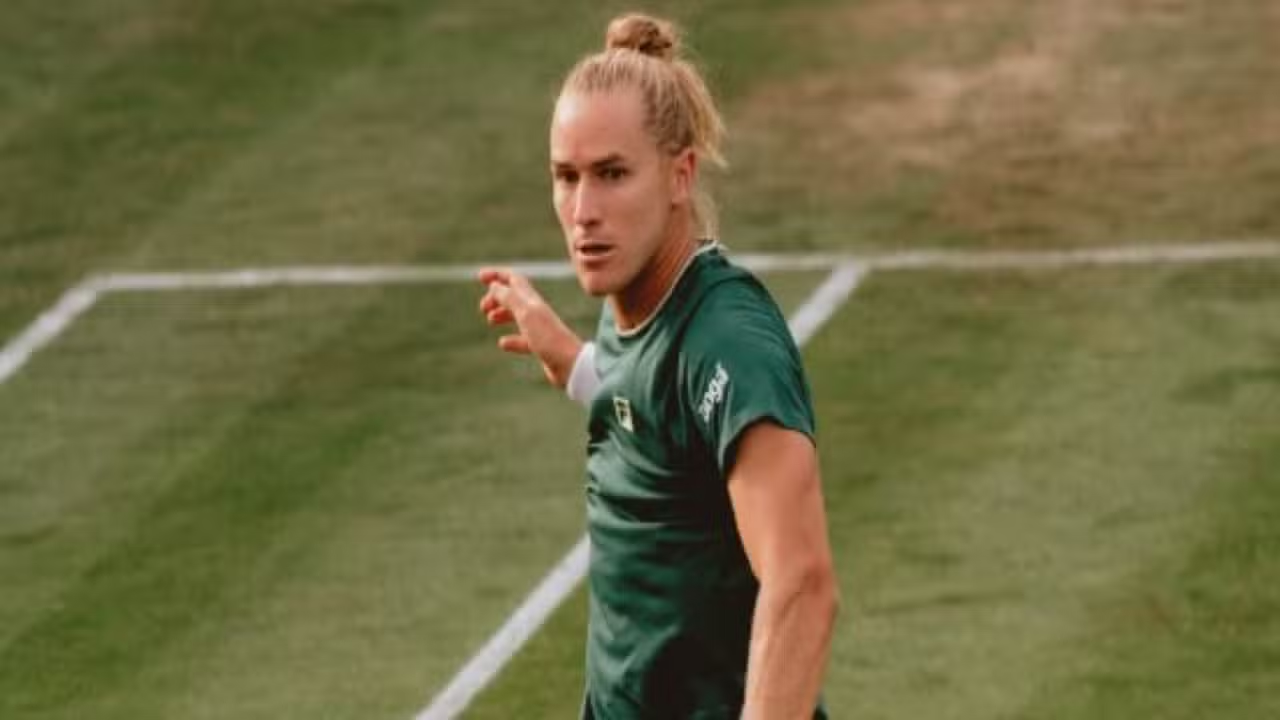
On Sunday, July 6, 2025, Brazilian tennis players made their mark in international tournaments, with Rafael Matos and Marcelo Melo advancing to the men’s doubles quarterfinals at Wimbledon, while Luísa Stefani secured a win in the second round of mixed doubles. In London, on the grass courts of the prestigious Grand Slam, Brazilian athletes displayed competitiveness, while others competed in challengers and ITF events across Europe and the United States. Notable results also came from the junior categories, with Guto Miguel and Nauhany Silva starting with victories. The day was marked by strong performances, despite some losses, such as Thiago Wild’s defeat in the Modena Challenger final. These results highlight the growing presence of Brazilian tennis on the global stage.
Brazil’s participation in Wimbledon, the world’s most traditional tennis tournament, brought moments of pride for fans. Beyond the doubles results, young talents showed promise in the junior draws, while other players chased crucial ranking points in smaller tournaments. The focus on various surfaces, from grass to clay, underscores the versatility of Brazilian players.
Key highlights of the day:
- Rafael Matos and Marcelo Melo triumphed in men’s doubles at Wimbledon.
- Luísa Stefani advanced in mixed doubles at the Grand Slam.
- Guto Miguel and Nauhany Silva shone in their junior debuts.
- Thiago Wild reached the Modena Challenger final but finished as runner-up.
The Sunday was intense for Brazilian tennis, blending experience and youth in high-level competitions.
Brazilian doubles thrive on Wimbledon’s grass
Rafael Matos and Marcelo Melo, one of Brazil’s most experienced doubles teams, secured a significant victory in Wimbledon’s round of 16. Facing Europeans Alexander Erler from Austria and Constantin Frantzen from Germany, the Brazilians won 2-1, with set scores of 6/4, 3/6, and 7/5. The match, played on a secondary court at the All England Club, demanded resilience, particularly in the decisive set, where the Brazilian duo clinched the win with a crucial break.
Matos and Melo’s Wimbledon campaign began with a win over another Brazilian, Orlando Luz, and Croatia’s Ivan Dodig, in a match that already hinted at their potential. Now in the quarterfinals, they are close to a historic achievement, as Brazil hasn’t had a men’s doubles team in the Wimbledon semifinals since the 2000s. Melo’s experience as a former world No. 1 in doubles, combined with Matos’s energy, has been a key factor on London’s grass.
Meanwhile, Luísa Stefani, partnered with Britain’s Joe Salisbury, delivered an exciting mixed doubles victory. The pair defeated Argentina’s Andrés Molteni and American Asia Muhammad 2-0, with scores of 7/6(7) and 7/6(5). Stefani, a Grand Slam doubles champion, showed consistency in tiebreaks, solidifying her status as a top doubles player on the circuit.
Young Brazilian talents shine in junior draws
The next generation of Brazilian tennis also left its mark at Wimbledon. In the boys’ junior draw, Guto Miguel debuted with a convincing win over South African Connor Doig, 7/5 and 6/2. The young player, rising in the ITF rankings, displayed solid baseline play and capitalized on break point opportunities to advance to the second round.
In the girls’ draw, Nauhany Silva fought a three-set battle against American Maya Iyengar. After losing the first set 5/7, the Brazilian bounced back, winning 7/6(1) in the second and 6/0 in the third. The comeback highlighted Silva’s grit, as she now aims to establish herself among the world’s top junior prospects.
On the other hand, Victória Barros faced challenges in her debut. Against Bulgaria’s Rositsa Dencheva, the No. 16 seed, the Brazilian lost 6/4, 6/4. Despite the result, Barros showed flashes of quality, suggesting her Wimbledon appearance is a valuable step in her development.
Thiago Wild takes runner-up spot in Modena
In the Modena Challenger in Italy, Thiago Wild reached the final but fell short of the title. Facing Italian qualifier Stefano Travaglia, Wild lost 6/4, 6/3 in a match where his opponent was more effective in decisive moments. The Brazilian, seeded No. 4, had a strong tournament but couldn’t overcome Travaglia’s efficiency on the Italian clay.
Wild, a former top 60 ATP player, is working to regain his peak form after an up-and-down 2024. The Modena final, though not a victory, is a positive sign for the Brazilian, who earned valuable ranking points. His performance underscores the importance of challengers as a platform for Brazilians to build momentum and confidence.
Challenges in qualifying rounds of other tournaments
Beyond Wimbledon and Modena, other Brazilians competed in smaller tournaments with mixed results. In the Braunschweig Challenger in Germany, Orlando Luz advanced in qualifying by defeating Austria’s Maximilian Neuchrist 7/6(7), 7/5. Luz, known for his doubles prowess, is also working to establish himself in singles.
In the Iasi Challenger in Romania, Matheus Pucinelli had a solid qualifying debut, beating Romania’s Dan Alexandru Tomescu 6/3, 6/4. Pucinelli, another young Brazilian talent, is chasing his first major breakthrough at this level.
However, João Ceolin struggled in the Newport Challenger qualifying in the United States, losing to American Reese Stalder 7/5, 6/2. In the women’s game, Carol Meligeni failed to advance in the WTA 125 Contrexeville qualifying in France, falling to Ekaterina Kazionova 6/4, 6/4. Giulia Aguiar also exited early in the ITF W50 Corroios-Seixal qualifying in Portugal, losing 6/2, 6/0 to South Africa’s Wozuko Mdlulwa.
Versatility across different surfaces
Sunday’s results showcase the ability of Brazilian players to compete on varied surfaces, from Wimbledon’s grass to Modena’s clay and the hard courts of other events. This adaptability is critical in the professional circuit, where players face constant surface changes throughout the season.
At Wimbledon, grass demands quick adaptation, with shorter points and a premium on serving and returning. Rafael Matos and Marcelo Melo, for instance, have excelled with precise serves and aggressive net play. On clay, as seen in Modena, patience and consistency in rallies are key, an area Thiago Wild tried to exploit but couldn’t master in the final.
Factors contributing to Brazilian performance:
- Experience of veterans like Marcelo Melo and Luísa Stefani in Grand Slams.
- Growth of youngsters like Guto Miguel and Nauhany Silva in junior events.
- Consistent participation in challengers and ITFs for match rhythm.
- Adaptation to diverse surfaces, from grass to clay.
Importance of junior tournaments
Wimbledon’s junior draws are a springboard for future tennis stars. For Brazilians, competing in a Grand Slam like this offers a chance to gain experience and visibility. Guto Miguel, for example, is already viewed as a rising star in the boys’ game, while Nauhany Silva is gaining attention in the girls’ category.
These tournaments also test mental toughness. Facing opponents from different countries in a high-pressure environment helps shape young players’ competitive mindset. Victória Barros’s loss, while disappointing, is part of this learning process, which could pay dividends in the future.
Competitive landscape of challengers
Challengers like Modena, Braunschweig, and Iasi are vital for players aiming to climb the ATP and WTA rankings. For Brazilians, these tournaments provide opportunities to earn points and build confidence before tackling bigger events. Thiago Wild, for instance, used Modena to regain his form, while Orlando Luz and Matheus Pucinelli aim for consistency.
The presence of Brazilians competing simultaneously across continents reflects the country’s effort to maintain a strong tennis foundation. Despite logistical and financial challenges, these athletes continue to seize opportunities to shine.
Next steps at Wimbledon
With Rafael Matos and Marcelo Melo in the quarterfinals, Brazil has high hopes for men’s doubles at Wimbledon. The duo will face tough opponents, but their confidence from recent rounds could make a difference. Luísa Stefani, meanwhile, remains a strong contender in mixed doubles, with a chance to go further.
In the junior draws, Guto Miguel and Nauhany Silva have the opportunity to continue their campaigns, facing new challenges in the second round. Their performances will be closely watched by fans and analysts who see them as the future of Brazilian tennis.
Preparation for the rest of the season
July is a pivotal month for tennis players, with the hard-court season approaching, particularly the US Open. Results at Wimbledon and in challengers provide a foundation for Brazilians to refine their strategies and gain momentum. For veterans like Marcelo Melo and Luísa Stefani, the goal is to maintain top-level performance in Grand Slams, while youngsters aim to establish their careers.
Competing in smaller tournaments, such as ITFs and challengers, will also be crucial for players like Carol Meligeni and João Ceolin, who need wins to climb the rankings. Balancing high-profile events with developmental tournaments is an ongoing challenge for Brazilians.