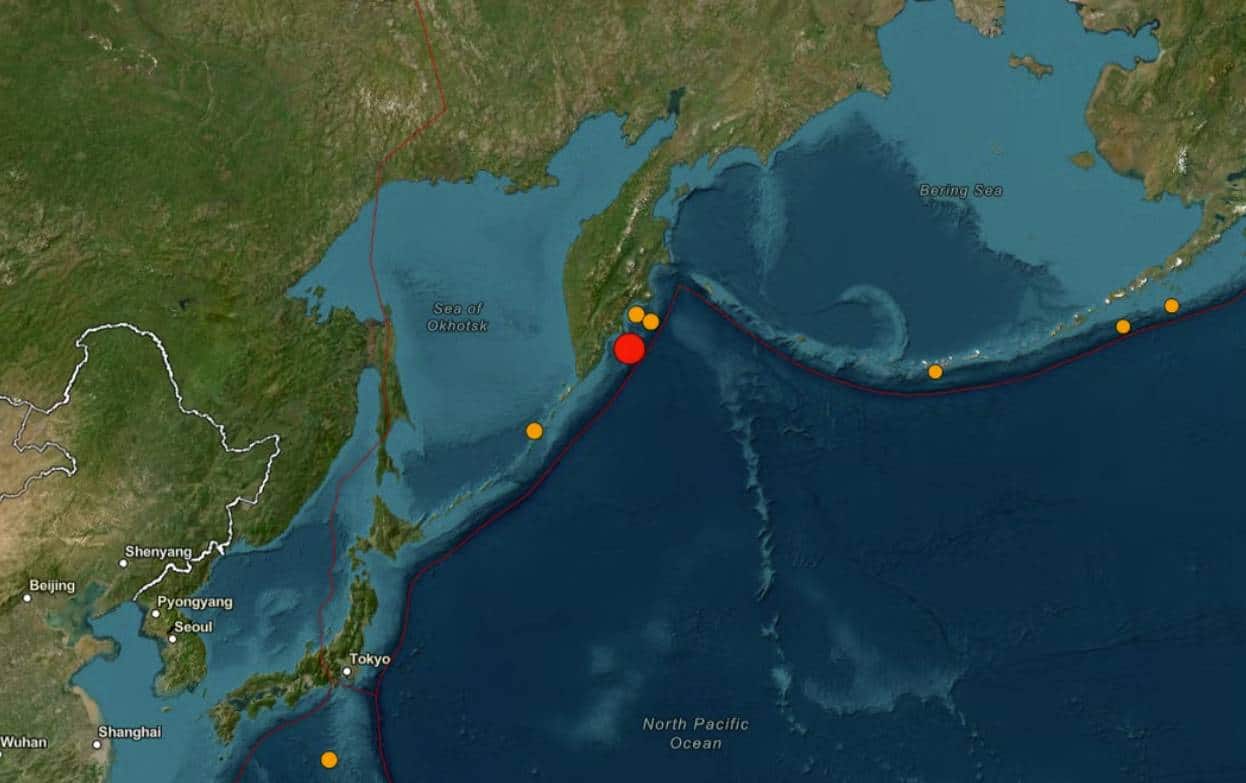
A powerful magnitude 8.8 earthquake, recorded on Tuesday, July 29, 2025, approximately 100 km off the Kamchatka Peninsula in Russia’s far east, triggered tsunamis that struck Russia, Japan, and Hawaii, prompting alerts in countries such as the United States, Mexico, Chile, Ecuador, and French Polynesia. The epicenter, located 125 km from Petropavlovsk-Kamchatsky, a city of 165,000 residents, caused water displacements that led to waves up to 5 meters high in areas like Severo-Kurilsk in the Kuril Islands. Authorities across multiple nations mobilized mass evacuations, with sirens blaring in coastal cities. The quake, occurring at a depth of 20.7 km, was followed by about 70 aftershocks, intensifying emergency responses across the Pacific region.
The tremor’s strength, one of the most intense in recent years, caused immediate impacts. In Hawaii, coastal areas were evacuated, with waves of 1.74 meters recorded in Maui. In Japan, nearly 2 million people received evacuation orders across 220 municipalities. Despite the severity, no confirmed deaths have been reported so far.
- Earthquake magnitude: 8.8 on the Richter scale, with an epicenter at sea.
- Affected areas: Russia, Japan, Hawaii, with alerts in Chile, Mexico, and Ecuador.
- Recorded waves: Up to 5 meters in Russia and 1.74 meters in Hawaii.
- Evacuations: Around 2 million people in Japan and thousands in Hawaii.
Global response was swift, with meteorological and emergency agencies on high alert. The absence of fatalities has provided initial relief to authorities.
Immediate effects in Russia
The Kamchatka Peninsula, where the earthquake’s epicenter was located, faced severe consequences. In Severo-Kurilsk, Kuril Islands, tsunami waves up to 5 meters flooded the fishing port, damaging infrastructure and disrupting power supply. The Russian government declared a state of emergency in the region, deploying rescue teams to assess damage and provide assistance.
A kindergarten in Petropavlovsk-Kamchatsky suffered structural damage, but no injuries were reported. A striking video showed doctors performing surgery holding onto a patient during the tremors, maintaining composure to complete the procedure. The local Health Minister, Oleg Melnikov, praised the professionals’ courage.
- Reported damage: Severo-Kurilsk port flooded and kindergarten damaged.
- Local response: State of emergency declared in the Kuril Islands.
- Aftershocks: Approximately 70, with magnitudes between 2 and 5.
The power grid in Sakhalin was also affected, leaving areas without electricity. Russian authorities confirmed no deaths from the tsunami, but material damage assessments are ongoing.
Impacts in Japan and evacuation measures
Japan, situated in the Pacific Ring of Fire, was among the hardest hit. Tsunami waves struck the northeast coast, particularly in Iwate, where a timelapse video from Kuji port captured significant sea level changes. Japan’s Meteorological Agency issued tsunami alerts for wide areas, maintaining maximum alert levels in the north, while regions like Ibaraki and Wakayama saw alerts downgraded to advisories.
Nearly 2 million people across 220 municipalities received evacuation orders. In Hokkaido, factory workers and residents sought shelter on elevated ground, as advised by public broadcaster NHK. Only one minor injury was reported—a woman in her 60s who fell during evacuation in Hokkaido.
- Evacuated areas: Over 220 municipalities, notably Hokkaido and Iwate.
- Recorded waves: Significant variations at Kuji port.
- Safety measures: Ships removed from the coast and evacuation alerts issued.
- Injuries: One woman with minor injuries in Hokkaido.
Japanese authorities continue monitoring, with potential for new alerts if aftershocks escalate.
Alerts and response in Hawaii
In Hawaii, sirens echoed across beaches, and coastal areas like Maui were evacuated. Waves of 1.74 meters hit Kahului, but the Pacific Tsunami Warning Center (PTWC) downgraded the alert hours later, stating a major tsunami was no longer expected. Governor Josh Green announced the cancellation of flights in Maui and the closure of commercial establishments.
The Oahu Emergency Management Office confirmed no major damage, allowing residents to gradually return home. Authorities advised avoiding beaches and waterways for safety.
- Recorded waves: 1.74 meters in Kahului, Maui.
- Measures taken: Flight cancellations and business closures.
- Evacuations: Coastal areas evacuated, with returns authorized later.
Other Pacific nations on alert
Beyond Russia, Japan, and Hawaii, other Pacific countries issued alerts. In French Polynesia, the Marquesas Islands expect waves up to 4 meters, with significant impact in Nuku Hiva, Ua Huka, and Hiva Oa. In Chile, President Gabriel Boric confirmed the entire coast is on alert, with preventive evacuations started three hours before the expected wave arrival.
In California, a tsunami with 1.1-meter waves hit Crescent City, and sirens were activated to warn residents. Mexico anticipates waves up to 1 meter on its Pacific coast, while Canada expects minor impacts, with waves up to 30 centimeters in Tofino. China issued alerts for Shanghai and Zhejiang provinces, already on edge due to Typhoon CoMay.
- French Polynesia: Waves of 1.1 to 4 meters expected in the Marquesas.
- Chile: Alert for the entire coast, with preventive evacuations.
- California: 1.1-meter waves in Crescent City.
- Mexico and Canada: Smaller waves, between 30 and 100 centimeters.
- China: Alerts in Shanghai and Zhejiang, worsened by typhoon risk.
Natural mechanism of the tsunami
The magnitude 8.8 earthquake resulted from tectonic plate collisions in the Pacific Ring of Fire, a region known for high seismic activity. The displacement of billions of liters of water generated tsunami waves that spread rapidly across the Pacific. The quake’s shallow depth of 20.7 km intensified its effects, increasing the destructive potential of the waves.
Aftershocks, ranging from 2 to 5 in magnitude, continue to be recorded, keeping authorities on alert. The combination of a shallow, high-magnitude quake makes such events particularly dangerous, especially in densely populated coastal areas.
- Primary cause: Tectonic plate collision in the Ring of Fire.
- Depth: 20.7 km, amplifying the impact.
- Aftershocks: At least 70 recorded so far.
- Propagation: Waves crossed the Pacific, affecting multiple countries.
Recovery and monitoring efforts
Rescue teams in Russia are focused on assessing structural damage, particularly in Severo-Kurilsk, where the port was heavily impacted. In Japan, continuous monitoring by the Meteorological Agency ensures real-time updates for the population. In Hawaii, the gradual reopening of businesses and resumption of flights signal stabilization, though caution remains.
Countries like Chile, Mexico, and French Polynesia maintain evacuation and monitoring protocols, while China faces the added challenge of Typhoon CoMay. The absence of deaths so far reflects the effectiveness of early warning systems, but material damage assessments are still underway.
- Russia: Rescue teams assess damage to ports and kindergartens.
- Japan: Ongoing monitoring and evacuations in at-risk areas.
- Hawaii: Gradual resumption of activities after alert downgrade.
- Other countries: Active evacuation and monitoring protocols.
