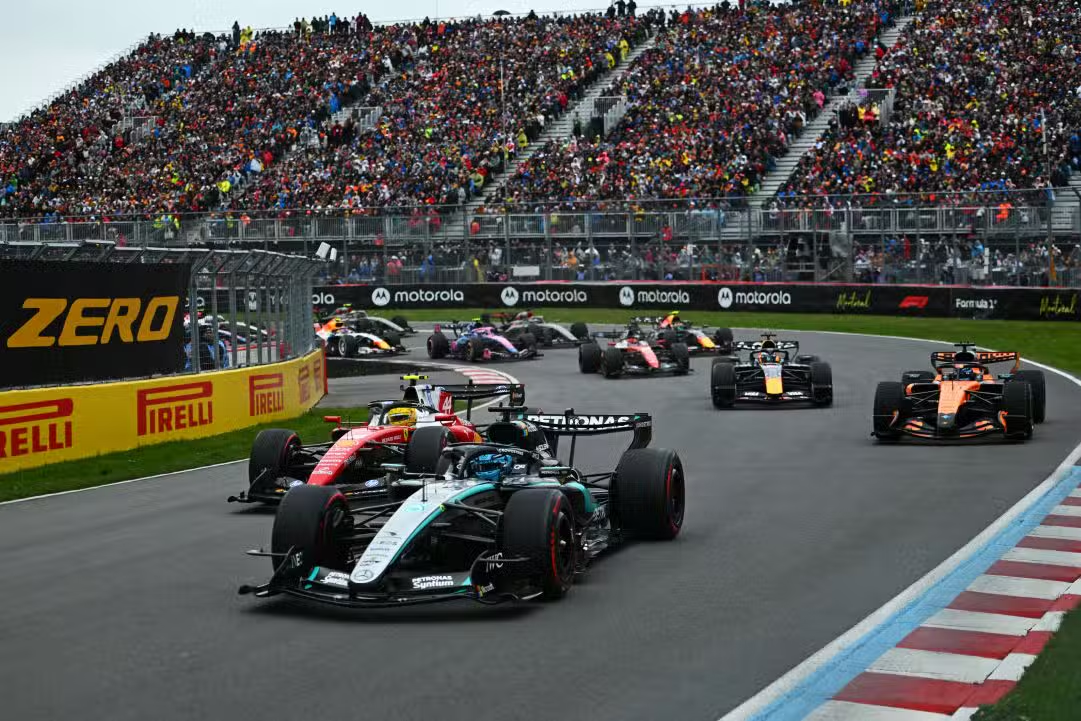
Argentine Formula 1 driver Franco Colapinto, from the Alpine team, suffered an accident on Wednesday morning, August 6, 2025, during a Pirelli tire test session at the Hungaroring circuit in Budapest, Hungary. The crash occurred at Turn 11, a high-speed section where drivers can reach speeds of around 228 km/h. Despite the severe impact, which heavily damaged the A525 car, Colapinto was evaluated at the circuit’s medical center and released without serious injuries. Alpine confirmed the driver is fine but provided no details on the cause of the incident or the car’s condition. The accident took place on the second day of testing, held after the Hungarian Grand Prix, won by Lando Norris. The session aimed to develop tires for the 2026 Formula 1 season.
The crash raised concerns among fans and the team, especially given Colapinto’s struggles to score points in the 2025 season. The 22-year-old Argentine, who replaced Jack Doohan at Alpine in May, has yet to finish in the top 12 in races.
- Crash details: The incident occurred at Turn 11, a challenging section of Hungaroring.
- Driver’s condition: Colapinto was cleared after medical evaluation with no serious injuries.
- Test context: The Pirelli session involved Alpine, Ferrari, McLaren, and Racing Bulls.
- Recent performance: Colapinto finished 18th in the Hungarian GP with problematic pit stops.
What happened at Turn 11
Turn 11 at Hungaroring is notorious for its complexity. It’s a high-speed right-hand curve requiring precision from drivers. During the Pirelli tire test, Colapinto lost control of the A525 car, colliding with the protective barrier. The impact severely damaged the vehicle, halting Alpine’s test session. The team reported that Colapinto was immediately taken to the medical center for thorough examinations. His release brought relief, but the incident raises questions about safety in testing and Colapinto’s readiness for the season.
The tire test is a critical phase for Formula 1 development. Teams collaborate with Pirelli to evaluate compounds for the 2026 season, when new technical regulations take effect. Alpine, struggling with a tough year and only Pierre Gasly scoring points, aimed to gather valuable data.
- Turn speed: Turn 11 can be navigated at 228 km/h, heightening accident risks.
- Car damage: The A525 sustained extensive damage, disrupting Alpine’s tests.
- Test goal: Develop more compact and efficient tires for 2026.
Colapinto’s journey in Formula 1
Franco Colapinto, aged 22, is a rising star in Argentine motorsport. He debuted in Formula 1 with Williams in 2024, earning five points in nine races. His performance caught Alpine’s attention, leading to his role as a test driver and later a full-time seat, replacing Jack Doohan after the Emilia-Romagna GP in May 2025. However, Colapinto has struggled to adapt to Alpine’s car, with the team languishing at the bottom of the constructors’ championship.
In the Hungarian GP on Sunday, August 3, Colapinto started 14th but finished 18th, hampered by two slow pit stops of 11 and 7 seconds. These technical issues reflect Alpine’s broader challenges in improving competitiveness. The crash in testing, while not physically harmful, may increase pressure on Colapinto, whose seat has been subject to speculation.
Impact on Alpine
Alpine is enduring a challenging 2025 season, with only 20 points, all scored by Pierre Gasly, placing the team last in the championship. Colapinto’s crash, though without casualties, poses logistical and financial setbacks, as the A525 car suffered significant damage. The team has not confirmed whether Colapinto will resume testing or if Gasly will take over. The incident also disrupted Pirelli’s data collection for 2026 tire development, critical under the new regulations.
The team issued a brief statement emphasizing the driver’s safety but offered no insight into the crash’s cause. Speculation points to a possible mechanical failure or driver error, though Alpine has not commented officially.
- Alpine’s struggles: Last in the championship, with only Gasly scoring points.
- Crash costs: Car damage may strain the team’s budget.
- Colapinto’s future: The incident heightens pressure on the young driver.
- Test disruption: Alpine’s Pirelli session was halted.
Safety in Formula 1 testing
Accidents in test sessions, though rare, reignite discussions about Formula 1 safety. Hungaroring, while technical, is considered relatively safe due to its protective barriers and medical oversight. However, the high speed at Turn 11 underscores the sport’s inherent risks. The FIA and Pirelli enforce strict protocols, including immediate medical evaluations and detailed car inspections, to ensure driver safety.
In Colapinto’s case, the rapid response of the circuit’s medical team was vital. The driver underwent a full check-up and was cleared without serious injuries, highlighting the effectiveness of safety measures. Still, the incident may prompt a review of testing protocols, particularly in high-speed corners.
Pirelli’s testing performance
Pirelli’s tire tests are essential for Formula 1’s future. Alongside Alpine, teams like Ferrari, McLaren, and Racing Bulls participated in the Hungaroring sessions. On the first day, Alpine’s reserve driver, Paul Aron, completed 159 laps and set the fastest time, outpacing Lando Norris and Liam Lawson. Aron’s performance contrasted with Colapinto’s crash on the second day, emphasizing the need for consistency in testing.
The tested tires aim to meet the FIA’s 2026 requirements for more compact and efficient compounds. Alpine’s interrupted program may delay their data collection, but other teams continued their sessions without issues.
- Test objectives: Evaluate tires for 2026, focusing on efficiency and durability.
- Aron’s performance: 159 laps and the fastest time on day one.
- Teams involved: Alpine, Ferrari, McLaren, and Racing Bulls.
- Crash impact: Alpine lost valuable testing time.
Reactions from fans and experts
Colapinto’s crash sparked immediate reactions on social media and among Formula 1 analysts. Argentine fans expressed relief at his safety but voiced concerns about his season performance. Experts noted that the incident could intensify scrutiny over Colapinto’s adaptation to Alpine’s car, especially compared to Gasly, the team’s primary point-scorer.
Some commentators suggested that pressure may be affecting the young driver’s performance. In recent statements, Colapinto admitted struggling with confidence in the car, particularly in corners, a contrast to his 2024 stint with Williams. The Hungaroring crash, though not severe, may fuel debates about his future with Alpine.
- Fan reactions: Relief for safety, concern for performance.
- Expert critiques: Questions about Colapinto’s adaptation.
- Team pressure: The crash may spark internal discussions.
Next steps for Colapinto and Alpine
Alpine has yet to confirm whether Colapinto will return to the track for further tests or if Gasly will take over. The team’s immediate focus is assessing the car’s damage and investigating the crash’s cause. For Colapinto, the incident is a setback in his bid to establish himself in Formula 1. At 22, he has potential but needs to overcome technical challenges and pressure to deliver results.
The 2025 Formula 1 season pauses in August, giving Alpine time to reassess its strategy. The upcoming Belgian Grand Prix offers Colapinto a chance to demonstrate resilience. Meanwhile, Pirelli and the FIA will continue testing, focusing on 2026 technical developments.