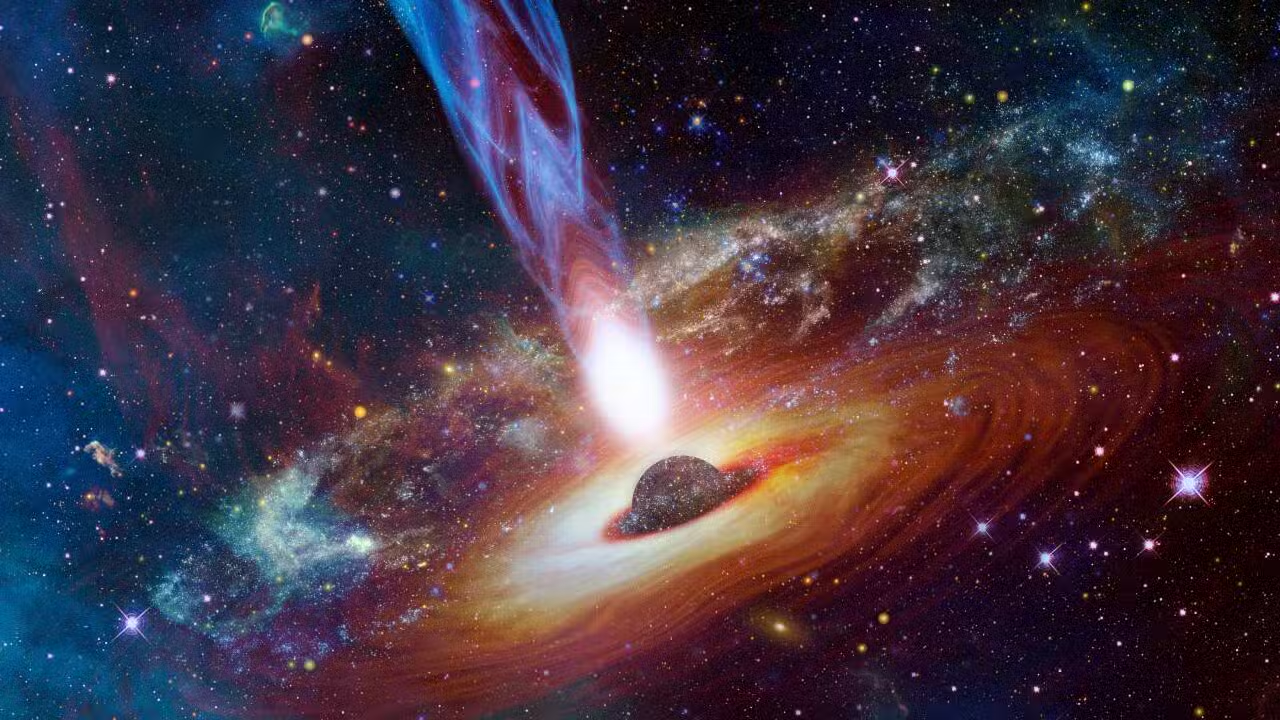
In August 2025, a celestial spectacle unfolds in the morning sky, featuring six planets in a rare planetary parade, the last of the year. Venus, Jupiter, Saturn, Mercury, Uranus, and Neptune align toward the east, visible just before dawn, captivating amateur astronomers and curious onlookers. The event, where planets appear aligned in the sky, can be observed without special equipment for four of them, while binoculars or telescopes are needed for the other two. The best viewing window is the next week, before Mercury vanishes in the sunlight. Cities with clear skies and low light pollution offer the best conditions. This planetary parade is a unique chance to connect with the cosmos, but it requires planning to catch the ideal timing.
This month’s celestial setup is special for combining bright planets with fainter ones. Venus and Jupiter, for instance, appear close together in the sky, creating a striking visual pair. Saturn and Mercury complement the show, while Uranus and Neptune require optical aids to be seen. Observation demands attention to timing and the right direction, with the east as the focal point.
- Ideal time: Before dawn, between 4 a.m. and 5:30 a.m., depending on location.
- Equipment: Binoculars for Uranus and Neptune; naked eye for the others.
- Conditions: Clear, cloudless sky and areas with low light pollution.
- Practical tip: Use astronomy apps to locate planets accurately.

What is a planetary parade
A planetary parade occurs when multiple planets align in the same sector of the sky, as seen from Earth. Though not physically aligned in space, the terrestrial perspective creates this visual effect. The phenomenon is relatively common, occurring at least once a year, but a six-planet lineup is less frequent. In 2025, August’s event stands out as the last of the year, following parades in January and February.
Planet visibility depends on their position relative to the Sun and sky clarity. Venus and Jupiter, due to their brightness, are easiest to spot, while Mercury requires focus near the horizon. Uranus and Neptune, being farther away, appear as faint points of light, visible only with optical aids.
Best conditions for sky observation
Observing the planetary parade requires planning. Ideally, seek locations away from urban centers where light pollution is minimal. Rural areas, beaches, or open fields are perfect for maximizing visibility.
- Clear sky: Check the weather forecast to avoid clouds.
- Open horizon: Avoid areas with tall buildings or mountains blocking the east.
- Helpful apps: Stellarium and SkySafari assist in planet location.
- Simple equipment: Basic binoculars allow viewing of Uranus and Neptune.
The pre-dawn timing is critical, as sunlight can obscure the planets, especially Mercury, which reaches its greatest elongation from the Sun next Tuesday. After this period, Mercury dips into the solar glare, making observation difficult.
Planets in the spotlight
Each planet in the parade has unique traits. Venus, known as the “morning star,” shines brightly and is easy to spot. Jupiter, nearby, forms a pair with Venus that astronomers liken to “cat’s eyes” in the sky. Saturn, with its rings, appears more isolated, while Mercury, close to the horizon, challenges observers due to its proximity to the rising Sun.
Uranus and Neptune, though less accessible, are exciting targets for those with binoculars or telescopes. Uranus appears as a bluish dot, while Neptune has a grayer hue. Accurate identification requires patience and, preferably, a star chart.
How to plan your observation
To make the most of the planetary parade, follow some practical steps. Choose a location with a clear view of the eastern horizon and check the weather forecast. Astronomy apps like Stellarium, SkySafari, or Star Walk are valuable tools for real-time planet tracking.
- Preparation: Arrive at the location at least 30 minutes before dawn.
- Equipment: Bring binoculars or a telescope for Uranus and Neptune.
- Appropriate clothing: August mornings can be chilly in some regions.
- Notes: Record observations to compare with other nights.
A crescent moon will join the spectacle in late August, adding extra charm to the planetary parade. The event is a chance to witness the solar system in action, with planets that, though distant, seem aligned in a cosmic dance.
Curiosities about the phenomenon
The planetary parade is not just a visual event but also an opportunity to understand planetary motion. Each planet orbits the Sun at different speeds, making these alignments temporary.
- Frequency: Parades with three or more planets occur nearly annually.
- History: In February 2025, all solar system planets were visible.
- Next event: The next significant parade is in February 2026.
- Visual trait: Planets don’t twinkle like stars, aiding identification.
The mix of bright planets and the option to use simple equipment makes the event accessible to all. Astronomers recommend seizing the coming mornings before Mercury disappears into the solar glare.
Tips for astronomy beginners
For those new to skywatching, the planetary parade is a perfect introduction. No expensive equipment is needed; basic binoculars enhance the experience. The key is patience and practice in identifying celestial bodies.
Astronomy communities, such as local clubs or online groups, offer support for beginners. Many organize collective observation events during planetary parades, enriching the experience. Additionally, free apps provide interactive star charts, simplifying planet location.
The August planetary parade is an invitation to gaze at the sky and connect with the universe. With simple planning and curiosity, anyone can witness this phenomenon, blending science, beauty, and contemplation.