

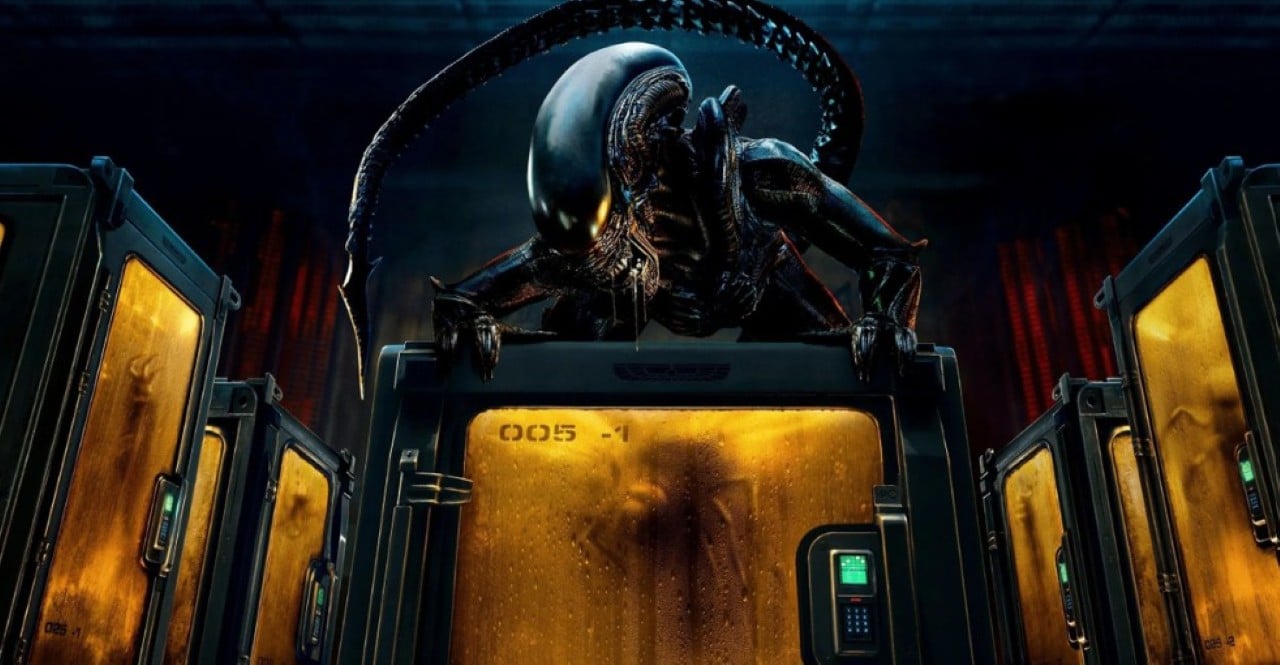
Alien: Earth, under Noah Hawley’s creative direction, opts for an approach that distances itself from specific elements of the prequels Prometheus (2012) and Alien: Covenant (2017). Hawley chose to ignore the narrative about the Xenomorphs’ origin as creations of the android David, proposed in Ridley Scott’s films, to align with the spirit of the original films, focusing on horror and tension. This decision allows the series to explore new narrative paths while maintaining the franchise’s essence, without being tied to detailed explanations about the creatures’ creation.
The plot introduces the Prodigy Corporation, led by Boy Kavalier (Samuel Blenkin), a young billionaire seeking immortality through hybrids like Wendy (Sydney Chandler). This technology, which transfers human consciousness to artificial bodies, represents an innovation unseen in the franchise, altering the status quo of synthetics seen in films like Alien and Aliens. The rivalry with Weyland-Yutani, now led by Yutani (Sandra Yi Sencindiver), adds layers of corporate intrigue, a recurring theme in the saga.
The first episode sets the tone, with the crash of a Weyland-Yutani ship in Prodigy City, releasing five deadly alien species, including the iconic Xenomorph. The series maintains the suspense and visceral horror characteristic of the franchise but adds a new dynamic by exploring interactions between humans, synthetics, and hybrids in a terrestrial environment.
- Narrative innovations in Alien: Earth:
- Introduction of hybrids as a new class of beings.
- Focus on a dystopian Earth controlled by corporations.
- Exploration of immortality and technological ethics.
- Suspense centered on survival against multiple alien species.
Connection to the franchise timeline
Alien: Earth is set in 2120, 16 years after the events of Alien: Covenant (2104) and two years before Alien: The Eighth Passenger (2122). This placement raises questions about coherence with the supposed “first encounter” of humans with Xenomorphs, depicted in the 1979 film. Hawley sidesteps this by minimizing direct connections to Prometheus and Covenant, focusing on a narrative that aligns more with the retro-futuristic aesthetic of the first two films.
The series does not directly contradict the films’ events but explores an isolated incident on Earth, suggesting that the Prodigy City event may have been covered up or unknown to the Nostromo crew, protagonists of the 1979 film. The presence of Weyland-Yutani as an antagonist reinforces continuity with the franchise, as the corporation is a constant in all films, always seeking to exploit Xenomorphs for its own purposes.
Mais sobre o assunto: Alien: Earth conecta universo Alien com trama inovadora na Terra em 2120
Hawley’s decision to overlook elements of Prometheus and Covenant, such as the Xenomorphs’ creation by David, allows Alien: Earth to connect more directly with the psychological horror and tension of the original films. This also opens space for introducing new alien creatures alongside the Xenomorph, expanding the franchise’s mythology without rewriting its history.
- Key timeline points:
- 2093: Events of Prometheus, with the expedition funded by Peter Weyland.
- 2104: Alien: Covenant, with David perfecting the Xenomorphs.
- 2120: Alien: Earth, with the ship crash in Prodigy City.
- 2122: Alien: The Eighth Passenger, the official first encounter with the Xenomorph.
Standout cast and production
The series boasts a talented cast, led by Sydney Chandler as Wendy and Timothy Olyphant as Kirsh, her mentor. Other notable names include Alex Lawther (Andor), Samuel Blenkin (Mickey 17), Richa Moorjani (Fargo), and Sandra Yi Sencindiver as Yutani. The executive production includes Ridley Scott, ensuring a direct connection to the Alien universe, while Noah Hawley imprints his auteur vision, known for blending suspense, drama, and science fiction.
The premiere of Alien: Earth, with two episodes released simultaneously on August 12, 2025, was met with enthusiasm, achieving a 90% approval rating on Rotten Tomatoes based on 29 reviews. Critics praised the series’ ability to expand the Alien universe without losing its identity, highlighting Hawley’s direction and the cast’s performances. The remaining six episodes will be released weekly on Tuesdays, keeping audiences engaged until the season finale on September 23, 2025.
Cobertura completa: EUA
The production also stands out for its visual effects, with the Xenomorph CGI receiving praise, though some fans criticized the lack of suspense compared to the original film. The setting in Prodigy City, a futuristic metropolis, offers a visual contrast to the claustrophobic ships of the films, expanding the franchise’s scope.
- Main cast:
- Sydney Chandler as Wendy, the hybrid protagonist.
- Timothy Olyphant as Kirsh, Wendy’s mentor.
- Samuel Blenkin as Boy Kavalier, leader of the Prodigy Corporation.
- Sandra Yi Sencindiver as Yutani, Weyland-Yutani’s representative.
Reception and future potential
The initial reception of Alien: Earth indicates a promising success, with reviews highlighting the blend of horror, science fiction, and ethical dilemmas. The series earned a 9 rating on IMDb, based on 267 reviews, and 90% on Rotten Tomatoes, reflecting its acceptance among critics and audiences. Hawley’s approach, balancing innovation with respect for the original mythology, has been noted as one of the production’s strengths.
The series also opens doors for potential continuations, depending on its performance on Disney+. Hawley has indicated that, if successful, Alien: Earth could evolve to connect its events directly to Alien: The Eighth Passenger, exploring how the Prodigy City incident may have influenced Weyland-Yutani’s trajectory. The introduction of hybrids and new alien creatures suggests potential for further expanding the universe, without relying solely on Xenomorphs.
Variety’s review described the series as “a chilling prequel with a surprising array of interests,” while fans on social media expressed excitement for the Earth-based setting and the new approach to synthetics. However, some franchise purists questioned the chronological coherence, particularly for preceding the supposed first Xenomorph encounter.
Saiba mais: Alien: Earth estreia no Disney+ e revela conexão com filmes da franquia
- Initial reactions:
- 90% approval on Rotten Tomatoes, based on 29 reviews.
- 9 rating on IMDb, based on 267 reviews.
- Praise for Noah Hawley’s direction and visual effects.
- Minor criticism for less suspense compared to the original film.
Themes and cultural impact
Alien: Earth reinforces the franchise’s core themes, such as corporate greed and the dangers of seeking immortality. The series updates these ideas by depicting an Earth dominated by megacorporations, reflecting contemporary concerns about the power of large companies and technological advances. The introduction of hybrids raises ethical questions about consciousness transfer and human-machine coexistence, themes that resonate in a world increasingly focused on artificial intelligence.
The choice to set the story on Earth allows the series to explore humanity in a closer context, contrasting with the isolated settings of the films. The rivalry between Prodigy and Weyland-Yutani mirrors real-world conflicts among tech corporations, while the presence of alien creatures adds a layer of horror that preserves the franchise’s essence.
The series also pays homage to the original films by recreating the retro-futuristic aesthetic, with technology reminiscent of the 1970s and 1980s, adapted to a terrestrial setting. This visual approach, combined with Hawley’s narrative, ensures that Alien: Earth is both a continuation and a reinvention of the saga.
- Explored themes:
- Corporate greed and rivalry among megacorporations.
- Ethics in creating hybrids and synthetics.
- Survival against alien threats.
- Reflections on immortality and technology.