
United States President Donald Trump announced the immediate dismissal of Federal Reserve Governor Lisa Cook, in a decision published on the Truth Social network on the evening of August 25, 2025, in Washington. The move was prompted by allegations of mortgage fraud made by the director of the Federal Housing Finance Agency (FHFA), Bill Pulte, who accused Cook of falsifying documents in mortgage applications. The action, marking a new chapter in Trump’s pressure on the U.S. central bank, raises concerns about the Federal Reserve’s independence and its implications for monetary policy. The Justice Department’s investigation, requested by Pulte, is ongoing, and Cook denies the allegations, stating she will not yield to intimidation. Cook’s departure opens the door for Trump to appoint an ally, intensifying control over the Fed’s board.
The decision was formalized in a letter posted on Truth Social, where Trump justified Cook’s removal based on her alleged improper conduct. The governor, the first Black woman to serve on the Fed’s board, had been under scrutiny since Pulte sent a formal complaint to the Justice Department on August 15, alleging irregularities in two mortgage contracts signed by Cook in 2021.
The episode comes amid tensions between Trump and the Federal Reserve, with the president repeatedly pressing for interest rate cuts, which Fed Chairman Jerome Powell has resisted, citing inflation concerns. Cook’s dismissal is seen as part of a broader strategy to shape the central bank’s board in line with the Trump administration’s interests.
- Key points of the controversy:
- Mortgage fraud allegations against Lisa Cook by Bill Pulte.
- Dismissal announced by Trump via Truth Social on August 25.
- Ongoing Justice Department investigation.
- Trump’s pressure to influence Fed monetary policy.
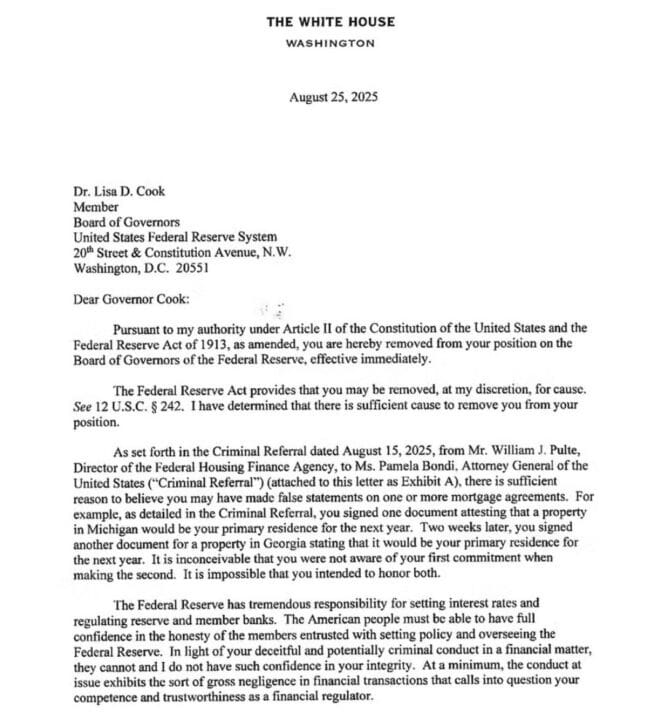
Allegations against Lisa Cook
The accusations against Lisa Cook, made by FHFA Director Bill Pulte, center on two mortgage contracts signed in 2021. According to Pulte, Cook declared two properties—one in Ann Arbor, Michigan, and another in Atlanta, Georgia—as primary residences within a two-week span, which could violate housing finance rules. Declaring multiple properties as primary residences is considered an attempt to secure more favorable loan terms, as primary residence mortgages typically have lower interest rates.
Cook, who joined the Fed in May 2022, responded to the allegations on August 20, stating that the claims were based on social media posts and that she is committed to clarifying the facts. The governor emphasized that the accusations relate to transactions made before her Fed tenure and denied any intention of resigning.
Pulte’s complaint, sent to Attorney General Pam Bondi, calls for a criminal investigation, but there is no official confirmation yet of a formal Justice Department inquiry. The FHFA, under Pulte’s leadership, has also made similar accusations against other public figures, such as Senator Adam Schiff and Attorney General Letitia James, suggesting a pattern of actions against Trump’s political opponents.
Pressure on the Federal Reserve
Lisa Cook’s dismissal intensifies Trump’s criticisms of the Federal Reserve, which he accuses of maintaining high interest rates, currently between 4.25% and 4.5%. The president has publicly pressured Fed Chairman Jerome Powell, whom he has called “incompetent” and “stubborn,” to cut rates, arguing it would benefit sectors like real estate.
- Recent Trump actions against the Fed:
- Appointment of Stephen Miran to the Fed board after Adriana Kugler’s resignation.
- Public criticisms of Powell, including threats of legal action over alleged excessive spending on Fed headquarters renovations.
- Statements from allies, like Senator Tommy Tuberville, calling for Powell’s resignation.
- Increased scrutiny of board members appointed by previous administrations.
Cook’s exit leaves the Fed board with an additional vacancy, allowing Trump to nominate a fourth member to the seven-seat body. Analysts note this could facilitate the approval of policies more aligned with the administration’s interests, such as rate cuts, though Fed decisions are made by majority vote in the Federal Open Market Committee (FOMC).
Reactions to the dismissal
Cook’s removal sparked mixed reactions. Republican lawmakers, such as Senator Bernie Moreno, celebrated the decision, while Democrats, like Senator Elizabeth Warren, criticized what they call Trump’s attempt to undermine the central bank’s independence. Warren warned that Trump’s actions could raise borrowing costs and affect financial markets.
Cook reiterated her intent to address the allegations, stating she is gathering documents to respond to questions about her finances. The governor, who holds a background in economics and taught at the University of Michigan, highlighted her academic and professional record to bolster her credibility.
- Notable reactions:
- Senator Bernie Moreno: “Lisa Cook must leave the Fed immediately.”
- Senator Elizabeth Warren: “Trump is seeking pretexts to intimidate the Fed.”
- Bill Pulte: “I believe the Justice Department will investigate the case.”
History of tensions with the Fed
The relationship between Trump and the Federal Reserve has been fraught with conflicts since his first term. In 2018, Trump publicly criticized the Fed for raising interest rates, accusing Powell of harming the economy. Cook’s recent dismissal and the appointment of Stephen Miran, a close ally, suggest a continuation of this interventionist stance.
The Fed’s independence is considered vital for global economic stability, as the U.S. central bank plays a key role in shaping monetary policy. Experts warn that replacing board members with government-aligned nominees could compromise the institution’s autonomy, especially amid economic uncertainties, with inflation at 2.7% annually, according to the Consumer Price Index for July 2025.
Impact on the Fed board
With Cook’s departure, the Fed board is left with six members, three of whom were appointed by Trump. The nomination of a new governor requires Senate confirmation, which may lead to political clashes, as the FOMC’s composition directly influences interest rate decisions. The committee’s next meeting, scheduled for September 17, is highly anticipated, with analysts estimating an 88% likelihood of a rate cut, according to FactSet data.
- Current Fed board composition:
- Three members appointed by Trump.
- Three members appointed by previous administrations.
- One vacancy following Cook’s exit.
- Stephen Miran awaiting Senate confirmation.
Political and economic landscape
Cook’s dismissal comes amid economic and political pressures. The Trump administration has advocated for policies like robust tariffs, which, according to Powell, could drive inflation. The Fed’s resistance to cutting rates reflects concerns about these impacts, while Trump argues high rates harm sectors like real estate.
Cook’s exit also raises questions about diversity on the Fed board, as she was the first Black woman to hold the position. Her replacement by a Trump nominee could shift the balance of perspectives in the body, particularly on issues like economic inclusion, which Cook championed in her research.
- Key economic factors:
- Interest rates unchanged at 4.25%–4.5% since December 2024.
- Annual inflation at 2.7% in July 2025.
- 88% likelihood of a rate cut in September.
Future of the Federal Reserve
Cook’s dismissal marks a critical moment for the Federal Reserve, which faces political pressures in an uncertain economic environment. The appointment of new board members and the FOMC’s upcoming decisions will shape the direction of U.S. monetary policy. Meanwhile, the investigation into the allegations against Cook remains open, with the Justice Department still evaluating next steps.
