

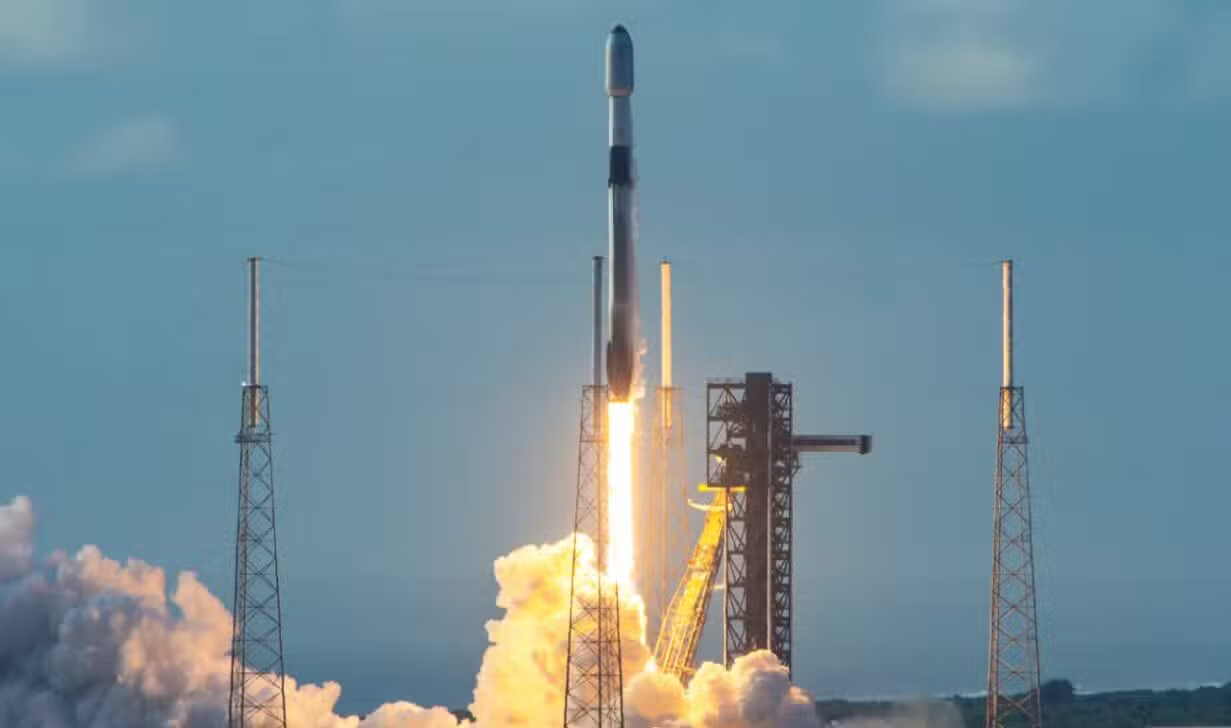
SpaceX conducted the 11th Starship test flight on Monday, October 13, 2025, from its Starbase facility in Texas. The launch occurred at 7:15 p.m. local time and marked the final test of the V2 version of the vehicle, focusing on reentry maneuvers and thermal shield stress. The Super Heavy booster, with 33 Raptor engines, separated from the upper stage after two and a half minutes of ascent, while the Starship continued on a suborbital trajectory.
The test included experiments for the next-generation Super Heavy booster and demonstrated the relighting of a Raptor engine in flight. The upper stage, Ship 38, deployed eight Starlink satellite simulators and performed the “belly flip” maneuver to reduce speed before reentry. These steps aim to refine the reusable system, critical for lunar and Martian missions.
- The Super Heavy used 24 previously flown engines, increasing hardware efficiency.
- Intentional removal of thermal shield tiles allowed evaluation of failure points under extreme heat of 1,400 degrees Celsius.
- The spacecraft withstood reentry with intact flaps, completing a controlled landing in the Indian Ocean after 65 minutes.
Hours after the Starship, a Falcon 9 launched at 8:08 p.m. Brasília time from Cape Canaveral, Florida, carrying 24 satellites for the Kuiper KF-03 Project. This mission, the third Falcon 9 flight for Amazon, brought the total satellites launched to 153, expanding the low-orbit internet network.
Starship Test Preparations
SpaceX engineers positioned the Super Heavy B15 booster on the Starbase orbital platform the day before the launch. The 120-meter-tall vehicle carried 11 million pounds of propellant, consisting of methane and liquid oxygen.
The countdown proceeded without technical interruptions, with 80% favorable weather conditions. Controllers confirmed fuel loading 30 minutes before liftoff, initiating the ignition phase.
Reentry and Landing Maneuvers
The Starship reached 800 km/h during descent, performing 90-degree rotations on the X and Y axes for stabilization. Without a dense atmosphere to aid the flaps, the spacecraft relied on thrusters for control.
The belly flip maneuver significantly reduced speed, enabling a controlled reentry. Plasma screens formed around the structure due to air compression, but the remaining shield maintained integrity.
The Super Heavy booster configured engines for a tailored landing burn, targeting the Gulf of Mexico. Separation occurred without anomalies, with the first stage returning for a water landing.
Kuiper KF-03 Mission Details
The Falcon 9, with first-stage B1091 on its second flight, followed a northeast trajectory after liftoff. The booster separated at eight minutes and landed on the drone ship “A Shortfall of Gravitas” in the Atlantic.
The 24 Kuiper satellites were released sequentially starting at 56 minutes, each weighing about 500 kg and equipped for high-speed broadband. This deployment strengthens Amazon’s commitment to a 3,236-satellite constellation.
The Falcon 9 second stage proceeded to low orbit, completing dispersion in under eight minutes. The launch marked the 85th orbital flight of 2025 from Florida’s Space Coast.
Advances in Thermal Shield and Reusability
SpaceX intentionally removed parts of the Starship’s refractory shield to expose the structure to extreme conditions, simulating potential failures. Insulating blankets replaced tiles in critical areas, withstanding reentry plasma without catastrophic breaches.
This approach generated data for the Block 3 version design, including Raptor 3 improvements. The test validated subsonic guidance algorithms, preparing for future return-to-launch-site missions.
The upper flap remained intact, unlike previous flights with damage. Engineers reported the spacecraft completed the trajectory with “honors,” concluding the V2 era without unexpected explosions.
In-Flight Experiment Integration
During ascent, the Starship tested engine configurations for the next-generation booster. The Raptor relight at space altitude occurred precisely, releasing simulated propellants.
Eight Starlink dummy satellites were ejected on a suborbital trajectory, collecting telemetry on separation. Dynamic braking maneuvers adjusted the descent, testing aerodynamic limits.
Dual SpaceX Operation Conclusion
Starship Flight 11 was the fifth test of 2025, paving the way for NASA’s Artemis program. The system aims for fully reusable landings, reducing costs for interplanetary exploration.
Meanwhile, KF-03 accelerates the Kuiper Project, competing with networks like Starlink. Amazon plans 38 more launches with ULA’s Vulcan Centaur to complete the constellation.
These events highlight SpaceX’s launch cadence, focusing on reusable innovation and global connectivity.