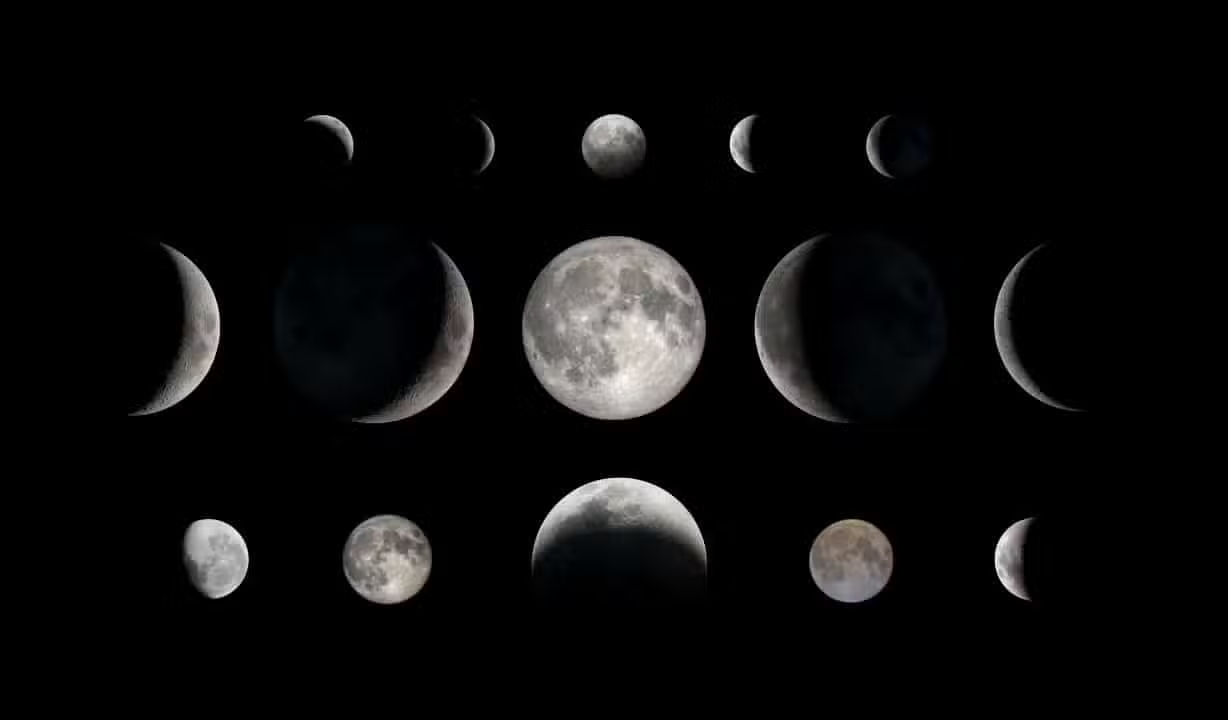
The second supermoon of the year occurs this Wednesday (5), when the full Moon coincides with perigee, the closest point to Earth in its elliptical orbit. The phenomenon will be visible to the naked eye throughout Brazil, with the satellite appearing up to 14% larger and 30% brighter than normal. Observation begins shortly after sunset, with varying times depending on the region.
Scientists explain that the lunar orbit varies between 356 thousand and 406 thousand kilometers from Earth. This proximity to perigee intensifies the Moon’s brightness and apparent size.
- Time in São Paulo: 6:45 pm
- Time in Belém: 6:14 pm
- Time in Recife: 5:28 pm
Elevated locations with a clear horizon favor visibility.
Origin of the term supermoon
The word supermoon appeared in 1979, created by an astrologer to describe the alignment between the full phase and perigee. Astronomers prefer the term Full Moon at perigee or perigee-syzygy.
The expression gained popularity in the media for simplifying the concept. The phenomenon does not significantly alter gravitational forces on a daily basis.
Characteristics of the lunar orbit
The Moon’s orbit forms an ellipse around the Earth. At perigee, the minimum distance reaches around 356 thousand kilometers.
At its peak, the most distant point, exceeds 406 thousand kilometersetros. This variation occurs monthly due to terrestrial and solar gravity.
The coincidence with the full phase produces the enlarged visual effect.

Observation best practices
Choose high points away from artificial lights for better appreciation. Cell phone cameras capture sharp images, especially with orange tones near the horizon.
The phenomenon lasts all night, but the rising of the Moon offers the most impressive initial spectacle. No special equipment required, just dumped sky.
Visual differences from the common Moon
The supermoon exhibits an apparent diameter 14% larger than the average full Moon. Brightness increases by about 30% due to proximity.
These percentages are based on precise astronomical calculations. The intense coloration results from atmospheric refraction at the horizon.
Detailed regional hours
The Moon appears at specific times depending on the longitude of each city. In the South, birth occurs later; in the North, earlier.
- Rio de Janeiro: approximatelyand 6:30 p.m.
- Brasília: 6:20 pm
- Manaus: 6:05 pm
Consult astronomy apps for local accuracy. Peak visibility remains until dawn.
Accessible photographic record
Smartphones with night mode record the event with quality. Use a tripod to avoid shaking and capture details.
Increase the digital zoom moderately to frame the full Moon. Simple editors adjust contrast and saturation post-capture.
The phenomenon repeats itself a few times a year, making each occurrence unique for records.