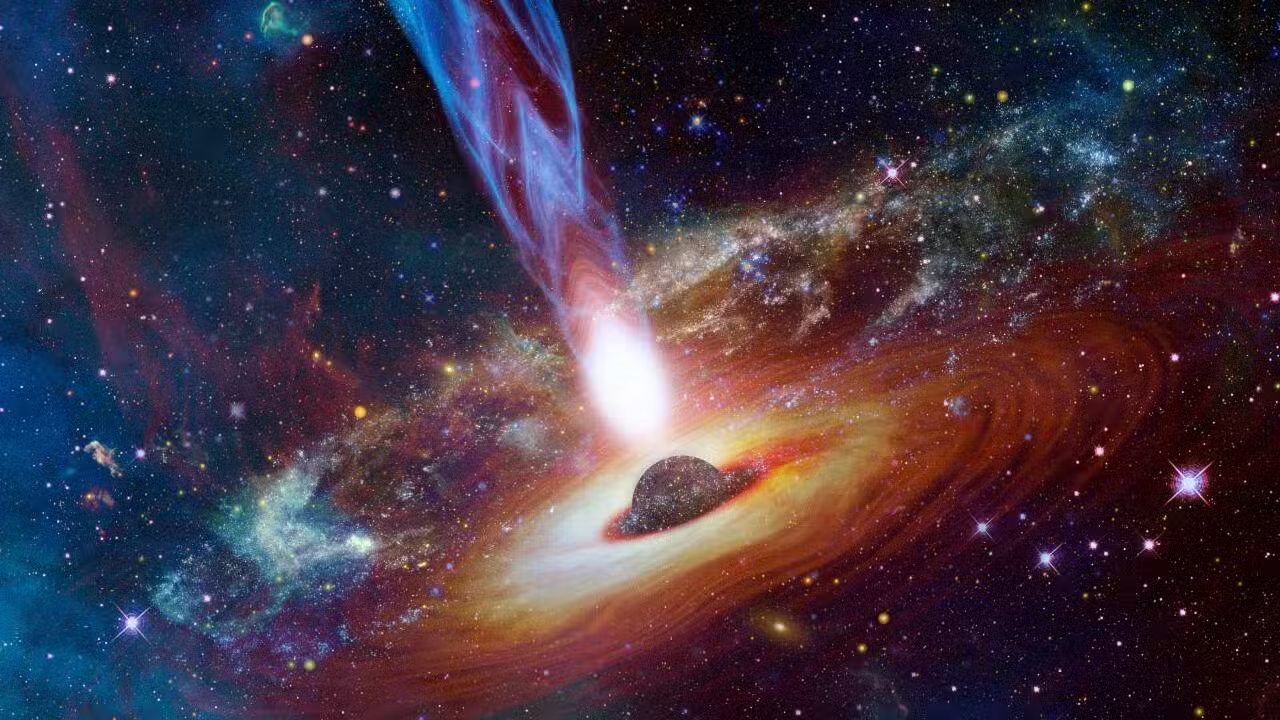
The James Webb Space Telescope has identified the wandering planet Cha 1107-7626 devouring gas and dust at a rate of 6.6 billion tons per second. Located in the Chameleon constellation, the celestial body exhibits behavior typical of forming stars. The discovery occurred with the support of the Very Large Telescope, in Chile, and was published on November 2, 2025 in The Astrophysical Journal Letters.
Researchers observed a sudden increase in accretion in August 2025. The rate of absorption increased eightfold from the previous pattern. This phenomenon remains unexplained for isolated planets.
- Accretion rate: 6.6 billion tons per second.
- Recorded increase: eight times normal.
- Instruments used: JWST and VLT.
Atypical object behavior
Cha 1107-7626 wanders through space without orbiting any star. Wandering bodies absorb matter from circumstellar disks, but on smaller scales.
This planet presents extreme accretion, similar to protostars. Activity suggests growthaccelerated movement.
Sudden increase in absorption
Observations indicate a drastic change in August 2025. The accretion outbreak increased the ingestion of gas and dust.
Phenomena like this occur in young stars. Recording on a wandering planet represents a scientific novelty.
Scientists monitor variations in the disk around the object. Data helps map frequency of events.
Hypotheses about nature
The celestial body can represent a link between planets and stars. One possibility involves reorganization of the nucleus or magnetic field.
Another theory points to isolated formation from molecular clouds. Process similar to that of stars, but with insufficient mass for fusion.
Researchers question current classification. The object defies traditional definitions of a planet.
Planned continuous monitoring
Teams from James Webb and VLT will monitor Cha 1107-7626 in the coming months. Observations look for patterns in accretion bursts.
Results contribute to understanding the evolution of wandering planets. Discovery opens ways to review models of planetary formation.
Location and features
The Chameleon constellation houses the planet at interstellar distances. Imagesin infrared light reveals surrounding dust disk.
The object maintains planetary mass, despite stellar activity. Studies compare it with other known wanderers.
Implications for astronomy
Extreme accretion expands knowledge about isolated objects. Future research tests hypotheses of ejected or independent origin.
JWST data provides unprecedented resolution in distant regions. International collaboration accelerates analysis of rare phenomena.