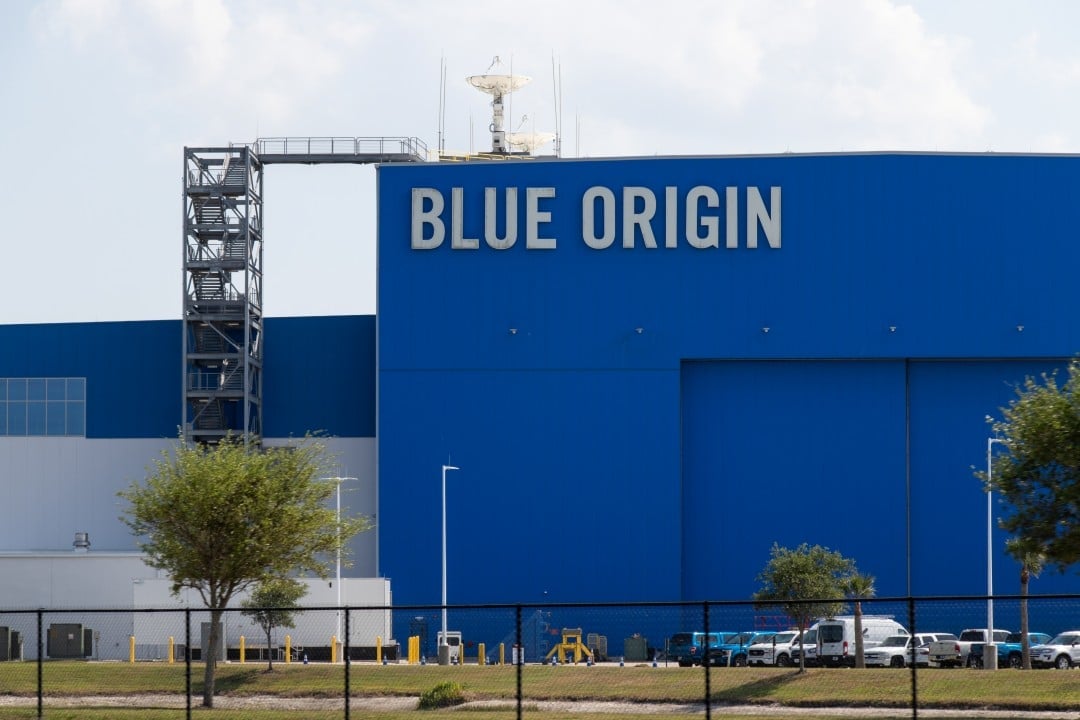
Blue Origin postponed the launch of the New Glenn rocket on Sunday afternoon, at the Cape Canaveral Space Force Station, in Florida, United States. The flight, which would have carried the two twin spacecraft of NASA’s Escapade mission to Mars, was canceled because of a cloud layer that violated safety rules. The company is evaluating new opportunities, scheduled for this Wednesday, November 12, 2025.
The New Glenn, 98 meters tall, competes directly with SpaceX’s Falcon rockets in the commercial launch market. This would be the vehicle’s second orbital mission, following the inaugural flight in January that tested the company’s own satellite.
The decision complies with protocols that avoid electrical risks during ascent through charged clouds. Blue Origin representatives monitored the 88-minute window, which opened at 2:45 pm local time, but opted to suspend it to prioritize the integrity of the operation.
- Main reasons for postponement: formation of cumulus clouds and unstable forecast.
- Mission impact: spacecraft will remain on standby, with no damage reported.
- Next attempt: 87-minute window from 2:50pm on Wednesday.
Weather conditions influence space operations
Adverse weather on the east coast of the United States directly affected Blue Origin’s schedule. Ground teams identified the violation of launch regulations minutes before the final countdown.
Laura Maginnis, vice president of mission management at New Glenn, highlighted in a press conference that Monday’s conditions were similar to Sunday’s, with a 30% risk of recurrence. The company coordinates with the Federal Aviation Administration for airspace adjustments.
Technical details of the New Glenn rocket
The New Glenn uses BE-4 boosters in the first stage, designed for reuse in future missions. This operation includes an attempted controlled landing on a sea ferry in the Atlantic, named Jacklyn.
In January, the debut flight failed to recover the booster due to engine failures, but payload deployment occurred without incident. Blue Origin has implemented upgrades to the propellant management system and hardware to increase the chances of success.
The rocket structure supports heavy loads, with a capacity of 45 tons in low Earth orbit. NASA contracts worth billions depend on consistent demonstrations of reliability.
Almost ten months have passed since the first release, a period dedicated to analysis and corrections. Maginnis stated that multiple boosters are in production, mitigating operational risks.
Escapade mission scientific objectives
Escapade, an acronym for Escape and Plasma Acceleration Dynamics Explorers, represents NASA’s first low-cost design for multiple spacecraft in Martian orbit. Funded with $75 million, the initiative is led by the University of California at Berkeley.
The twin probes, built by Rocket Lab, will analyze the interaction between solar winds and Mars’ magnetosphere. They will measure ion and energy flows, helping to understand the planet’s atmospheric loss over billions of years.
The plan calls for insertion into initial Earth orbit, followed by waiting until 2026 for favorable alignment with Mars. The cruise trip will last 10 months, with arrival scheduled for September 2027.
Robert Lillis, principal investigator, explained that the data will allow predictions of solar storms, essential for future manned missions. The spacecraft operate with solar panels and X-band antennas for communication.
- Mission phases: launch, L2 loitering, interplanetary cruise and orbital insertion.
- Key instruments: magnetometers and plasma analyzers for real-time measurements.
- Scientific duration: from June 2028 to May 2029, with varying orbits.
Reuse strategies drive industry forward
Blue Origin focuses on first stage recovery to cut costs by up to 70% per flight. Landing on the ferryJacklyn tests autonomy in variable ocean conditions.
This approach aligns with the SpaceX model, but New Glenn incorporates innovations such as 7-meter fairings for larger payloads. The company has 10 billion dollars in outstanding contracts.
The next flight, with no set date, will transport the Mark 1 lunar module to the surface of the Moon. Integrations with NASA include support for the Artemis V mission.
Delays like this reinforce the need for safety margins in commercial operations. Blue Origin plans to increase the launch cadence to 12 per year by 2027.
History of delays in Martian exploration
Escapade has faced postponements since 2023, when it was removed from a joint mission with the Psyche probe due to orbital incompatibilities. The contract with Blue Origin, signed in February 2023 for 20 million dollars, aimed at the first flight of New Glenn.
In September 2024, NASA postponed the launch to spring 2025, avoiding additional costs with removing propellants. This flexibility allowed the adoption of an innovative “launch-and-loiter” trajectory, developed by Advanced Space.
The total cost of the mission, including construction and instruments, totals 55 million dollars. Compared to projects like MAVEN, worth 582 million, the low-budget model democratizes planetary science.
The current window takes advantage of planetary alignment to save fuel, with the probes consuming 70% of their mass in propulsion. Previous successes, such as theIndian orbiter for 74 million, validate this economic strategy.
Preparations for orbital flight
Blue Origin teams carry out final inspections at Launch Complex 36. Fueling with liquid hydrogen and oxygen takes place hours before liftoff.
The FAA has imposed temporary restrictions on commercial flights between 6 a.m. and 10 p.m. due to government shutdowns, but the company is seeking exemptions. Coordination with NASA ensures compliance with air traffic regulations.
The NG-2 flight marks the debut of commercial payloads on New Glenn, including a Viasat demonstrator. Live broadcasts begin 20 minutes before the liftoff, accessible via official channels.