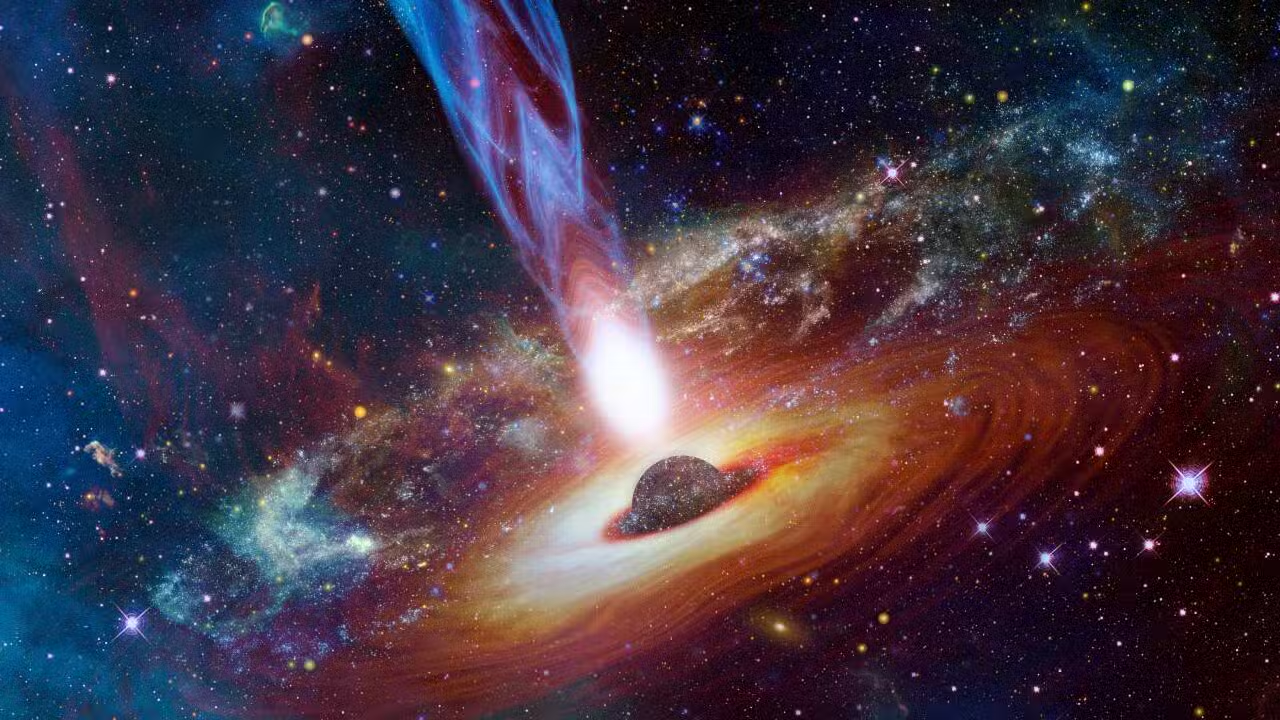
James Webb Telescope locates LAP1-B star cluster 13 billion light years from Earth. Researchers identify signals compatible with Population III stars, formed shortly after the Big Bang. The observation occurred through gravitational lensing of the galaxy MACS J0416.
The study, published in The Astrophysical Journal Letters, analyzes spectra that indicate high-energy photons and masses of about 100 suns. The team led by Eli Visbal, from the University of Toledo, highlights three criteria met by the cluster. These stars consist mainly of hydrogen and helium, with no heavy metals.
- Training in a low metallic environment;
- Low-mass clusters with giant stars;
- Predicted mass distribution for initial populations.
Characteristics of the LAP1-B cluster
The LAP1-B cluster presents emission lines consistent with theoretical predictions. Stars exhibit high brightness and primordial composition.
Previous research has come close to similar detections in the galaxy GN-z11. However, the current work offers more robust evidence.
Role of gravitational lensing
The galaxy MACS J0416 distorts the light from LAP1-B, increasing visibility. James Webb’s 6.5-meter mirror captures details in infrared.
This phenomenon allows you to observe distant objects with mgreater precision. The curvature of spacetime creates arcs and rings in the image.

Spectra and emission analysis
The spectra reveal a large number of energetic photons. This aligns with Population III star models. The estimated masses reach 100 times that of the Sun. The absence of heavy elements reinforces the primordial hypothesis.
Comparison with previous studies
A March 2024 paper examined the galaxy GN-z11, formed 430 million years after the Big Bang. At the time, signs suggested ancient stars, but without definitive confirmation.
LAP1-B meets additional temperature and crowding criteria. Visbal emphasizes the distinction from past observations.
Infrared Contributions
The James Webb operates in infrared wavelengths. This penetrates cosmic dust and reveals early formations. The technology allows for detailed spectroscopy of remote objects. Even without absolute confirmation, the understanding of stellar cosmogenesis advances.
Primordial Formation Details
The stars Population III emerged from primordial gas after the Big Bang, 13.8 billion years ago. They reached gigantic sizes due to the absence of metals.
The combination of hydrogen, helium and dark matter generated stars with millions of times the solar mass. Its direct detection remained elusive until now.
Advances in distant observation
The telescope uses instruments such as NIRSpec for spectral analysis. The distance of 13 billion light years is equivalent to the light emitted in the infancy of the universe. This ability expands knowledge about early cosmic eras. The study validates Einstein’s theoretical predictions about star clusters.