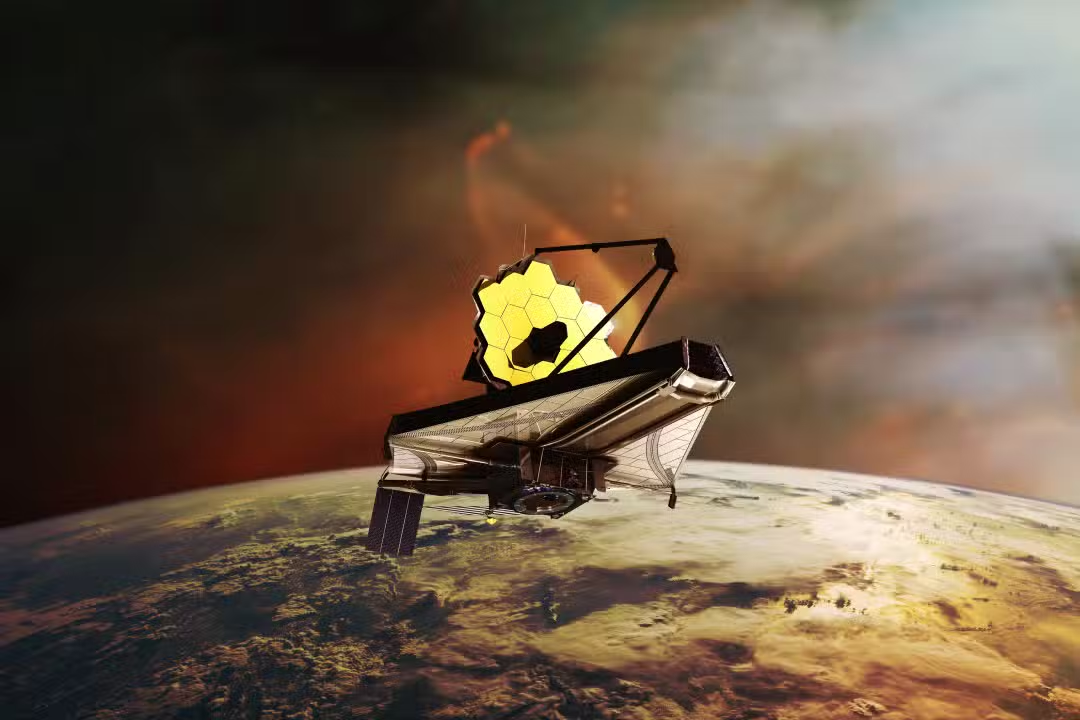
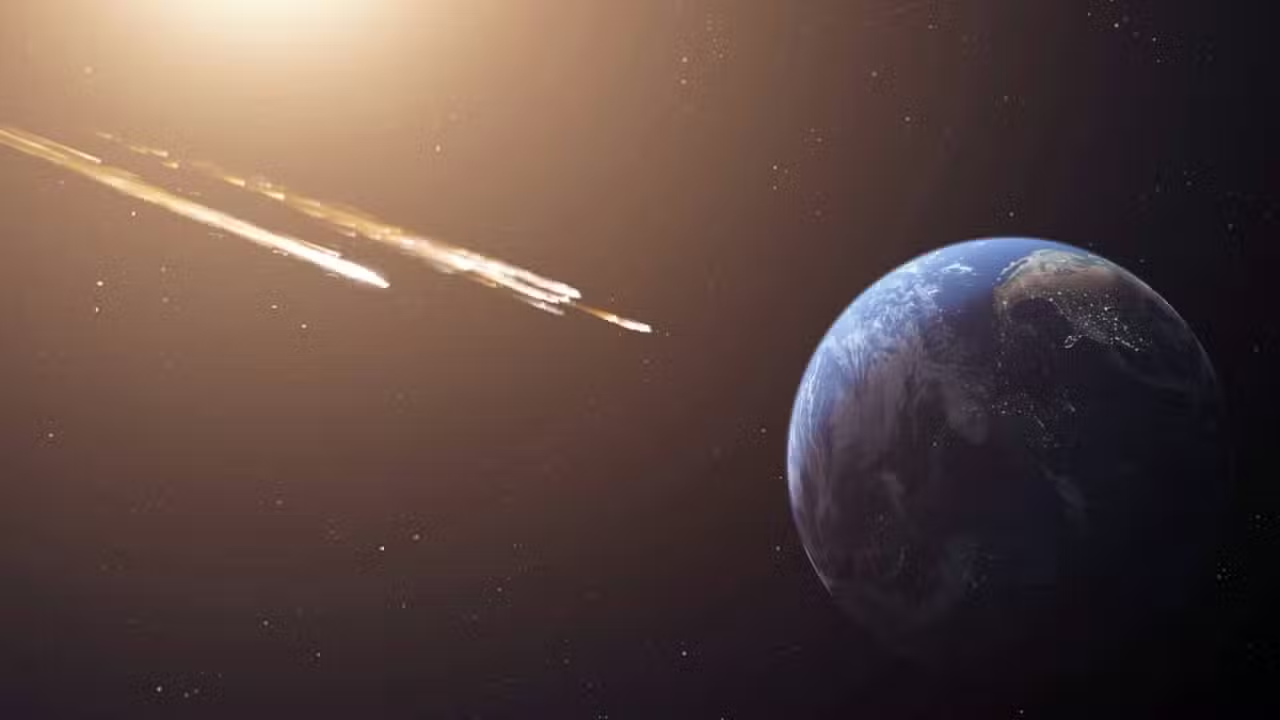
The interstellar comet 3I/Atlas, the third object of its type already identified, crosses the inner solar system in November 2025 with an average speed of 57 km/s. The hyperbolic trajectory confirms that the body will not be captured by the Sun’s gravity and will leave the system in a few weeks. Astronomers from ground-based and space observatories monitor the phenomenon in real time.
The discovery occurred recently through automated surveys. Preliminary orbit data indicates that the comet maintains sufficient energy to escape solar influence at all points in its passage.
Extragalactic origin confirmed
Spectroscopic analyzes reveal a distinct chemical composition of comets formed in the solar system. The proportion of heavy and volatile elements differs from local standards.
Orbital calculations show a speed greater than the escape velocity in relation to the Sun. This reinforces the classification as an interstellar object expelled from another stellar system.
Speed and comparison with predecessors
The 3I/Atlas records 57 km/s, a value greater than the 26 km/s of ‘Oumuamua (2017) and the 33 km/s of Borisov (2019).
- ‘Oumuamua showed non-gravitational acceleration detected at the end of the passage.
- Borisov exhibited a coma and tail typical of active comets.
- 3I/Atlas has not yet shown significant release of gases to date.
The speed remains high even far from perihelion, a characteristic exclusive to interstellar objects.
Detailed hyperbolic trajectory
The comet’s path forms an open hyperbola in relation to the Sun. Solar gravity causes a deflection, but does not reduce the speed below the escape limit.
Models predict perihelion in December 2025, followed by additional acceleration due to the gravitational slingshot effect. The object will return to the opposite direction to the original when leaving the system.
Global monitoring in progress
Observatories such as the Catalina Sky Survey, Pan-STARRS and ESA and NASA telescopes adjust orbital parameters daily. Corrections refine the prediction of the point of closest approach.
The passage takes place at a safe distance from Earth. There is no risk of impact or dangerous approach.
Data collected so far
The absence of an intense coma differentiates 3I/Atlas from Comet Borisov. High-resolution images look for signs of activity as the object approaches the Sun.
Spectra indicate the presence of carbon monoxide and theother volatile compounds in proportions not yet cataloged in the local solar system. Observations continue until the comet moves beyond optical range.
Limited observation window
High speed reduces the useful data collection period to a few weeks. International teams coordinate efforts to maximize the recording of reflected light and thermal emission.
The results will help understand ejection processes in distant planetary systems. 3I/Atlas represents the third confirmation of interstellar visitors in less than a decade.