
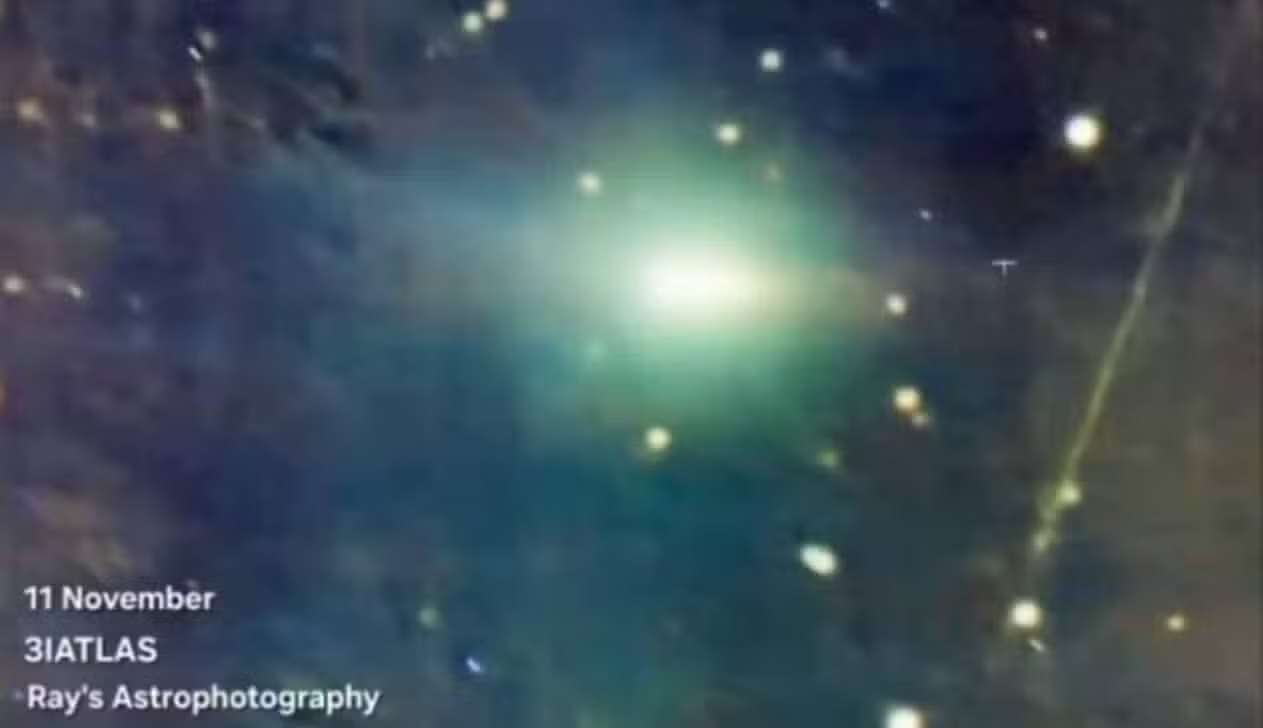
Astrophotographer Efrain Morales captured on November 17, 2025 a new image of the interstellar comet 3I/ATLAS in Aguadilla, Porto Rico. The record shows an asymmetrical coma and an elongated tail, showing the object’s persistent activity almost three weeks after its closest passage to Sol, on October 29. The observation confirms that the comet maintains the release of gas and dust even during solar separation.
3I/ATLAS is the third interstellar object confirmed in Sistema Solar and follows a hyperbolic trajectory at around 221 thousand km/h. Especialistas monitor the phenomenon to analyze the different composition of comets originating in Nuvem from Oort.
- The thin tail results from the action of the solar wind on ionized particles.
- Asymmetric coma indicates irregular ejection of material.
- The core has an estimated diameter of between 5 and 11 km.
Detailed logging in Porto Rico
Efrain Morales used dedicated equipment to obtain the image on the night of November 17th. The comet appeared with a defined tail and expansive coma, approximately 190 million kilometers away from Terra.
The capture occurred during morning visibility in the constellation Virgem. The object maintains enough brightness for recording by medium-sized amateur telescopes.

Asymmetric structure of the coma
The asymmetry observed in the coma suggests accelerated release of material in specific directions. Esse pattern differs from the behavior recorded in 2I/Borisov, the second interstellar object detected in 2019.
Data indicate significant presence of carbon dioxide and water in the composition. Telescópios spaces such as Hubble and James Webb perform spectral tracking.
The nucleus maintains a stable brightness despite the increasing distance from the Sol. The ionic tail extends millions of kilometers away from the star.
Additional international observations
Projeto Telescópio Virtual recorded 3I/ATLAS on November 11 with a narrow ion tail. Imagens from the Gemini Sul observatory, at Chile, on November 3 showed a coma exceeding 56 thousand kilometers.
Agência Espacial Europeia’s JUICE mission collected data between November 2nd and 25th. The Tianwen-1 telescope, from China, obtained sequences in October from 30 million kilometers away.
Records from the Mars Reconnaissance Orbiter probe on October 2 revealed a halo of gas around the nucleus during a close pass to Marte.
Prolonged post-perihelion activity
The comet continued to eject jets after October 29th. Imagens on November 11th shows a tail with a length of three million kilometers.
The geometry evolves as the object moves away from Sol. The brightness remains at magnitude 7 to 8, allowing terrestrial monitoring.
The minimum approach to Terra is scheduled for December 19th at 269 million kilometers. Não there is a risk of collision.
NASA contributions to monitoring
The agency broadcast on November 19 with images from the PUNCH, Lucy and MAVEN missions. Records show the comet between September and October at distances of 231 to 235 million miles.
The Lucy mission captured the object on September 16 with a short tail visible. Combined observations include close passage to Marte.