
Lua and Saturno form a visible conjunction in the night sky between 28 and 30 November 2025. The phenomenon occurs in the constellation of Astrônomos highlight the moment as an opportunity to locate the ringed planet easily. The proximity makes viewing easier, especially on Saturday, the 29th, when the Moon reaches 68% illumination.
The alignment results from common orbital motion in the ecliptic, the plane of Sistema Solar. Saturno appears brighter due to the annual peak in luminosity. Observadores on Hemisfério Sul have a privileged view, with the event starting one hour after sunset.
- Locate the southern sky to identify Lua and the yellowish dot of Saturno next to it.
- Use binoculars for initial details; telescopes reveal the narrow rings.
- Avoid urban areas with light pollution for better contrast.
Orbital alignment details
Astronomers explain that Lua and Saturno follow similar trajectories in the sky due to the ecliptic. Esse plane aligns celestial bodies periodically, creating apparent proximity. No on the 29th, the angular distance is below five degrees, facilitating observation.
The planet reaches magnitude 0.7, making it one of the most visible spots after Júpiter and Vênus. The growing Lua reflects enough sunlight to highlight the pair. Condições Favorable weather in central regions of the country increases the chances of clear viewing.
Visibility in different regions
South and southeast regions of Brasil record ideal times between 6pm and 10pm. No Norte, the event appears slightly higher on the horizon due to latitude.
Cities like São Paulo and Rio of Janeiro offer observation points in outlying parks. No Nordeste, observers at Fortaleza notice the alignment 30 minutes earlier.
- South: Pôr from sun to 7pm, alignment visible until midnight.
- Midwest: Céus darker colors favor contrast in rural areas.
- North: elevated Horizonte allows observation to be extended until 11pm.
A live broadcast takes place on YouTube from the Urânia planetarium, with guidance for beginners. Especialistas recommend astronomy apps for accurate tracking.
Characteristics of Saturno rings
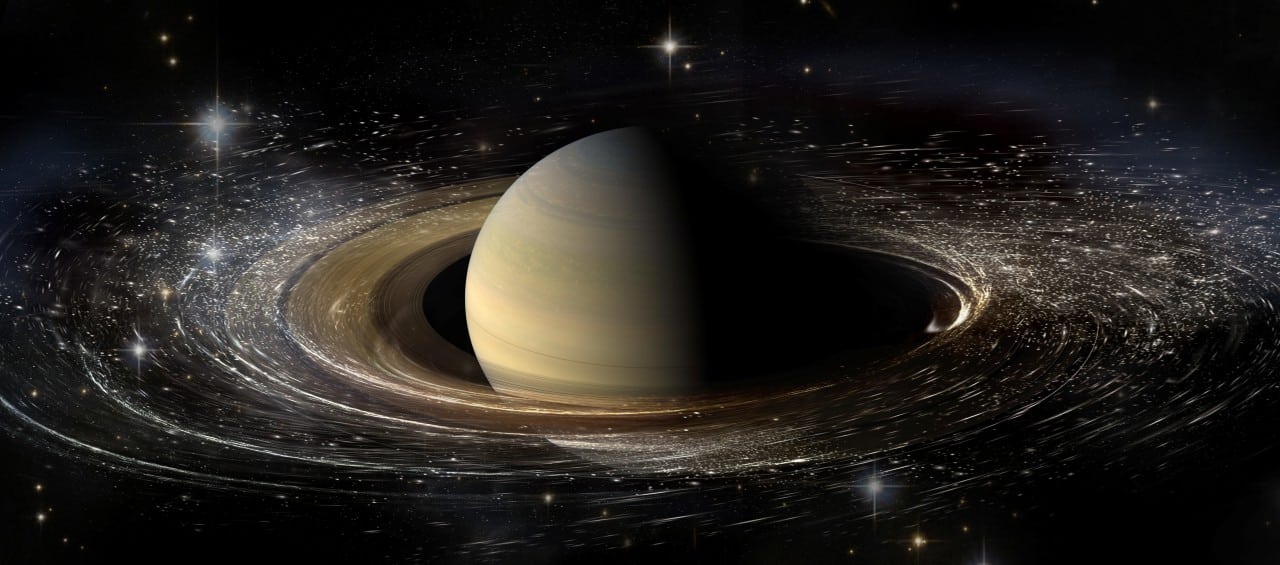
Saturn displays rings composed mainly of ice particles and dust. Esses structures measure about 282 thousand kilometers in external diameter, but vary in thickness from 10 to 100 meters. The current tilt allows lateral vision, revealing details with modest equipment.
The phenomenon occurs after the “crossing” of the rings, when the planet temporarily “hides” them from Earth’s perspective. Essa configuration lasts until 2026, with the rings gradually opening. Observadores notice the diffuse glow caused by the reflection of sunlight off the particles. Telescópios of 70mm opening is enough to distinguish the main ring, known as A.
Practical tips for observation
Choose locations with little artificial light to maximize nighttime contrast. Inicie the search an hour after dusk, aiming south. The Lua serves as a natural guide, with Saturno positioned to the right or left, depending on the date.
Neptune appears below par, but requires higher power telescopes due to magnitude 7.8. Registre the event with cell phone cameras in night mode for basic photos. Grupos of amateur astronomy organize meetings at public observatories during the weekend.
Applications like Stellarium simulate the sky in real time, adjusting by location. Evite excessive zoom in photos, prioritizing wide framing of the horizon.
Historical context of similar conjunctions
Records indicate close alignments on November 23, 2025, with three degrees separation. The next similar event is projected for 2038, with a distance of less than four degrees. Esses phenomena occur every 13 months, but lunar luminosity varies the visual impact.
Explorations such as the Cassini mission, between 2004 and 2017, mapped the rings in detail, confirming frozen water compositions. Observações terrestrials date from the 17th century, with Galileu describing the rings as early “wings”.
The orbital cycle of Saturno, with 29.5 Earth years, influences the periodicity of these alignments. Dados from NASA reinforce that 2025 marks recovery of visibility after ring eclipse.
Preparation for future events
November 2025 includes meteor showers like Leónidas, peaking on November 17. Uma supermoon occurs on the 20th, enlarging the lunar disk by 14% compared to the average.
- Leonids: Até 15 meteors per hour, visible in the eastern quadrant.
- Supermoon: Iluminação total, ideal for landscape photography.
- Opposition of Urano on November 21: Planeta observable all night with binoculars.
These events complement the annual calendar, promoting accessibility to astronomy.
