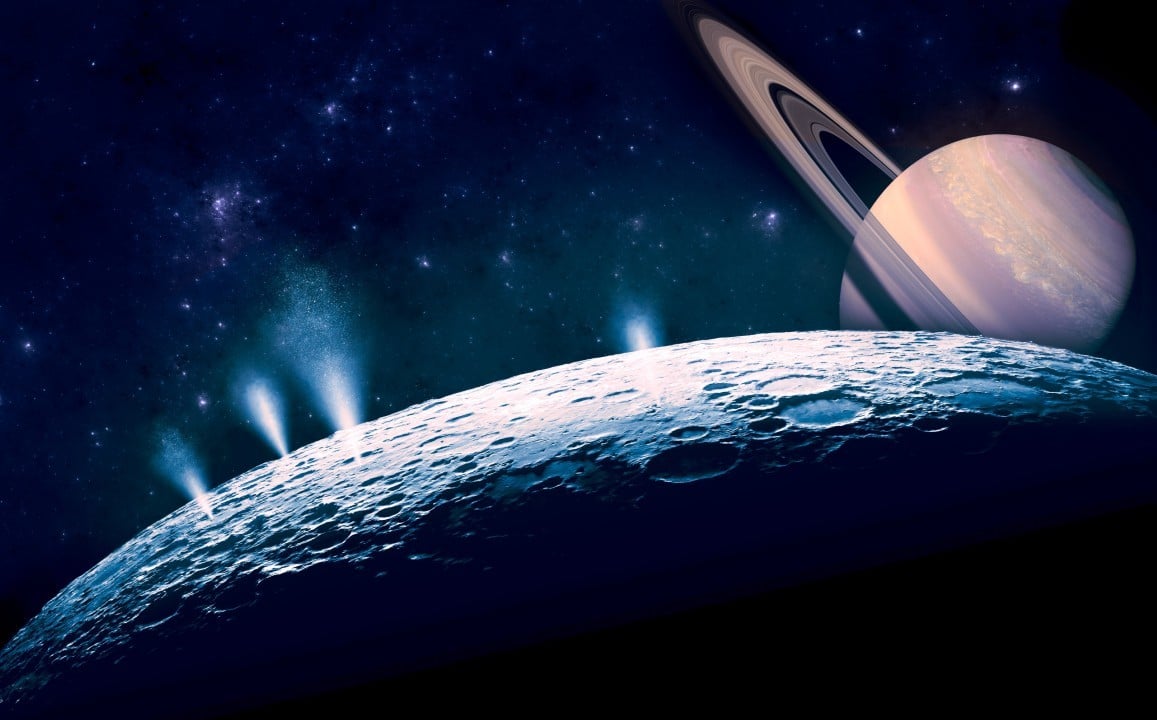
A study published in the magazine Nature Astronomy this Monday (24) reveals that small icy moons of Sistema Solar may harbor boiling underground oceans. The research, led by geophysicist Maxwell Rudolph, from Universidade to Califórnia in Davis, analyzed the behavior of ice sheets under continuous gravitational influence.
The moons Encélado and Mimas, from Saturno, and Miranda, from Urano, present conditions that allow “cold boiling” near the surface. Esse phenomenon occurs when pressure decreases to the triple point of water, allowing the liquid to boil at temperatures close to zero degrees Celsius.
The discovery reinforces the potential of these moons as candidates for missions to search for extraterrestrial life. The presence of active liquid water makes these environments particularly interesting for astrobiology.
Ice thinning alters ocean dynamics
The thinning process of ice sheets occurs due to gravitational interactions with planets and other moons. Essas forces cause periodic flexing that generates internal heat and melts the ice at the base of the crust.
Researchers have identified that on moons with a diameter of less than 600 km, the reduction in ice thickness significantly reduces the pressure on the underground ocean.
This pressure drop allows the water to reach the triple point, starting boiling in the superficial layers of the reservoir.
- Enceladus: Jatos of vapor observed by the Cassini probe confirms connection between ocean and surface
- Mimas: Oscilações orbitals suggest young, active ocean beneath crust
- Miranda: Falhas tectonics indicate a history of intense oceanic activity

Cold boiling does not compromise habitability
The “cold boil” occurs only in the upper layers of the oceans, keeping the deep regions stable and protected. Organismos hypothetical could survive at depths where temperature and pressure remain constant.
Maxwell Rudolph explained that surface boiling does not affect most of the water reservoir. Conditions at depth remain suitable for microbial life forms.
The phenomenon may explain the release of gases observed in Encélado. The detected steam jets contain organic compounds and salt, suggesting a nutrient-rich ocean.
Differences between small and large moons
Larger moons, such as Titânia and Urano, exhibit different behavior.
The thickness of the ice on these moons prevents the pressure from dropping to the triple point. Instead of boiling, extensive fractures occur in the frozen crust. Essas ruptures create visible canyons and faults on the surface of Titânia.
Released gases shape lunar surfaces
Internal boiling produces steam and gases that form clathrates at the ice-water interface. Essas crystalline structures trap molecules and influence surface geology.
- Methane clathrates and carbon dioxide were detected in samples from Encélado
- Volcanic gases create plumes that stretch hundreds of kilometers
- Recent ice formations indicate active geological activity
The researchers plan to investigate how these gases migrate through the crust. Analysis of surface markings can reveal the chemical composition of the oceans.
