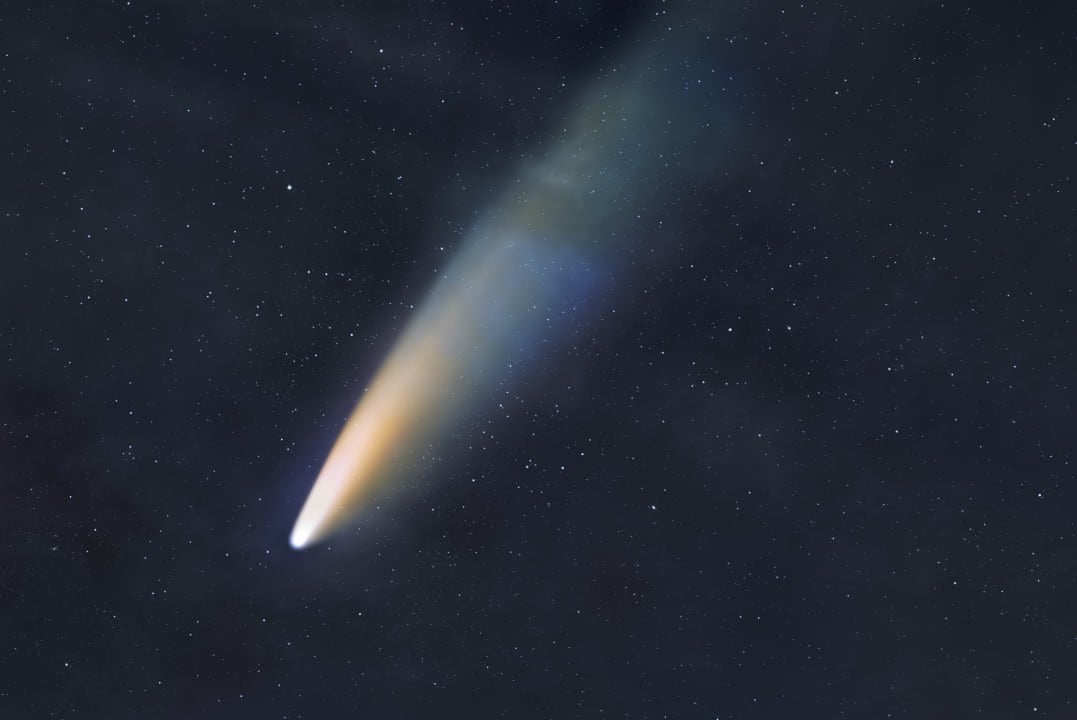
An international collaboration of astronomers has announced the identification of a new long-period comet, tentatively cataloged as C/2024 S3. The celestial object was detected by automated sky scanning systems and its existence was confirmed by large observatories located at Chile and Havaí in recent days, generating great expectation in the scientific community.
The initial discovery occurred during a routine analysis of deep-sky images designed to find transient objects such as supernovae and asteroids. Após the software signaled, teams of researchers carried out follow-up observations to calculate its preliminary orbit and confirm its cometary nature, distinguishing it from a simple asteroid by the presence of a faint coma, the cloud of gas and dust around its nucleus.
What makes C/2024 S3 particularly interesting is its unusual trajectory and initial brightness projections. Calculations indicate that it could become a prominent object in the night sky over the next year, mobilizing both scientists and amateur astronomy enthusiasts for a detailed observation campaign.
A trajectory that challenges current models
Classified as a long-period comet, C/2024 S3 is believed to have originated in Nuvem of Oort, a vast and distant sphere of icy bodies that surrounds Sistema Solar. Objetos from this region takes thousands or even millions of years to complete a single orbit around Sol.
Its orbit is highly inclined in relation to the plane where most planets orbit Sol, a detail that intrigues scientists. Essa feature suggests that it may have been pushed into the interior of Sistema Solar due to gravitational perturbations from neighboring stars long ago.
Analysis of its trajectory indicates that this is probably the first time that C/2024 S3 has visited the inner Sistema Solar. Isso makes it a “pristine” object, the material of which has not been altered by heat and solar radiation in previous passes.
Studying the composition of comets like this is fundamental to planetary science. Eles are considered fossils from the formation of Sistema Solar, and analysis of their gases and dust can provide valuable clues about the chemical and physical conditions of more than 4.6 billion years ago.
What to expect from the visibility of the celestial object
Current models about the behavior of C/2024 S3 are still being refined, but initial projections indicate that it will reach its perihelion, the point of closest approach to Sol, in mid-2025. The big uncertainty, however, lies in how bright it will become. The visibility of a comet directly depends on the amount of gas and dust that its nucleus releases when heated by solar radiation, a process known as sublimation. Embora there is a possibility that it may become visible to the naked eye in places with little light pollution, astronomers are adopting a cautious stance. The history of astronomy is full of comets that have proven unpredictable, with some that promised a great show disintegrating or simply failing to develop the expected brightness, while others surprised with bursts of activity that made them exceptionally bright. The best observation windows should occur first for Hemisfério Sul, before perihelion, and later for Hemisfério Norte, after it passes through Sol.
Scientific mobilization for observation
Large observatories around the world are already adjusting their schedules to allocate telescope time to study C/2024 S3. Spectroscopic analysis will be one of the main tools used, allowing scientists to break down the light reflected by the comet to identify its detailed chemical composition. The search for elements such as water, carbon monoxide, cyanide and complex organic molecules will help to draw a precise profile of its origin and compare it with other comets already studied.
Space agencies, including their planetary defense programs, are also monitoring the new object. Embora’s orbit presents absolutely no risk of collision with Terra, the passage of such a primitive comet offers a rare opportunity for data collection. The information obtained by terrestrial and space telescopes will be fundamental to improve models about the structure and dynamics of Nuvem and Oort and the diversity of bodies that inhabit this remote region of our system.
Monitoring instruments and techniques
Initial detection of the comet was carried out by wide-field telescopes, specifically designed to cover large areas of the sky quickly and identify moving or varying brightness objects.
Now, the focus turns to more powerful and specialized instruments, which can analyze in detail the morphology of the coma and the development of the ion and dust tails, which will form as it approaches Sol.
The community of amateur astronomers also plays a vital role. With increasingly sophisticated equipment, they can provide a continuous stream of data, especially photometry (brightness measurements) and images that document structural changes in the coma and tail, complementing the work of professional observatories.
The Unpredictability of Icy Visitors
Experts emphasize that accurately predicting the brightness of newly discovered comets, especially those that first entered the inner Sistema Solar, is a notoriously difficult task. The composition and structure of the nucleus are completely unknown.
There are historical cases of comets that generated enormous expectations and ended up proving to be insignificant, while others, initially considered modest, became memorable events in the night sky. Therefore, continued observation in the coming weeks will be crucial.
How to observe the new star
Currently, C/2024 S3 is an extremely faint object, visible only through large professional or advanced amateur telescopes. Conforme approaches and its brightness increases, observatories, planetariums and astronomy clubs must publish celestial maps and observation guides to help the public interested in locating it.
