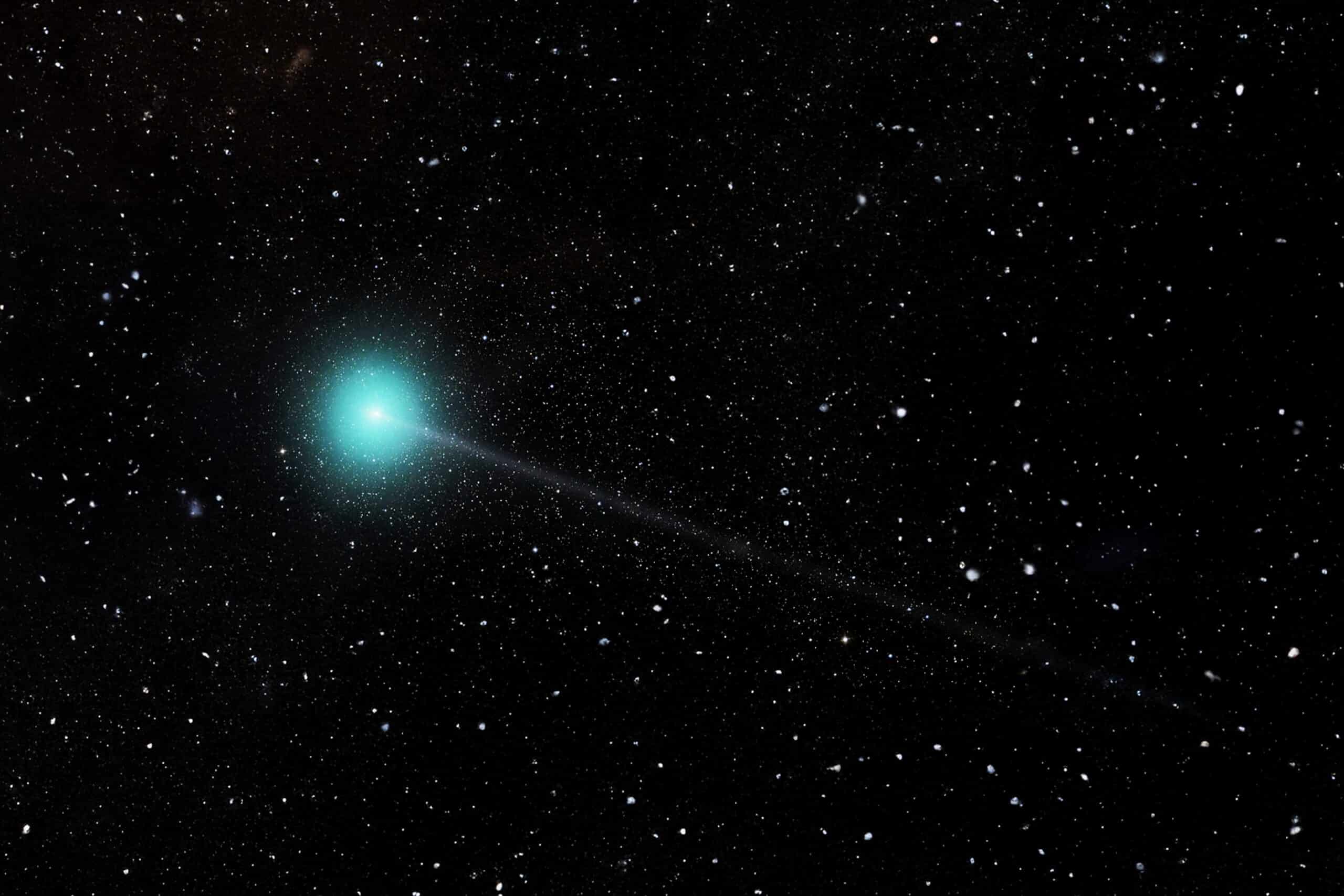
An anomaly detected by NASA in the interstellar comet 3I/ATLAS on November 5, 2025 has generated intense debate among astronomers about its composition and behavior. The object, discovered in July by the ATLAS telescope at Chile, displayed an inverted tail that pointed toward Sol, a phenomenon unprecedented in known comets. Essa structure, technically called the antitail, suddenly disappeared, being replaced by a conventional tail more than 56,000 kilometers long.
The North American space agency confirmed that the comet will pass 270 million kilometers from Terra, without any risk of impact. Observações carried out with the Telescópio Espacial James Webb revealed bluish tones in the emission of gases, associated with the ionization of carbon monoxide. Cientistas have been monitoring the event since perihelion on October 29, when the comet reached its closest point to Sol.
Experts highlight the unique opportunity to study materials from other stellar systems. 3I/ATLAS is the third confirmed interstellar visitor to be observed, following ‘Oumuamua in 2017 and 2I/Borisov in 2019, each displaying features that challenge current astronomical models.
Initial discovery and hyperbolic trajectory
The ATLAS telescope (Asteroid Terrestrial-impact Last Alert System) identified the comet on July 1, 2025, from its location at The analysis of its orbit confirmed a hyperbolic trajectory, a clear indication that its origin is outside our Sistema Solar. The object travels at an impressive speed of 58 kilometers per second, a speed that prevents it from being captured by solar gravity, ensuring its unique passage through our cosmic neighborhood. The Essa characteristic fundamentally differentiates it from comets that originate from Nuvem from Oort or from Cinturão from Kuiper.
Astronomical calculations estimate that the object traveled for millions of years through vast interstellar space before entering our system. Sua future journey is also the subject of study, as in March 2026, it will approach Júpiter at a distance of 50 million kilometers. The gas giant’s immense gravitational force could significantly alter its exit trajectory from Sistema Solar, providing valuable data on gravitational interactions with high-speed objects. Esse encounter will be closely monitored to refine orbital prediction models.
Chemical composition reveals mysteries
Spectrographic analysis conducted by Telescópio James Webb revealed an unusual chemical composition. Carbon dioxide is the dominant component, followed by water and traces of cyanide. What caught the most attention was the presence of an atypical nickel alloy, which differs from the composition of comets native to our Sistema Solar and suggests its formation in a distinct and distant stellar environment.
A radio emission at frequencies of 1,665 GHz and 1,667 GHz, captured in November, marked the first record of an interstellar comet in this spectrum band. Esses signals indicate the presence of volatiles that have been preserved since the object’s origin, offering a window into the chemical conditions of its home star system.
After passing through perihelion, the comet lost about 13% of its mass, which resulted in a greater acceleration than predicted by solar wind pressure alone. Additional Observações from Telescópio Espacial Hubble allowed us to estimate the diameter of its core, which is between 320 meters and 5.6 kilometers, a wide range that reflects the difficulty of measuring such an active and distant object.
Changes in structure observed
NASA images captured on November 3 recorded the jet of material that formed the antitail, projecting against the direction of Sol. Apenas two days later, on November 5, this structure had completely disappeared, giving way to the extensive ion tail that now stretches into space.
This rapid transition challenges conventional explanations based on gas sublimation. The current hypothesis is that charged particles interacted in an atypical way with the solar magnetic field, causing the abrupt change in the comet’s morphology.
Probes such as SOHO and STEREO-A recorded the event between September and October, providing a continuous view of its evolution. Additional Dados indicate an extreme polarization of the reflected light, suggesting an alignment of dust never before observed in other comets, whether interstellar or not.
The scientific community is closely following these developments as they could lead to a fundamental revision of understanding about the interaction between cometary bodies and the interplanetary environment.
Reactions from the scientific community
Astronomers describe the behavior of 3I/ATLAS as extremely difficult to model with current theories. The anti-tail phenomenon and its rapid disappearance, coupled with anomalous acceleration, force research teams to rethink hypotheses about the ejection of objects from their original stellar systems and their subsequent evolution in interstellar space. The debate intensified in specialized publications, such as the Minor Planet Center bulletins, where different interpretations are discussed. Astrophysicist Avi Loeb, of Universidade of Harvard, known for exploring the possibility of technological origins for space anomalies, raised the hypothesis, although without concrete evidence to support it at the moment. Enquanto Therefore, the main line of investigation focuses on natural, albeit exotic, explanations for the comet’s behavior. NASA’s planetary defense protocol was activated in October as a precautionary measure to monitor any fragments that could break away from the object, although no risks were identified.
Observations by space telescopes
Telescópio James Webb estimated hydroxyl emission activity when the comet was 450 million kilometers from Sol. Simultaneamente, data from Hubble revealed an irregular rotation, a feature that was later confirmed in TESS satellite files dated May 2025.
The MAVEN probe, in orbit around Marte, also captured variations in the comet’s nucleus during its approach. Essas measurements provide a crucial comparative basis with data collected from previous interstellar visitors, ‘Oumuamua and Borisov, enriching knowledge about the diversity of these objects.
Possible interactions with planets
The approach of Júpiter in March 2026 will exert a significant gravitational influence on 3I/ATLAS. Simulações computations predict a notable deviation in its outward trajectory from Sistema Solar, an event that will be observed to test the accuracy of celestial mechanics models.
In October, the comet had already passed within 27 million kilometers of Marte, where probes such as Mars Reconnaissance Orbiter provided high-resolution images. Durante this passage, an inexplicable pause in his activity was recorded for several days, another behavior that adds to the list of anomalies.
Unreleased radio signals and broadcasts
Radio frequency detections, carried out on November 13, 2025, confirm a primarily icy composition, similar to that of comets in our system, but with exotic characteristics. Técnicas of radio astronomy allowed, for the first time, to “listen” to the activity of an interstellar comet, validating models on the preservation of primordial matter within its interior. Cientistas plan new observations with Very Large Array to further analyze these emissions.
Implications for interstellar studies
Comet 3I/ATLAS offers a true time capsule of another star system. Anomalias and its extra acceleration and chemical composition challenge models of comet formation in protoplanetary disks, suggesting that the processes may be more varied than previously thought.
Global collaborations, including European programs like ESA’s Comet Interceptor, are accelerating the analysis of raw data to extract the most information. The participation of amateur observers has also been valuable, complementing the professional data with high-quality images of the developing tail.
The object will leave Sistema Solar with no expected return, but the information collected during its brief visit will leave a lasting legacy on cosmic migrations. Astrônomos predict that with more advanced telescopes, the detection of such visitors will become increasingly frequent.
