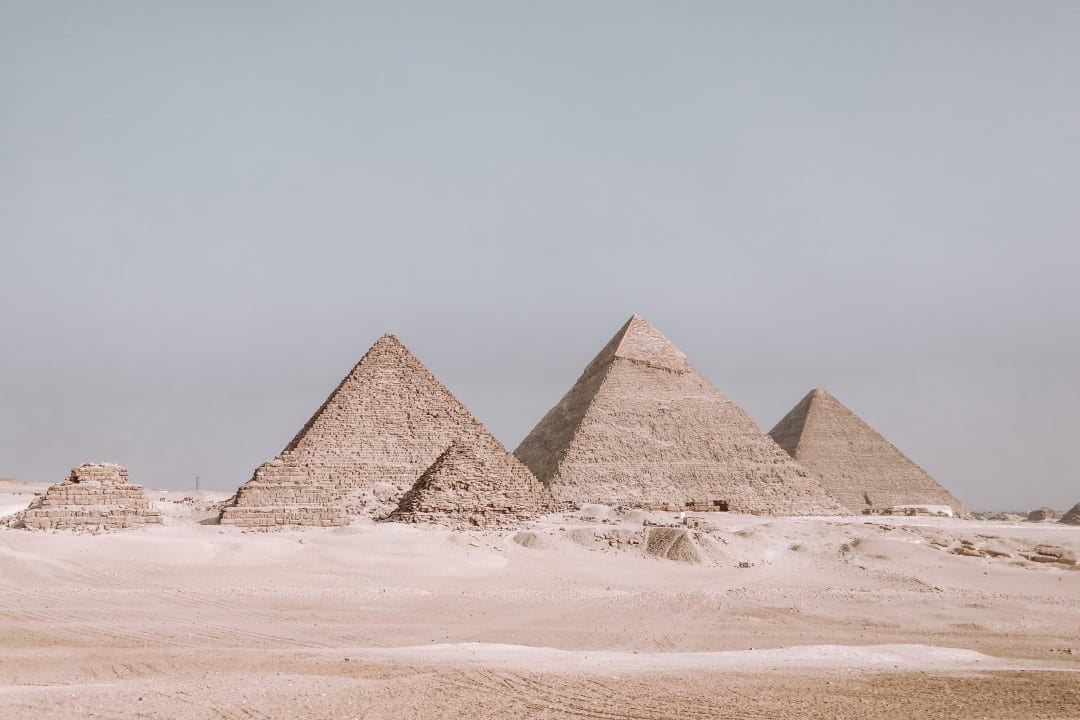
Radar satellites identified an ancient branch of the river Nilo, now completely buried, which passed right next to dozens of pyramids in Egito. The discovery, published in the journal Communications Earth & Environment, solves one of archaeology’s greatest mysteries: why so many monuments were built in a narrow strip of desert.
Researchers led by Egyptologist Eman Ghoneim, of Universidade of Carolina of Norte in The canal, about 64 kilometers long, served as a main transportation route during the Antigo and Médio Império.
Arm Ahramat had impressive dimensions
The extinct river was between 200 and 700 meters wide in different sections. Sua depth reached 8 meters, values comparable to the current Nilo in some regions.
These measures indicate the capacity to receive large vessels loaded with stone blocks, workers and supplies. The proximity to construction sites drastically reduced the transport distance for heavy materials.

Radar technology penetrated layers of sand
The team used images from the Sentinel-1 and TanDEM-X satellites, which emit waves capable of crossing the desert surface. The data revealed linear irregularities beneath dunes and agricultural areas.
On the ground, researchers applied ground-penetrating radar and electromagnetic tomography. Perfurações complements reached up to 20 meters deep and confirmed sediments typical of a river environment.
These combined techniques made it possible to trace the complete path of the channel from Lisht to the plain of Gizé.
Temples functioned as river ports
The ceremonial sidewalks that connect the funerary temples to the pyramids point in a perpendicular direction to the ancient bed. Muitas end exactly on the edge of Braço Ahramat.
The pyramidal complexes had dock-like structures. Barcos unloaded materials a few meters from construction sites.
- Granite blocks from Assuã traveled hundreds of kilometers down the river
- Limestone from the quarries of Tura arrived via nearby waterways
- Workers and food also used the same route
Change in course of the Nilo altered construction locations
The Braço Ahramat began to silt and dry out about 4,700 years ago. Secas intense intensity and natural displacement of the river contributed to its disappearance.
Over time, pharaohs began to choose new locations closer to the main course of the Nilo. The concentration of pyramids in the uncovered band reflects the period in which the channel remained active.
Evidence reinforces logistic theory
Previous studies have already suggested the use of artificial channels for transport. The new research demonstrates that the solution was natural and much broader than previously imagined.
The find explains how the Egyptians were able to move millions of tons of stone without advanced mechanical technology. The river network made the greatest concentration of monumental works in ancient history viable.
The discovery changes the understanding of urban planning in Antigo Egito. The pyramids did not appear isolated in the desert for exclusively religious reasons, but in strategically chosen locations due to the ease of water access.
Next steps of the research
The team plans to map other segments possibly connected to Braço Ahramat. Novas drilling must determine the exact date of complete silting.
The data also helps preserve archaeological sites threatened by agricultural and urban expansion. Knowledge of the ancient bed prevents construction on remains that are still unknown.
