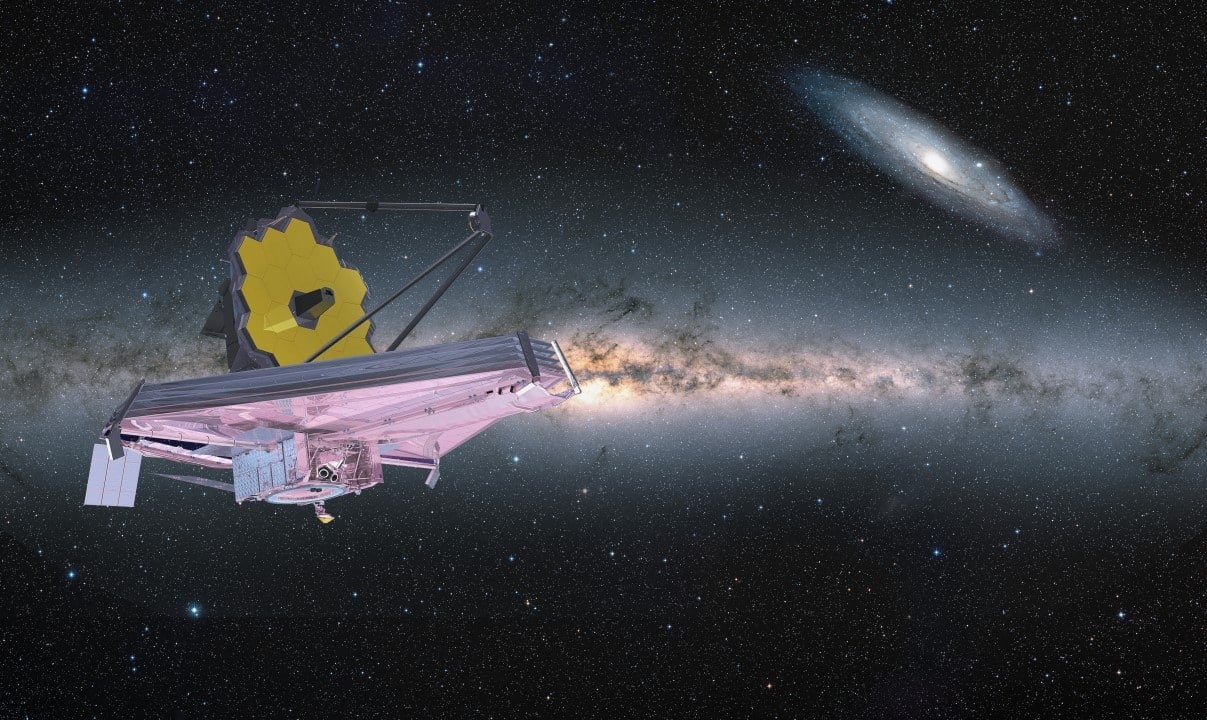
Telescópio Espacial James Webb (JWST), launched by NASA in December 2021, revolutionized exoplanet observation, but has failed to confirm exomoons to date. Quase Four years after its operation, astronomers face technical barriers to identifying moons orbiting distant planets. A recent study, led by David Kipping of Universidade Columbia, analyzed data from the NIRSpec instrument and highlighted the complexity of the task.
Researchers dedicated 60 hours of observation to the exoplanet Kepler-167e, a gas giant similar to Júpiter, located 1,119 light-years away in the constellation Cisne. The planet orbits its star at a distance similar to that of Marte in relation to Sol, which makes it a promising target for searches for natural satellites. Apesar of expectations, the data did not confirm the presence of an exomoon, attributing variations in light to stellar phenomena.
JWST represents the most advanced instrument for this detection, but the transit method – which measures drops in brightness as a body passes in front of the star – requires precise alignments and subtle signals. Exoluas block less light than planets, complicating distinction from instrumental noise or stellar activity.
- Kepler-167e has a mass 1.01 times that of Júpiter and an orbital period of 2.9 years.
- The system includes three super-Earths, increasing interference in measurements.
- Observations occurred in six blocks of ten hours each, processed with specialized pipelines.
Previous exomoon candidates
Astronomers identified indirect clues in other systems before focusing on Kepler-167e. On the exoplanet WASP-39b, a hot Saturno, variations in sodium and sulfur dioxide suggested a volcanic moon spewing gases. Telescópios as well as Hubble and Very Large Telescope detected these elements, but without direct observation of the moon.
A brown dwarf called W1935 showed unexplained methane emissions, possibly linked to an unseen exomoon. Esses cases are based on atmospheric evidence, without visual confirmation. JWST has raised hopes, but early results reinforce the need for robust data.
The Kipping study reviewed these candidates to contextualize the current search. Apesar of the potential, alternative interpretations such as volcanic ejections or orbital interactions persist. The absence of direct detections highlights the rarity of favorable alignments in distant systems.
JWST found an exomoon — or just a star spot?
— JAMES WEBB (@jameswebb_nasa)December 2, 2025
Why hunting for moons in other systems is so difficult — and what the new research reveals
Since before the release of Telescópio Espacial James Webb (#JWST), in 2021, astronomers dream of an ambitious goal: detecting…pic.twitter.com/LGizykdnl7
Detailed Analysis of Kepler-167e
Kepler-167e emerged as an ideal target due to its similarity to Júpiter, which has more than 70 moons in Sistema Solar. Localizado at 1,119 light years, the planet transits its star periodically, allowing transit measurements. The team divided the observations into blocks to capture subtle variations in the light curve.
The light curves showed gradual decreases, initially mistaken for exomoon transits. Efeitos of the NIRSpec detector contributed to this ambiguity, as they operate at speeds similar to those of an orbiting satellite. Processamentos with three pipelines – including the custom ExoTiC-JEDI and katahdin – generated comparable data.
Four mathematical models tested the results, from simple adjustments to sophisticated analyzes for minute variations. Sete combinations suggested an exomoon in Roche-skimming orbit, about 10% of the planetary radius. However, alignments such as syzygies – when the moon, planet and star align – have complicated interpretation.
The star Kepler-167, considered stable, displays spots detected by missions Kepler and Spitzer. Essas structures cause brightness dips consistent with JWST data. Cálculos indicated that the supposed moon would need to be 30% larger than models predict, weakening the hypothesis.
Processing and mathematical models
The pipelines handled raw data in an automated way, organizing noise and calibrations. ExoTiC-JEDI, developed for exoplanets, highlighted non-Gaussian variations. Katahdin, another standard, confirmed trends in light curves. The custom pipeline optimized for lunar signals by integrating infrared filters.
Early models used linear regressions for isolated planetary transits. Advanced Versões incorporated orbital parameters such as inclination and eccentricity to simulate exomoons. Esses methods revealed ambiguities, where a single transit dominates the fits due to the superiority of JWST over predecessors.
The combination of seven scenarios favored strong detections, but tests against moonless baselines showed bias towards mid-transit events. Isso reinforces that JWST, being more sensitive, amplifies interpretations in low data regimes. Astrônomos emphasize the need for multiple transits for validation.
Teams plan to refine these models with simulations of Monte Carlo, incorporating star spot distributions. Tal approach quantifies probabilities, separating astrophysical signals from artifacts. The study is submitted to American Astronomical Society journals for review.
Alternative hypotheses in play
Starspots emerge as main explanation for the signal at Kepler-167e. Previous Estudos of Kepler recorded similar events, with sizes compatible with the observed falls. A spot crossed by the planet during the transit simulates the light blocking of an exomoon.
Syzygies represent another possibility, aligning bodies for periodic variations. However, the mid-transit event favors the spot as it requires precise orbits unlikely without additional evidence. The tranquility of the star Kepler-167 does not exclude sporadic flares, detected in 10% of past transits.
Other hypotheses include NIRSpec instrumental noise, calibrated but persistent in the near-infrared. Modelos of planetary atmosphere, with clouds or hazes, also mimic lunar signals. The study rules out exomoons with 95% confidence, prioritizing the spot as the most parsimonious cause.
These alternatives highlight the robustness of the analysis, testing against multiple scenarios. The conclusion avoids overfits, aligning with Occam’s razor principles in astronomy. Futuras observations will validate or refute these findings.
Plans for future observations
The team proposes a new campaign in October 2027, during the next transit of Kepler-167e. Isso would allow multiple data, reducing ambiguities from a single event. The JWST allocates annual cycles, with competitive proposals for 5,500 hours in 2024-2025, including searches for exomoons.
Other dedicated programs move forward, as in WASP-49b, another hot Jupiter candidate. JWST prioritizes targets with frequent transits, integrating Cycle 3 proposals for moons in protoplanetary disks. Complementary Missões, like the future Roman Space Telescope, will assist in broad surveys.
- Cycle 3 of the JWST includes 253 programs, focusing on exomoons and black holes.
- Disks around CT Cha b reveal directly measured moon-forming materials.
- Candidates like WASP-39b test lunar volcanism via SO2 emissions.
These efforts accumulate data for exomoon occurrence statistics. Modelos predicts similar abundance to Júpiter, but confirmed detections remain pending. Persistence reflects commitment to explorations of exoplanetary systems.
JWST continues to expand the exoplanet catalog, with more than 5,500 known worlds. Buscas by exomoons integrate long-term agendas, combining spectroscopy and photometry. Avanços in AI, such as convolutional neural networks, speed up identifications in surveys like TESS.
