

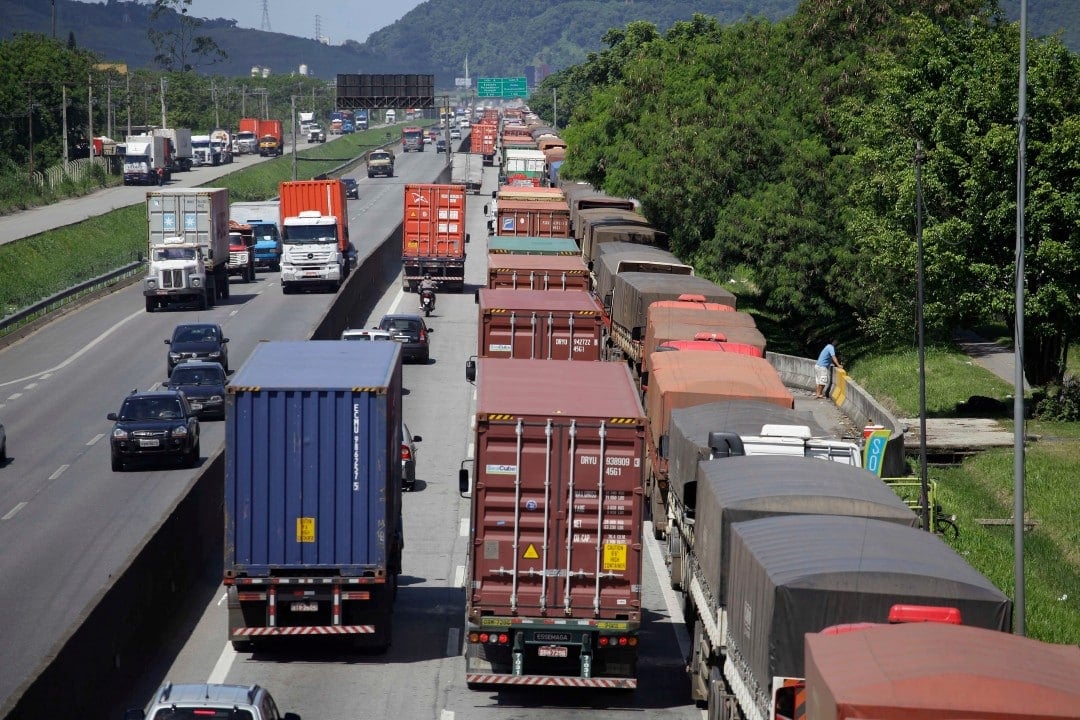
Truck driver leaders announced the beginning of a national strike this Thursday, December 4, 2025, in several regions of the country. The movement, articulated mainly by União Brasileira of the Caminhoneiros, seeks labor demands such as contractual stability and improvements in road infrastructure. The call takes place amid internal divisions in the category, but with legal support filed in Presidência of República.
Representatives such as Chicão Caminhoneiro, from União Brasileira from Caminhoneiros, and retired judge Sebastião Coelho confirmed the action in a video posted on social media. Eles emphasized that the strike will respect legality, focusing on sectoral demands.
The mobilization could affect cargo transport on federal roads, especially on Sudeste, where a large part of the autonomous fleet is concentrated.
- Main starting points include highways at São Paulo and Minas Gerais.
- Initial adoption is expected to be around 20% of the 1.2 million self-employed people.
- Support for associations such as Associação Catarinense of Transportadores Rodoviários of Cargas.
Internal divisions mark articulation of the strike
Entities representing the category expressed concerns about the lack of consensus for the strike. Federação of Caminhoneiros Autônomos of Cargas in Geral of Estado of Representantes highlight the absence of formal assemblies to approve demands.
For the president of Cooperativa of Caminhoneiros Autônomos of Porto of Santos, Marcelo Paz, decisions like this require broad dialogue and voting among workers. Ele warned that isolated actions could harm the category’s image.
Federal deputy Zé Trovão, linked to the sector, repudiated the initiative in a video, arguing that it does not address structural transport problems.
Central demands drive the movement
The strike agenda includes the review of the regulatory framework for cargo transportation to reduce bureaucracy. Caminhoneiros ask for contractual stability and effective compliance with labor laws.
Another demand involves the allocation of 30% of cargo from state-owned companies to self-employed people, aiming for greater competitiveness in the market.
Influencer Daniel Souza, with almost 100 thousand followers, reinforced the precariousness of the profession, citing low pay and insecurity on the roads.
- Special retirement after 25 years of proven contribution.
- Improvement in the condition of highways, with a reduction in potholes and rest areas.
- Limitation of axles for vehicles, changing current circulation rules.
These proposals differ from those of 2018, when the focus was on fuel prices, but maintain their sectoral nature.
Legal support guarantees legality of the action
Retired judge Sebastião Coelho committed to following the legal process of the strike. Ele stated that the movement has filed actions to ensure compliance with Constituição.
Chicão Caminhoneiro highlighted that the strike will respect the right to come and go, without total road blockages. The initiative began with a petition delivered to Planalto on Tuesday, December 2nd.
Analysts note that legal support can attract more supporters, avoiding immediate retaliation.
This structure aims to protect participants from sanctions, as provided for in labor legislation.
History of mobilizations influences expectations
The 2018 strike, which lasted ten days, caused fuel and food shortages in several regions. At the time, the federal government met demands such as diesel subsidies after intense negotiations.
Unlike that year, the current movement arises without a prior increase in fuel prices, but with accumulated dissatisfaction due to deficient infrastructure.
Leaders like Luciano Régis, from Santa Catarina, criticize the mix of political agendas in labor demands. Ele defended an exclusive focus on road transport.
The sector transports around 60% of cargo in the country, which amplifies the potential for logistical impact.
Possible effects on supply worry sectors
Broad compliance could interrupt the distribution of essential products in the early hours of December 4th. Postos of fuel and supermarkets monitor stocks to mitigate shortages.
Polícia Rodoviária Federal plans to reinforce patrols at strategic points to avoid obstructions. Especialistas estimate that initial blockages will occur in 40 national locations.
Industries dependent on daily inputs, such as the automotive industry, prepare contingencies for production lines.
- One-off increase in gasoline and diesel prices in affected areas.
- Delays in deliveries of medicines and perishable food.
- Pressure on ports to prioritize essential cargo.
Federal government monitors the scenario via ministries of Transportes and Economia.
Leaders ask for gradual and organized adherence
Chicão Caminhoneiro advised that the strike should begin by sector, with expansion depending on support. Ele expects unity from the base to press for quick responses.
Hemerson Galdim, from Fenttrocar, pointed out that the absence of decision-making rituals weakens the movement from the beginning.
Other representatives, such as Wallace Landim, demand caution to avoid harm to the category.
This sectoral approach aims to build momentum without immediate collapse in national logistics.
Political agendas generate controversies in the category
Some demands include amnesty for those convicted of the acts of January 8, 2023, which divides opinions. Luciano Régis classified this as an issue for the whole of society, not exclusive to truck drivers.
Tax reform appears as a banner to simplify taxes on the transport sector.
Chicão denied partisan bias, insisting on a labor focus, but the support of figures like Sebastião Coelho fuels debates.
The category, with 1.2 million self-employed people, seeks a balance between protest and economic sustainability.
Initial monitoring indicates low morning adherence
Until the early hours of this Thursday, federal highways recorded normal traffic without significant blockages. Polícia Rodoviária Federal reports the absence of mobilizations in Brasília and surrounding areas.
Posts on social media indicate that the strike may have started in a limited way, focusing on isolated points.
Analysts attribute this to internal divisions and a lack of unified calling by larger unions.
The day continues with the expectation of updates on possible stops on the Sudeste and Sul highways.