
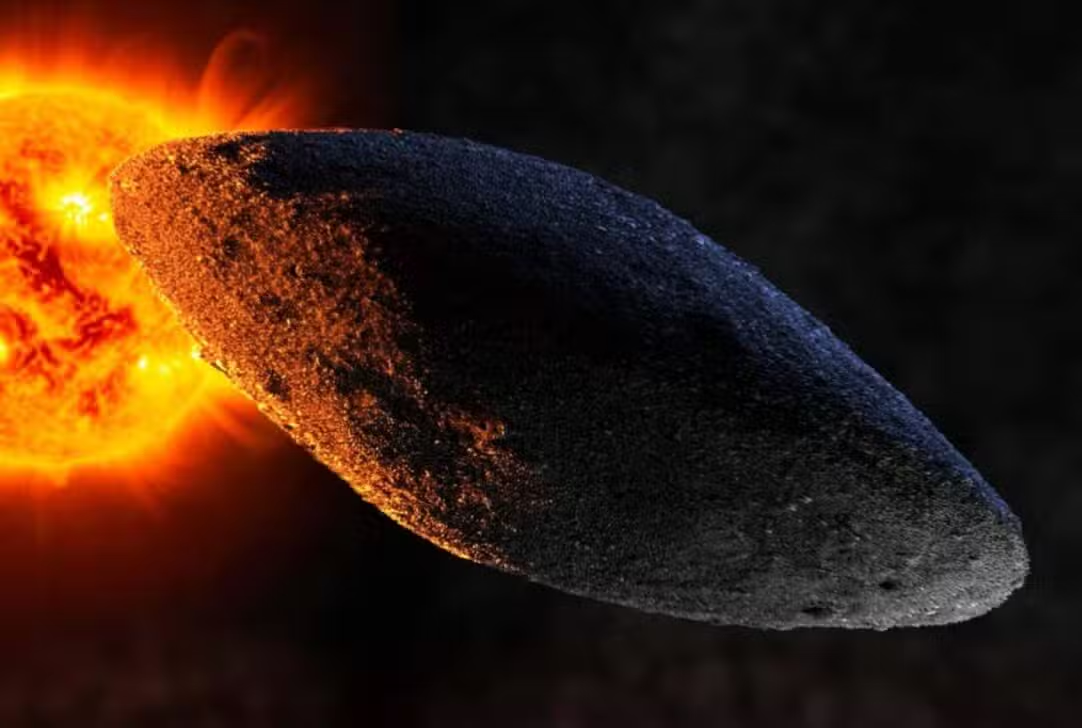
The interstellar comet 3I/Atlas, a discovery that has captured the attention of the scientific community, records an impressive speed of 57 kilometers per second as it passes through the solar system. Sua’s trajectory is classified as hyperbolic, a pattern that prevents it from being captured by the gravitational pull of Sol, ensuring that it does not enter orbit and continue its journey through interstellar space. Astrônomos, through advanced telescopic observations, confirmed its origin in another star system, significantly differentiating it from comets native to our system.
The passage of 3I/Atlas represents the third confirmation of an interstellar object ever observed in our system, following the precedents established by ‘Oumuamua and Borisov. Este type of event is crucial to understanding the formation and evolution of other planetary systems and the composition of the material that travels between stars.
The speed of 3I/Atlas is notably faster than its interstellar predecessors, highlighting the dynamic diversity of these cosmic visitors.
Origin and propulsion of interstellar visitors
Celestial bodies like 3I/Atlas often orbited distant stars in their home systems before being expelled into vast interstellar space. Essa expulsion can occur due to complex gravitational interactions, such as close encounters with giant planets or other stars, which give them the kinetic energy needed to escape.
These cosmic travelers can spend millions of years on their journey through space, crossing star systems like our solar system without ever having been gravitationally bound to Sol. Modern Telescópios are able to identify features that confirm its external nature, such as the absence of an elliptical orbit around Sol.
The dynamics of a hyperbolic trajectory
The hyperbolic trajectory is a clear indication that an object has a speed greater than the local escape velocity at a certain point in its cosmic journey. In the case of 3I/Atlas, this means that, upon entering the solar system, it is deflected by solar gravity, but its high speed prevents it from being captured in a closed orbit.
Sol’s gravity, although powerful, only changes the comet’s direction without slowing it enough to trap it. Esse type of interaction is a common phenomenon, but the magnitude of the 3I/Atlas velocity makes it a particular case of interest.
Precise calculations of the comet’s closest approach to Sol, known as perihelion, show that the gravitational interaction, although intense, lasts only a few days. Modelagens computational techniques are essential to simulate the exact effect of this gravitational “slingshot” on the object’s path.
Comparison with comets in the solar system
Comets that are native to the solar system can also reach speeds of tens of kilometers per second as they approach perihelion, the closest point to Sol in their orbits. However, these comets are gravitationally bound to Sol, following elliptical orbits that bring them back periodically.
The main distinction lies in the total orbital energy: while solar comets have negative energy (closed orbit), interstellar objects like 3I/Atlas have positive energy, allowing them to escape. Spectroscopy, a technique that analyzes the light emitted or absorbed by an object, is essential for studying the composition of these bodies and identifying the proportions of the chemical elements present.
Unusual accelerations and their causes
The interstellar object ‘Oumuamua, observed in 2017, showed unprecedented non-gravitational acceleration during its passage through the solar system. Essa acceleration was attributed to the release of gas resulting from solar heating, a process known as degassing.
When the heat from Sol reaches the surface of a comet, the ice sublimes, launching gas and dust into space, which can generate a small impulse, altering its trajectory in a subtle way. Hipóteses alternatives for ‘Oumuamua acceleration have been proposed, but degassing is the most accepted, although not fully proven for all cases.
Effect of gravitational interaction
3I/Atlas’s passage near Sol bends its path significantly, resulting in an angular acceleration that propels it out of the solar system. Observadores around the world monitor and refine orbital data in real time using a global network of telescopes.
The kinetic energy of 3I/Atlas prevails over the gravitational attraction of Sol. Esse object will maintain its perpetual motion through the cosmos, following a trajectory that will take it out of the solar system and back into interstellar space.
Chemical composition analysis
Spectroscopic studies carried out on interstellar objects reveal common elements found in different proportions in solar systems. Detailed analysis allows us to classify these bodies as truly interstellar, differentiating them from comets or asteroids formed in our own system.
High-resolution telescopes are able to capture the light spectra of these objects, which are then compared with known local material. Essa analysis helps understand formation conditions in other star systems and the chemical diversity of the universe.
The future of observing interstellar objects
The detection and study of interstellar objects like 3I/Atlas are vital to modern astrophysics. Eles offer a unique opportunity to examine material from other star systems without the need for interplanetary space missions.