
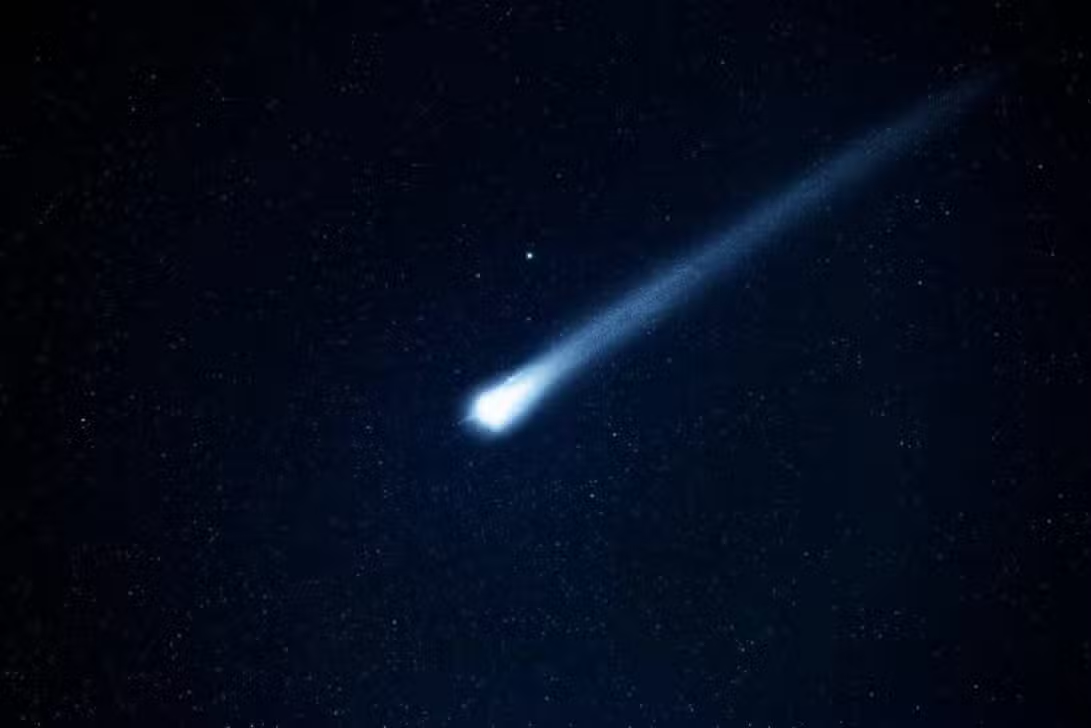
A celestial object of interstellar origin, identified as 3I/Atlas, is on its way through the solar system, traveling at a speed of 57 km/s. Este event confirms its provenance from outside our galaxy, offering a unique window into the distant universe.
The comet follows a hyperbolic trajectory, a characteristic that prevents it from being permanently captured by the gravity of Sol. Essa orbital dynamics ensure that 3I/Atlas will continue its journey through space after its brief visit.

Astronomers around the world are intensely monitoring the phenomenon, which marks the third officially recorded interstellar comet in the history of astronomical observation, following in the footsteps of Oumuamua and Borisov. The transition takes place in November 2025, mobilizing the scientific community.
Unraveling the cosmic origin of 3I/Atlas
The discovery of 3I/Atlas and its subsequent classification as an interstellar object represent a milestone in modern astrophysics. Telescópios advanced scientists were crucial in identifying the comet’s unique characteristics, which distinguish it from objects formed within our solar system.
Preliminary spectroscopic analyzes of 3I/Atlas have begun to reveal clues about its composition and original environment. Esses data is fundamental to understanding the conditions of planetary formation in stellar systems beyond our own, indicating variations in the proportions of elements.
Scientists estimate that 3I/Atlas traveled through interstellar space for millions of years, likely after being expelled from its home star system by gravitational interactions or large-scale cosmic events. Sua journey here is a testament to galactic dynamics.
The dynamics of a hyperbolic trajectory
The hyperbolic trajectory of 3I/Atlas is a crucial aspect that defines its behavior within the solar system. Diferentemente of the comets orbiting Sol, the velocity of 3I/Atlas is consistently greater than the gravitational escape velocity at each point along its route.
Although the gravity of Sol exerts a significant influence on the comet, diverting its course, it is not enough to trap it in a closed orbit. Essa gravitational interaction acts like a “slingshot”, changing the comet’s direction, but not its traveling nature.
Advanced computational models are employed to accurately predict the path of the 3I/Atlas. Esses calculations are continually updated as new observations are made, ensuring the accuracy of projections about your passage and eventual exit.
The “gravitational slingshot” phenomenon is well known in space exploration, used to propel probes on long-range missions. In the case of 3I/Atlas, nature uses it to propel the comet out of the solar system, back into deep space.
Global observation and technological advances
The passage of 3I/Atlas mobilized a global network of observatories and telescopes, both terrestrial and space-based. High-sensitivity Instrumentos are being used to capture as much data as possible, from high-resolution images to detailed spectra.
Real-time monitoring techniques allow for continuous refinement of the comet’s orbital data. The kinetic energy of 3I/Atlas, inherited from its interstellar travel, exceeds solar attraction, confirming its nature as an object not linked to our system.
Lessons from past interstellar comets
3I/Atlas joins a select list of detected interstellar objects, which includes Oumuamua, observed in 2017, and Borisov, in 2019. Cada, one of these cosmic visitors, brought with it valuable information and defied scientists’ expectations.
Oumuamua, the first confirmed interstellar object, exhibited anomalous acceleration that puzzled the scientific community, suggesting the release of invisible gases or other unusual properties. Borisov, in turn, was the first interstellar comet to display a tail, confirming its cometary nature. 3I/Atlas offers the opportunity to compare its characteristics with these precedents, deepening understanding of the diversity and origin of objects in other stellar systems, with observations from 2025 being crucial.
The chemical composition of 3I/Atlas
The analysis of the chemical composition of 3I/Atlas is one of the main focuses of the studies. The proportions of elements and molecules identified are different from those found in comets that formed within our own solar system, such as those of Nuvem and Oort.
These differences in chemical composition serve as fingerprints of their star system of origin. Elas provide valuable information about primordial conditions, the abundance of heavy elements, and the formation processes of planets and comets in other regions of the galaxy.
Scientific impact of the passage
The passage of 3I/Atlas represents a unique opportunity to deepen knowledge about astrophysics and the formation of stellar systems. Cada collected data contributes to the construction of a more complete panorama of cosmic diversity.
Observing these interstellar objects allows scientists to test theories about the ejection of planetesimals from young star systems and the distribution of matter in the universe. Eles are, in essence, direct samples of other worlds, accessible without the need for intergalactic travel.
Perspectives for future discoveries
The detection of a third interstellar comet in such a short time suggests that these objects may be more common than previously thought. Advances in telescope technology and the dedication of the astronomical community promise new discoveries in the coming years.