

Telescópio Espacial Hubble recorded new images of the interstellar comet 3I/ATLAS on November 30, revealing an intense outgassing. Este celestial object, the third confirmed interstellar visitor to our Sistema Solar, displays a distinct blue glow in its coma, the gaseous cloud that surrounds its core.
The observation, carried out by wide-field camera 3, occurred while the comet was at a distance of 286 million kilometers from Terra. Agências spacecraft such as NASA and ESA have coordinated efforts to monitor its trajectory and composition since its July 1 discovery at Chile.

The comet’s activity, heightened by the recent approach of Sol on October 30, allows scientists to collect crucial data. The detailed analyzes aim to understand the formation and evolution of objects outside our system, before 3I/ATLAS makes its closest pass to Terra on December 19.
The first records already indicate notable characteristics:
- The blue glow in the coma suggests the release of gases such as carbon dioxide and methane.
- Background stars appear as dashes, highlighting the comet’s rapid hyperbolic motion.
- Preliminary estimates point to a core diameter ranging between 440 meters and 5.6 kilometers.
[[_0]
Detailed observations of Hubble and Juice
Telescópio Espacial Hubble, with its high-resolution capabilities, provided crucial details about the morphology of the 3I/ATLAS coma. The observed bluish glow not only confirms the presence of volatile molecules, but also allows researchers to map the distribution of these gases as the comet moves through interplanetary space. The accuracy of the Hubble data is critical for modeling the sublimation rate and tail evolution.
At the same time, the Juice probe, Agência Espacial Europeia, contributed valuable captures on November 2, at a distance of 66 million kilometers from the comet. Although its navigation camera was not optimized for scientific purposes, it recorded the structure of the coma and signs of two tails — one of gas and the other of dust. Cinco scientific instruments aboard Juice have collected data on the movement and chemical composition of 3I/ATLAS, with full transmission of these results expected in February 2026.
Analysis of the chemical composition of 3I/ATLAS
Spectral analyzes performed by the Atacama Large Millimeter/submillimeter Array (ALMA), on Chile, detected high levels of hydrogen cyanide (HCN) and methanol on comet 3I/ATLAS. The presence of these compounds in concentrations significantly above the average found in comets originating from our Sistema Solar suggests a provenance from distinct stellar systems, offering clues about the chemical conditions of their initial formation.
The red glow observed in the comet’s coma also points to the presence of carbon-rich dust. The Esta feature is similar to the composition of primitive chondrites found in our own system, indicating that 3I/ATLAS may have formed in an environment rich in organic materials, preserving a “time capsule” of its home star system.
Combining this chemical data allows scientists to reconstruct a more complete profile of the comet’s internal composition. The abundance of volatile elements and the nature of the dust are direct indicators of the environment in which the object consolidated, providing unprecedented information about the chemical diversity present in other regions of the galaxy.
Trajectory and visibility of the interstellar visitor
Comet 3I/ATLAS follows a well-defined hyperbolic orbit, moving at a speed of approximately 30 kilometers per second. Após its passage through perihelion, the closest point to Sol, the object will continue its journey, definitively leaving Sistema Solar and returning to interstellar space.
On December 19, 3I/ATLAS will reach its closest proximity to Terra, at a safe distance of 269 million kilometers. Não there is no risk of collision, and the passage offers a unique opportunity for detailed observations without the worry of impacts.
The comet is currently visible in the constellations of Virgem and Leão, with a magnitude of 11.5 on December 6. Essa luminosity allows amateur astronomers with medium-sized telescopes to detect it, although observation requires suitable equipment and dark sky conditions.
Ground-based observations will continue until January, when the comet will reach opposition, making its detection even easier from Terra. Esta extended window is crucial to collect as much data as possible before 3I/ATLAS becomes too faint to observe.
Cryovolcanic activity and gas jets
Images captured by Telescópio Joan Oró, located at Montsec, Espanha, between November 22 and 27, revealed surprising cryovolcanic activity on the surface of 3I/ATLAS. Foram identified eruptions of spiral jets of gas and dust, a phenomenon that indicates the sublimation of dry ice at multiple points in the comet’s nucleus. The high resolution of the images made it possible to identify several active structures simultaneously, an unprecedented behavior for interstellar objects observed until then. Esses events provide important parallels with icy bodies of the outer Sistema Solar, such as the moon Encélado of Saturno, which also displays plumes of ice and water vapor, suggesting similar internal mechanisms of activity.
Contributions from other space missions
Missions such as NASA’s PUNCH and STEREO recorded the comet incidentally between September and October. Essas complementary observations to those of Hubble showed tail elongations and ultraviolet emissions, providing a more comprehensive view of 3I/ATLAS’s interaction with solar wind and radiation.
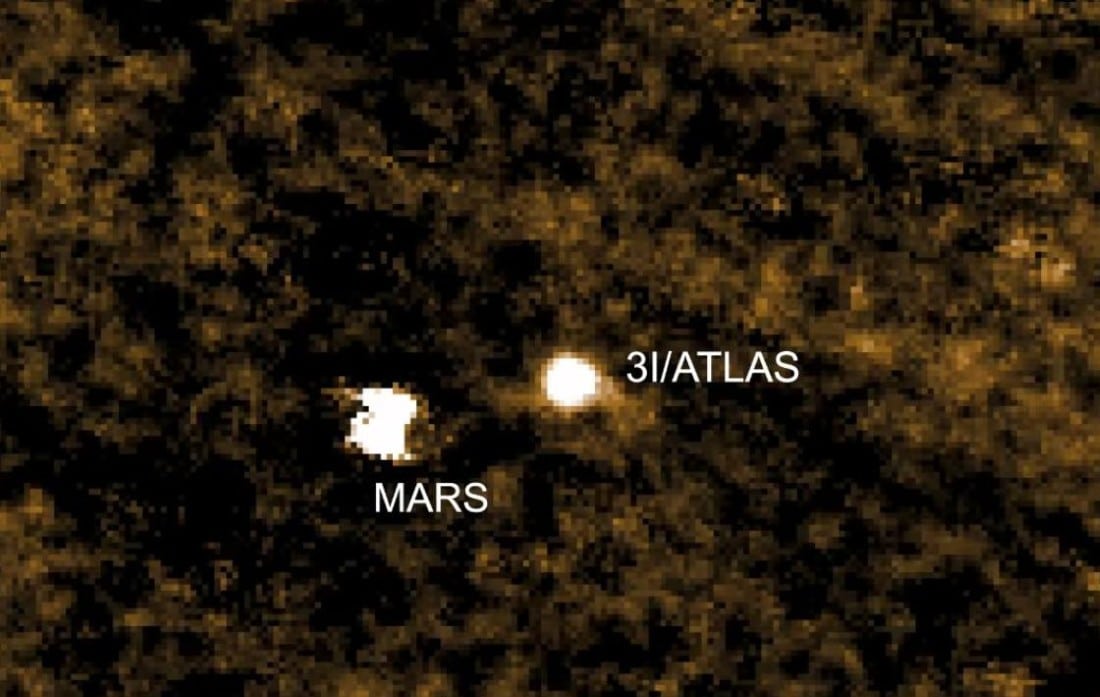
The object also passed within 29 million kilometers of Marte on October 3, allowing the space agency’s local orbiters to obtain additional views. Dados Preliminaries from these sources indicate significant mass loss rates, up to 60 kilograms of dust per second, underlining the intensity of their activity.
Debates about the origin and classification of the object
Recent studies, submitted to the EGUsphere platform, raise questions about the classification of 3I/ATLAS as a traditional comet. Pesquisadores propose a more complex origin, suggesting that the object may be a rocky fragment that underwent intense processes in its home star system, rather than a typical icy comet.
The Hubble data from November 30, for example, shows deviations in its brightness and acceleration that cannot be fully explained by simple ice sublimation alone. Além In addition, spectra obtained by the Very Large Telescope (VLT) detected pure nickel at levels 11 times above solar, without the associated presence of iron, an unusual chemical profile that challenges conventional theories about comet formation. Modelos indicate the possibility that it is a fragment of high-density interstellar crust, capable of surviving billions of years of cosmic travel.
Scientific implications for the future of astronomy
The passage of 3I/ATLAS offers an unprecedented scientific window to model the ejection of dust and gases in planetary formation processes outside our solar system. International collaborations continually expand datasets, refining the trajectories and compositions of these enigmatic objects. Este comet acts as a cosmic time capsule, preserving the chemistry of distant regions of the galaxy.
Preparations for future space interceptions
Agência Espacial Europeia (ESA) is already planning the Comet Interceptor mission, which envisions future launches to study dynamically new comets and potentially interstellar objects. The criteria for target selection include a delta-v (speed variation) of 1.5 km/s and relative speeds below 70 km/s, ensuring the safety and feasibility of interception.
Analysis of 125 years of historical data identified just three viable candidates among 132 known long-period comets, highlighting the rarity of ideal targets. The expectation is that the future Vera C. Rubin telescope will significantly increase detections, increasing the chances of finding more interstellar objects suitable for interception missions.