

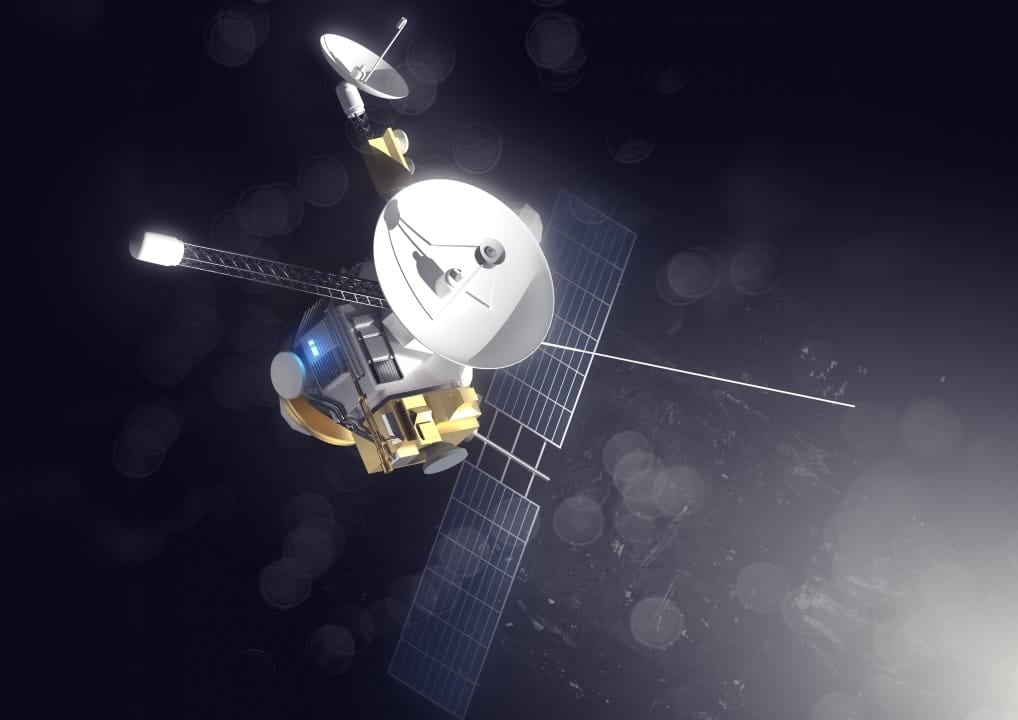
The Juice probe, Agência Espacial Europeia, recorded partial images of the interstellar comet 3I/ATLAS on November 2, 2025, revealing a bright gas halo and evidence of two distinct tails.
These observations occurred about 66 million kilometers away, just before closest approach, when the object was near the hottest point in its orbit after perihelion in October.
Preliminary data indicate active release of material from the core, driven by solar radiation, which allows initial analyzes of interactions with the Sistema Solar environment.
- Plasma tail formed by ionized gas, extending in the opposite direction to Sol;
- More diffuse dust tail, suggesting dispersion of solid particles in the corner of the image;
- It appears as a luminous envelope around the nucleus, with an estimated diameter of between 440 meters and 5.6 kilometers.
Details of the observed structures
The partial image, which represents just a quarter of the full record, highlights the coma as clear evidence of sublimation of volatiles under solar heat.
This formation occurs when the ice in the core turns into gas, creating a temporary atmosphere that reflects light and forms the visible halo.
A minor digital error affected peripheral edges, but did not interfere with the identification of main features.
https://twitter.com/esa/status/1996612996580384998?ref_src=twsrc%5EtfwInstruments activated during the flyover
Various equipment from Juice was activated to collect additional information about 3I/ATLAS.
The JANUS instrument captured high-resolution images of the nucleus and coma, allowing precise measurements of size and shape.
MAJIS and UVS carried out spectrometry to map the chemical composition of the gases released, including possible traces of hydrogen cyanide and methanol detected in terrestrial observations.
SWI measured thermal variations, while PEP analyzed emitted particles, recording interactions with the solar wind at a relative speed of 61 km/s.
Full transmission faces limitations due to the smaller antenna in use, which prioritizes the probe’s thermal shield.
Additional observations from other missions
Telescópio Espacial Hubble, in collaboration with NASA and ESA, acquired images on November 30, 2025, showing a teardrop-shaped coma with dust extension facing Sol.
These recordings, made with the Wide Field Camera 3, reveal a blue glow in the coma, the result of the sublimation of materials under prolonged exposure.
The SOHO mission, positioned at the point of Lagrange L1, identified the comet in coronal observations, contributing to more than 5 thousand historical detections of similar objects.
Rovers on Marte and solar orbiters such as STEREO and PUNCH have also repurposed instruments, improving the predicted trajectory by a factor of 10 via data from ExoMars Trace Gas Orbiter.
Preliminary analysis of chemical composition
The activity of 3I/ATLAS suggests a core rich in organic compounds, with constant release without detected outbreaks until August 2025.
TESS observations indicate that the coma may have started in May, 6.4 astronomical units from Sol, before the official discovery in July by the ATLAS telescope at Chile.
Initial spectroscopy points to the presence of water, carbon dioxide and carbon monoxide, common elements in interstellar comets.
These findings reinforce the object’s role as a time capsule for distant regions of the galaxy, with an entry speed of 61 km/s relative to Sol.
Expectations for data transmission
The complete files from Juice will arrive at Terra in February 2026, allowing full reconstruction of the 1,000 by 1,000 pixel image.
This delay results from the reduced sending rate by NavCam, which is designed for navigation rather than massive downlink.
Meanwhile, James Webb Space Telescope plans spectral contributions in the coming weeks, focusing on dust ejection and planetary formation modeling.
The shortest distance to Terra will occur on December 19, 2025, at 269 million kilometers, without risk of impact.
Contributions to interstellar studies
3I/ATLAS, the third confirmed object outside of Sistema Solar, offers references for future missions like ESA’s Comet Interceptor.
Their multifaceted tails, including a larger-grained antitail, demonstrate deflection by solar wind and radiation pressure.
Astronomers coordinate global monitoring, refining orbits and compositions to predict annual detections with telescopes like Vera C. Rubin.
These observations expand data sets, validating models of dust ejection in distant planetary formations.
Chronology of main detections
The comet was initially seen on July 1, 2025, on the border of the constellations Serpens Cauda and Sagittarius.
In October, it went through perihelion, intensifying the release of material and allowing records of missions such as Tianwen-1 and China.
November brought images of Juice and Hubble, highlighting complex structures such as multiple jets and elongated coma.
December marks the exit phase, focusing on the post-perihelion trajectory and environmental interactions.