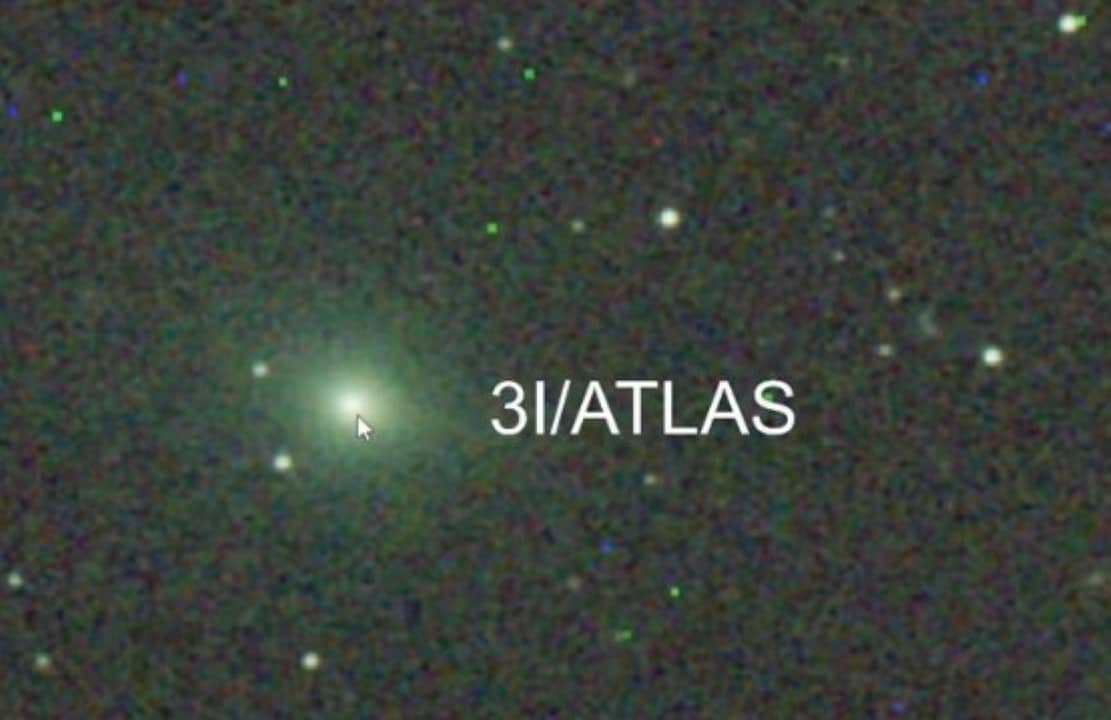
The Japanese XRISM telescope detected X-ray signals in the interstellar comet 3I/Atlas during a campaign carried out between November 26 and 28, 2025. The observation occurred when the object was in the constellation of Virgem and could be safely monitored. Trata is the first time that a comet coming from outside Sistema Solar presents this type of emission.
The Japanese space agency JAXA mission took advantage of the visibility window to collect 17 hours of data with the Xtend instrument. The comet, the third confirmed interstellar visitor, was identified in July 2025 and offers a unique chance to study materials formed in another star system.
Preliminary results show a faint glow distributed in an area of around 400,000 kilometers around the nucleus. The diffuse structure suggests interaction between gas released by the comet and the solar wind.
Campaign required constant adjustments
The operation required detailed planning because XRISM cannot point closer than 60 degrees to Sol. Durante over the three days, the team carried out 14 repositionings of the satellite to keep the comet in the center of the field of view.
The Xtend instrument covers a region equivalent to around 3 million square kilometers. Essa capacity allowed recording the extent of the detected emission.
First detection of an interstellar comet
To date, neither of the two previous interstellar comets has emitted X-rays. 1I/ʻOumuamua, discovered in 2017, and 2I/Borisov, identified in 2019, did not show this phenomenon.
The presence of X-rays indicates that 3I/Atlas has an icy core capable of releasing gas as it approaches Sol. The process follows the pattern observed in Sistema Solar comets.

Emission mechanism identified
The radiation arises from the charge exchange reaction between ions from the solar wind and neutral atoms from the comet’s coma. Quando ions capture electrons, emit X-rays when returning to the ground state.
- The emission extends for approximately 400 thousand kilometers
- The structure appears diffuse and larger than expected only due to instrumental limitations
- Brightness remains dim but consistent throughout exposure
This pattern reinforces that the comet contains volatiles similar to those found in Sistema Solar objects.
Characteristics of the instrument Xtend
The Xtend operates in the soft X-ray range and has a wide field of view. Essas characteristics make it possible to observe extensive phenomena such as comet comas.
The spatial resolution of the instrument made it possible to distinguish distributed emission from the cosmic background. The raw data was quickly processed to confirm the initial detection.
Comparison with solar comets
Comets from Sistema Solar have emitted X-rays since the 1990s. Observações with missions such as ROSAT and Chandra established the charge exchange mechanism as the main culprit.
The difference lies in the origin of the material. In the case of 3I/Atlas, the volatile compounds were formed in a stellar environment different from ours.
The observed phenomenon reinforces chemical similarities between comets from different systems. The presence of ice and the capacity for sublimation indicate common processes in planetary formation.
Next steps of the analysis
The complete data still undergoes detailed calibration. The team plans to publish refined results in the coming weeks.
Complementary observations at other wavelengths remain active. Telescópios terrestrial and space scientists follow the evolution of the coma as the comet moves away from Sol.
The detection paves the way for deeper studies of interstellar composition. Futuros visitors could be priority targets for X-ray missions.
The Japanese XRISM telescope detected X-ray signals in the interstellar comet 3I/Atlas during a campaign carried out between November 26 and 28, 2025. The observation occurred when the object was in the constellation of Virgem and could be safely monitored. Trata is the first time that a comet coming from outside Sistema Solar presents this type of emission.
The Japanese space agency JAXA mission took advantage of the visibility window to collect 17 hours of data with the Xtend instrument. The comet, the third confirmed interstellar visitor, was identified in July 2025 and offers a unique chance to study materials formed in another star system.
Preliminary results show a faint glow distributed in an area of around 400,000 kilometers around the nucleus. The diffuse structure suggests interaction between gas released by the comet and the solar wind.
Campaign required constant adjustments
The operation required detailed planning because XRISM cannot point closer than 60 degrees to Sol. Durante over the three days, the team carried out 14 repositionings of the satellite to keep the comet in the center of the field of view.
The Xtend instrument covers a region equivalent to around 3 million square kilometers. Essa capacity allowed recording the extent of the detected emission.
First detection of an interstellar comet
To date, neither of the two previous interstellar comets has emitted X-rays. 1I/ʻOumuamua, discovered in 2017, and 2I/Borisov, identified in 2019, did not show this phenomenon.
The presence of X-rays indicates that 3I/Atlas has an icy core capable of releasing gas as it approaches Sol. The process follows the pattern observed in Sistema Solar comets.
Emission mechanism identified
The radiation arises from the charge exchange reaction between ions from the solar wind and neutral atoms from the comet’s coma. Quando ions capture electrons, emit X-rays when returning to the ground state.
- The emission extends for approximately 400 thousand kilometers
- The structure appears diffuse and larger than expected only due to instrumental limitations
- Brightness remains dim but consistent throughout exposure
This pattern reinforces that the comet contains volatiles similar to those found in Sistema Solar objects.
Characteristics of the instrument Xtend
The Xtend operates in the soft X-ray range and has a wide field of view. Essas characteristics make it possible to observe extensive phenomena such as comet comas.
The spatial resolution of the instrument made it possible to distinguish distributed emission from the cosmic background. The raw data was quickly processed to confirm the initial detection.
Comparison with solar comets
Comets from Sistema Solar have emitted X-rays since the 1990s. Observações with missions such as ROSAT and Chandra established the charge exchange mechanism as the main culprit.
The difference lies in the origin of the material. In the case of 3I/Atlas, the volatile compounds were formed in a stellar environment different from ours.
The observed phenomenon reinforces chemical similarities between comets from different systems. The presence of ice and the capacity for sublimation indicate common processes in planetary formation.
Next steps of the analysis
The complete data still undergoes detailed calibration. The team plans to publish refined results in the coming weeks.
Complementary observations at other wavelengths remain active. Telescópios terrestrial and space scientists follow the evolution of the coma as the comet moves away from Sol.
The detection paves the way for deeper studies of interstellar composition. Futuros visitors could be priority targets for X-ray missions.
