

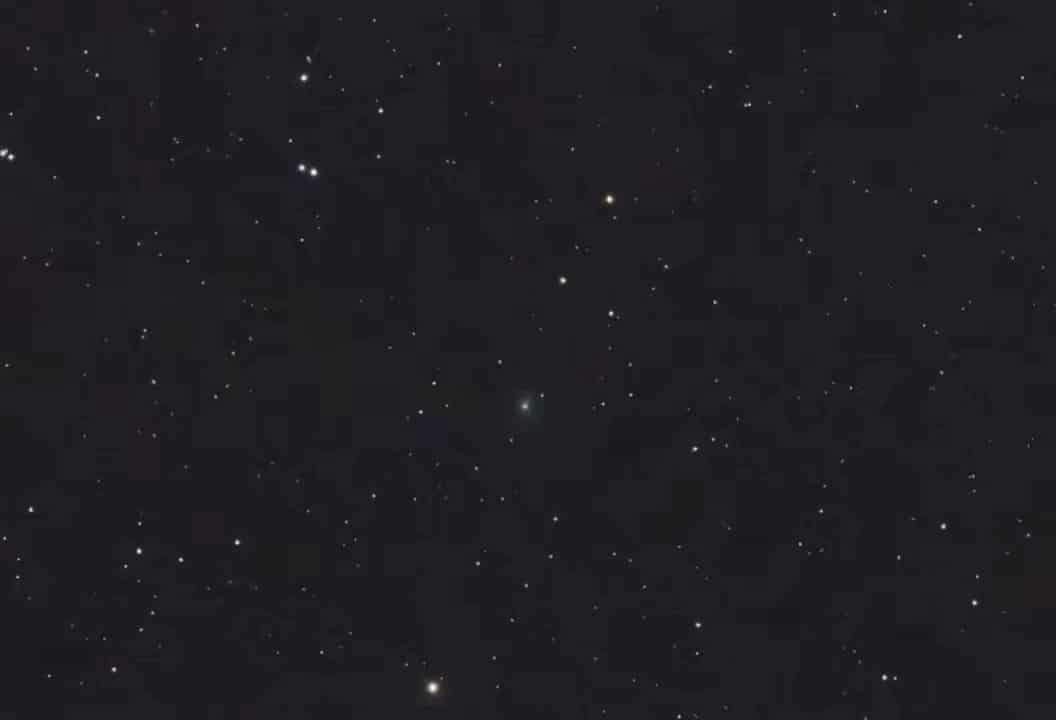
The interstellar comet 3I/ATLAS, detected in July 2025 by the ATLAS system in Chile, passes through the inner Sistema Solar at high speed. NASA’s Astrônomos and Agência Espacial Europeia monitor the object, the third confirmed to have an origin outside our galaxy. Sua passage offers valuable data on planet formation in other star systems.
On December 19, the comet will reach a minimum distance of 170 million kilometers from Terra, without posing a threat. Recent Observações, including images from the Hubble telescope, highlight their active coma and elongated tails.
The discovery occurred when the comet was 420 million kilometers from Terra, moving at 221 thousand kilometers per hour. Sua hyperbolic trajectory confirmed the interstellar origin, similar to the cases of 1I/Oumuamua in 2017 and 2I/Borisov in 2019.
- Average speed: 221,000 km/h upon entering the Júpiter orbit.
- Estimated core diameter: between 440 meters and 5.6 kilometers.
- Initial activity detected: possibly in May 2025, at 6.4 astronomical units from Sol.
Initial discovery and confirmation
The ATLAS system, funded by NASA and operated by Universidade of Havaí, identified the comet on July 1, 2025, at the Río Hurtado observatory. Inicialmente classified as a possible asteroid, subsequent observations revealed a coma and tail, confirming its cometary nature on July 2.
Ground-based telescopes, such as the Deep Random Survey at Chile and the Canada-France-Hawaii at Mauna Kea, have captured three-arcsecond stretches in the tail. The Nordic Optical Telescope verified the diffuse, active appearance, with a reddish color in the coma, indicative of dust.
Astronomers noted that the late detection was due to it passing in front of the dense galactic center, making viewing difficult.
Initial forecasts used data from June, extending backward observations. The designation 3I reflects its position as the third interstellar object.
New images from 3I/ATLAS. Hubble has recently observed the interstellar comet 3I/ATLAS, this time using its instrument Wide Field Camera 3 when it was 286 million kilometers away from Tierra.pic.twitter.com/NGno1zjVJ1
—Doctor Fisión (@doctorfision)December 6, 2025
Monitoring by space missions
NASA mobilized 12 space assets to track 3I/ATLAS, including Hubble, which photographed the comet on July 21 from 220 million miles away. On November 30, a new image showed the object 286 million kilometers away, with stars streaked by the movement.
ESA’s Juice probe, heading to Júpiter, used five instruments and its NavCam in November, 66 million kilometers away, recording tails of plasma and dust. Mars Reconnaissance Orbiter captured the comet on October 2, 29.9 million kilometers from Marte.
The Perseverance rover paused explorations at Marte to image with Mastcam-Z on October 4, while MAVEN detected the coma on October 9.
- Hubble: Imagens from July and November, focusing on nucleus and teardrop-shaped dust.
- Psyche: Quatro observations in September, 53 million kilometers away.
- Lucy: Superposição of images on September 16th, next to Marte.
- SOHO: Vislumbre in October, despite solar proximity.
Physical characteristics and composition
The comet displays an extensive coma of gas and dust, with two tails: one of ionized plasma and the other of solid particles. At perihelion, on October 30 at 1.4 astronomical units of Sol, activity increased, releasing gases at high rates.
SPHEREx analyzes between August 7 and 15 identified water ice, carbon dioxide and methanol in high proportions. Methanol production reaches 40 kilograms per second, four times higher than local comets, suggesting a nucleus rich in volatiles.
Studies indicate a CO2-water ratio of 1.4, similar to solar objects, but with abundant CO2, possibly limiting water sublimation. The reddish color of the coma evolved in July, indicating superficial changes.
The core could be up to 7 billion years old if it originated from the thick disk of Via Láctea, older than Sistema Solar.
Observations from ground-based and orbital telescopes
Telescopes like Gemini South in Chile recorded the active phase in October, with elongated tails. The James Webb Space Telescope analyzed the chemical structure, detecting organic molecules such as hydrogen cyanide in low quantities.
In October, Marte orbiters, including ExoMars Trace Gas Orbiter and Mars Express, triangulated data with ground-based telescopes, improving orbital precision by a factor of 10. Trace Gas Orbiter captured images, while Mars Express used short exposures.
NASA’s STEREO observed from September 11 to October 2, tracking the solar passage. Observações remain visible until September 2025 for ground-based telescopes, reappearing in December.
The IAWN campaign, activated in November, coordinates global tracking from November 27, 2025 to January 27, 2026, testing planetary defenses despite the absence of risk.
Importance for interstellar studies
3I/ATLAS provides insights into chemistry in distant systems, with emissions from prebiotic molecules like methanol suggesting galactic diversity. Sua stability, without explosions until August, contrasts with 2I/Borisov, which fragmented.
Spanish astronomers have detected possible ice volcanoes in the core, a “lost clue” to understanding cryovolcanoes in comets. Dados and Juice will be released in February 2026, mapping the exit of Sistema Solar.
ESA’s Comet Interceptor mission, launched in 2029, aims to intercept similar objects, using 3I/ATLAS as a test case. Observações reinforce early detection via ATLAS, expanding the catalog of interstellar visitors.
Trajectory and upcoming events
The comet tracks out of Sistema Solar after perihelion, briefly invisible behind Sol. In December, space telescopes like Hubble will continue monitoring, capturing its decrease in brightness.
The speed of 60 kilometers per second maintains a safe distance, 1.8 astronomical units from Terra. Previsões indicate permanent interstellar exit, with no return.
Updates from NASA and ESA include FAQs on official websites, with trajectory animations. The passage reinforces international collaborations in astrometry.



