Astronomers detected the 3I/ATLAS object on July 1, 2025, by the ATLAS telescope at Chile. Esse visitor comes from outside of Sistema Solar and represents the third confirmed case of such a phenomenon. The hyperbolic trajectory confirms its interstellar origin, with an initial speed of 58 km/s in relation to Sol.
The composition reveals a coma dominated by carbon dioxide, eight times higher than the water vapor typical in comets. Observações of Telescópio Espacial James Webb identified elevated levels of nickel on the surface. Esses traces suggest formation in a distant stellar environment, possibly older than our Sistema Solar.
The object reached perihelion on October 29, 2025, about 1.5 AU from Sol, with no fragmentation observed. NASA’s Missões, like MAVEN orbiting Marte, captured ultraviolet images of the coma in September. The closest passage of Terra occurred on December 19, 2025, 270 million km away.
- Composition: Alta in CO2 and nickel, with detection of methanol and hydrogen cyanide.
- Speed: Acelera to 61 km/s post-perihelion, heading to Júpiter in March 2026.
- Observations: ESA’s Hubble and JUICE recorded symmetrical coma and frontal jets of up to 1 million km.
Trajectory and speed defy expectations
3I/ATLAS follows an open orbit, with an eccentricity greater than 6, greater than that of 1I/ʻOumuamua (1.2) and 2I/Borisov (3.4). Essa characteristic prevents gravitational capture by Sol.
It originates from the direction of Sagitário, close to the galactic center, and will head towards Gêmeos after meeting with Júpiter. The Juno probe will take a closer look on March 16, 2026, from 50 million km.
Initial discovery by the ATLAS system
The ATLAS telescope, part of NASA’s planetary defense network, spotted the object 670 million km from Sol, in the orbit of Júpiter. Inicialmente classified as an asteroid, subsequent observations revealed marginal coma and tail elongation on July 2.
Confirmed as interstellar by Minor Planet Center, the name 3I/ATLAS reflects its position as the third such object. Amadores and professionals, including Telescópio Canadá-França-Hawaii, contributed initial data.
Early detection allowed continued tracking, with Zwicky Transient Facility providing images from June 2025. Esses backward recordings refined the hyperbolic orbit.
With no signs of explosive activity, the object maintained a stable brightness, unlike comets like 73P/Schwassmann-Wachmann 3.
Chemical characteristics reveal distant origins
Spectral analyzes of the James Webb detected methanol and hydrogen cyanide at high levels, components relevant to organic chemistry. Esses gases sublimated during the solar approach, forming a coma of 5 billion tons per month.
The predominance of CO2 suggests formation in a cold protoplanetary disk, possibly 7 billion years ago. Interstellar Radiação may have altered the surface, enriching it with nickel.
Comparisons with 2I/Borisov show similarities, but 3I/ATLAS exhibits more uniform coma gradient, without mixed spectral variations.
Observations from space missions on multiple platforms
The Psyche spacecraft captured four images on September 8 and 9, 2025, at 53 million km, refining the trajectory. Lucy, at 386 million km, recorded a coma and tail on September 16.
Telescópio Hubble observed on July 21 and November 30, revealing a weak east-pointing tail driven by solar radiation pressure. ESA’s JUICE photographed on November 2, confirming coma without irregularities.
This data, from more than 20 instruments, rules out threats to Terra and focuses on composition. NASA’s PUNCH mission monitored passage through the heliochromospheric system.
International collaboration, including Observatório ALMA, has expanded the scope for early radio emissions.
Nature debate: comet or something more?
Professor Avi Loeb, from Harvard, questions the classification as a pure comet, citing rotational stability and symmetrical jets. Seu Projeto Galileo, started in 2021, searches for unidentified phenomena, similar to ʻOumuamua’s analysis in 2017.
Loeb proposes that anomalies, such as the absence of detectable torques, occur in 1 in every 500 active comets. Ele escalated the case as level 4 in its potential artifacts metric.
Scientists like Jason Wright, from Penn State, advocate natural origin, attributing stability to low torque efficiency. Estudos in 2010 A&A corroborates minimal variations in similar comets.
NASA concluded in a November 2025 briefing that traces are consistent with an interstellar comet, without evidence of technology.
Implications for studying exoplanets
3I/ATLAS offers a window into the chemistry of remote stellar systems, with its estimated age surpassing that of Sol. Detecções of organic precursors suggest conditions for the formation of complex molecules.
Future missions like Comet Interceptor could intercept similar objects, expanding interstellar samples. The encounter with Júpiter in 2026 will test gravitational interactions.
These rare visitors, occurring every decade, improve models of ejection of material from natal discs.
Preliminary data indicate that 90% of comets show variable spins, but 3I/ATLAS remains stable, defying simulations.
Anomalies observed in recent images
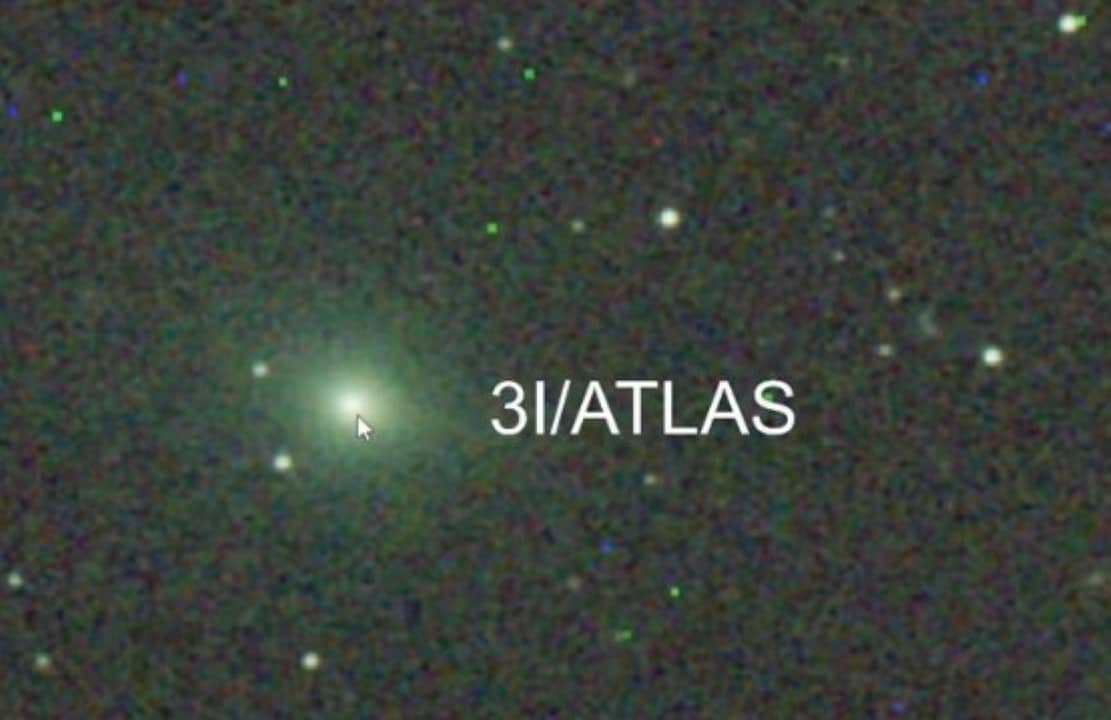
Photos from December 2, 2025, by amateur astrophotographers, show a symmetrical coma with no visible ionized tail. The nucleus appears punctual, like a star, in long exposures.
Uniform brightness gradient suggests absence of irregular jets, common in icy cores. Coloração homogeneous indicates consistent gaseous emissions.
These features differ from long-period comets, approaching hypervolatile bodies. The solar anti-tail, possibly from fragments, reflects light directionally.
Preparations for future observations
The Juno probe will adjust instruments for flyby in March 2026, measuring non-gravitational accelerations. Telescópios terrestrials, like Vera Rubin, will track exits.
These final collections will clarify post-perihelion evolution, including possible flares. The IAWN network coordinates alerts for nearby objects.
The event reinforces the need for sensitive infrared telescopes for early detections.