

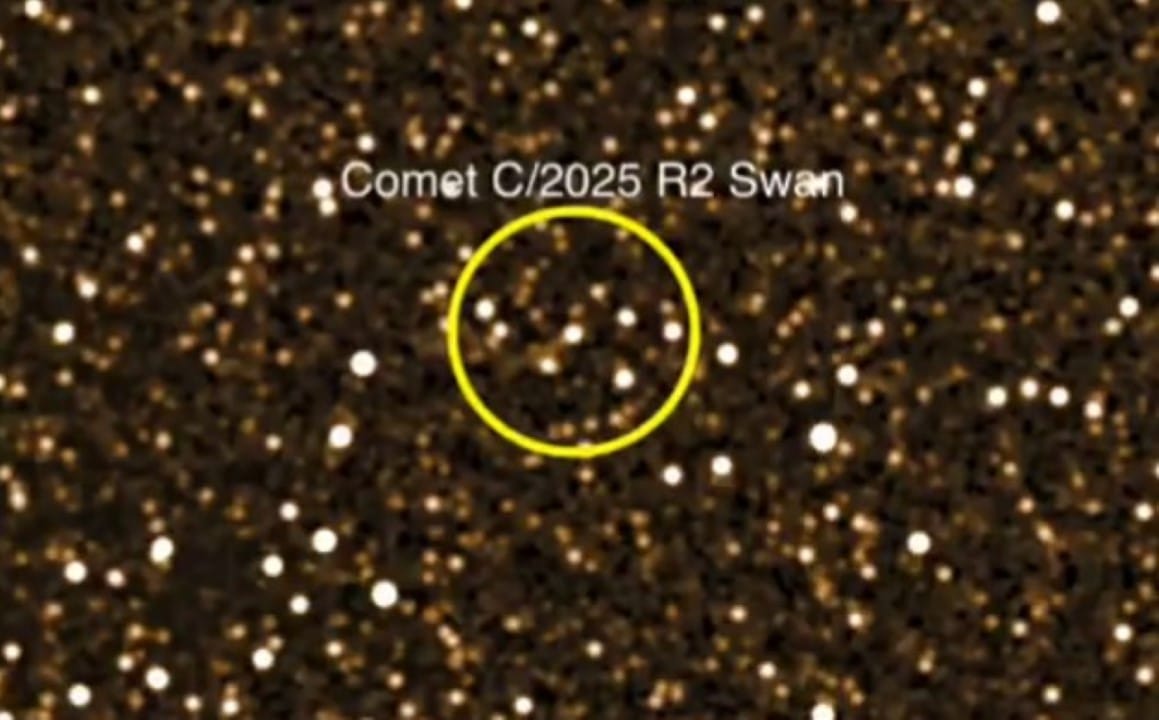
Comet C/2025 R2 (SWAN) was photographed in a rare position next to Pilares of Criação, in Nebulosa of Águia (M16), constellation of Serpens. The image was taken on October 17, 2025 by Italian astronomer Daniele Gasparri, in the desert of Atacama, Chile. The record highlights the comet’s intense green coma in contrast to the columns of gas and dust illuminated by young stars.
The visual proximity occurred just over a month after the comet’s perihelion, on September 12, 2025, when it still maintained high brightness.
How the image was captured
Daniele Gasparri used a 130 mm aperture Newtonian telescope. The final composition brought together 40 exposures of 120 seconds each, totaling almost 1h20 of integration.
Atacama’s sky conditions, with low turbulence and little light pollution, allowed fine details of the comet’s ionic tail and green coma to be recorded.
Characteristics of comet C/2025 R2 SWAN
The object was discovered on September 10, 2025 by Ukrainian amateur astronomer Vladimir Bezugly using images from the SWAN instrument, aboard the SOHO probe. The greenish color results from the presence of di-carbon gas (C2) and cyanogen excited by solar radiation.
The comet belongs to the long-period family and has an orbit inclined at approximately 90 degrees to the ecliptic plane. Sua The next passage through the interior of Sistema Solar is only scheduled for around 1,400 years from now.
1/4.☄️Hemos captured at Cometa C/2025 R2 (SWAN) from Observatorio to Teide.
— IAC Astrofísica (@IAC_Astrofisica)November 27, 2025
This cosmic journey has been in orbit for 800 years, and its last visit was in the XIII era! 🤯
📷Image from October 21st, highlighting its extensive and luminous color.
Credit: D. López and A. Rosenbergpic.twitter.com/Y0ukEiq6MU
The Pilares of the Criação in the center of the scene
The famous gas and dust columns of Nebulosa and Águia gained worldwide fame with the Telescópio Espacial Hubble image in 1995.
The structures are about 4 to 5 light-years long and house forming protostars within the denser columns. Ultraviolet radiation from nearby massive stars slowly erodes the material, sculpting the pillars over millions of years.
Observation with the naked eye and binoculars
During October 2025, comet SWAN reached magnitude close to 7.5, being at the limit of visibility with the naked eye in very dark places. With 10×50 binoculars or small telescopes, the green coma was easily identifiable.
Gasparri reported that the view through the telescope’s eyepiece was remarkable, with the comet crossing the star-rich field of Nebulosa and Águia. The event attracted attention from amateur astronomers across the Southern Hemisphere.
Current trajectory of the comet
After perihelion, C/2025 R2 SWAN heads towards aphelion, located at Nuvem of Oort. Atualmente, the comet is already beyond the orbit of Marte and continues to move away from Sol.
Its orbital speed gradually decreases as it approaches the outer region of Sistema Solar. Long-term Observações help refine orbit calculations and understand the origin of the object.
Equipment used in registration
The telescope used was a Astrograph Newtoniano 130/650 mm with coma corrector. The camera used was a monochrome version with an LRGB filter to capture visible light.
The exact location of the observation is close to Copiapó, a region recognized for having some of the best skies on the planet for astronomy. The average altitude of 2,500 meters contributes to atmospheric stability and air transparency.



