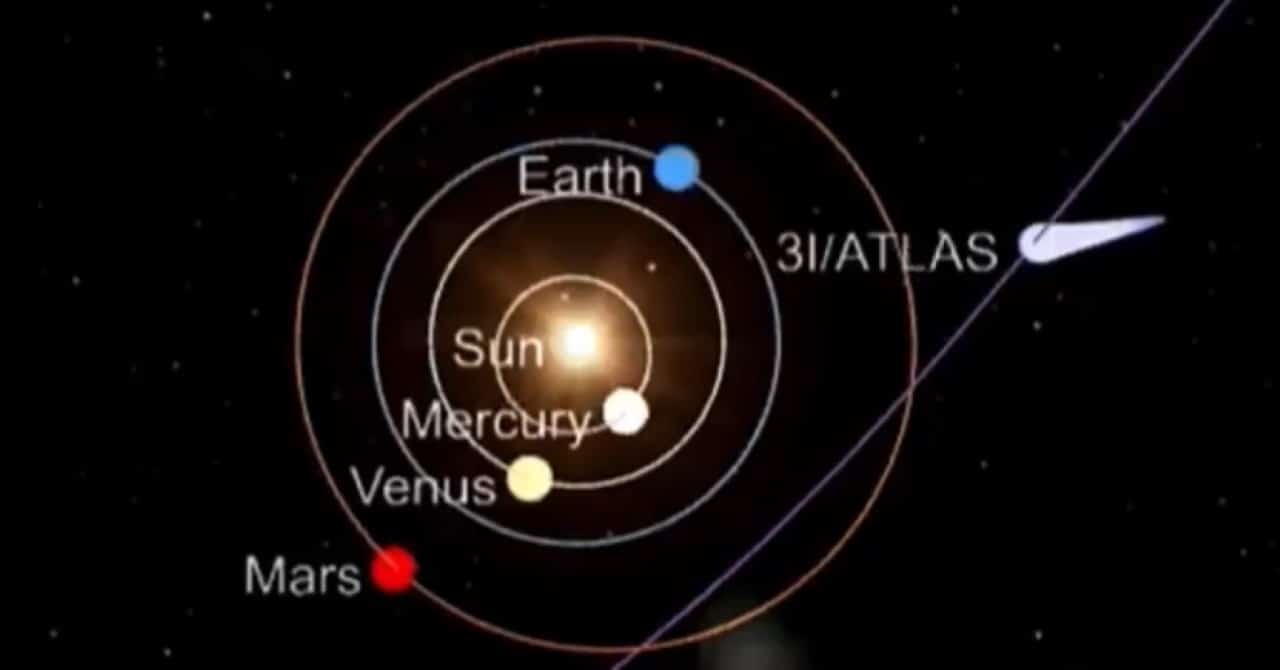
Scientists worldwide are intensifying their focus on Comet 3I Atlas as NASA continues its sophisticated tracking efforts, aiming to unlock critical secrets about this enigmatic interstellar visitor. Discovered initially as an object of unusual trajectory, 3I Atlas represents a rare opportunity for astronomers to study material originating from beyond our solar system. Its ongoing observation in 2025 is expected to provide unprecedented data on the composition and characteristics of cosmic wanderers, potentially revolutionizing our understanding of planetary formation across the galaxy.
The comet’s unique path and presumed interstellar origin make it a prime target for various space-based and ground-based telescopes. Researchers are particularly interested in its chemical makeup, which could offer clues about the environment in which it formed, distinct from the conditions prevalent in our own stellar neighborhood. The insights gleaned from 3I Atlas are vital for comparative planetology and understanding the diversity of exoplanetary systems.
Unveiling an interstellar wanderer
The journey of Comet 3I Atlas into our solar system has captivated the scientific community since its initial detection. Unlike comets that originate from the Oort Cloud or Kuiper Belt, 3I Atlas exhibits characteristics consistent with an object born elsewhere, making its passage a significant event.
Early observations indicated an unusually high velocity and a hyperbolic trajectory, signatures often associated with interstellar objects. These initial findings prompted a concerted effort by NASA and its international partners to dedicate considerable resources to its study, ensuring no detail of its fleeting visit is missed.
NASA’s advanced tracking capabilities
NASA’s Deep Space Network plays a crucial role in maintaining constant vigilance over 3I Atlas, employing an array of powerful radio antennas to pinpoint its exact location and velocity. This intricate network provides the backbone for precise orbital calculations, essential for planning detailed observational campaigns.
Advanced spectroscopic instruments on Hubble and Webb space telescopes are being utilized to analyze the light emitted and reflected by the comet. This process allows scientists to determine the elemental and molecular composition of its coma and nucleus, searching for unique signatures that could confirm its extra-solar origins.
Furthermore, NASA’s planetary defense coordination office, typically focused on Earth-bound threats, has lent its expertise in trajectory modeling to refine predictions for 3I Atlas’s path. This collaborative approach ensures that the scientific community can maximize observation windows and gather comprehensive data.
The unique nature of 3I Atlas
Comet 3I Atlas distinguishes itself from typical solar system comets through several key features. Its presumed birthplace outside our solar system means its constituent materials may have formed under vastly different astrophysical conditions, offering a comparative sample for solar system evolution models.
Scientists hypothesize that 3I Atlas could harbor primordial material from its home stellar system, preserved within its icy nucleus. Analyzing these components could reveal insights into the earliest stages of star and planet formation, providing a direct glimpse into another cosmic nursery.
The comet’s interaction with the sun’s radiation and solar wind also presents a unique observational opportunity. Researchers are studying how its volatile materials sublimate and form its tail, looking for discrepancies compared to comets that have spent billions of years within our sun’s gravitational influence.
Preliminary data from 2025 observations suggest a complex mix of water ice, carbon monoxide, and various organic molecules, though the precise ratios appear distinct from native comets. These subtle differences are what excite researchers most, as they could be the tell-tale signs of an alien origin.
Implications for planetary science in 2025
The study of 3I Atlas holds profound implications for how we understand the genesis and distribution of planetary systems. By analyzing an object that originated elsewhere, scientists can directly test models of planet formation and the chemical enrichment of interstellar space. This information can refine our understanding of how common certain elements and compounds are in other parts of the galaxy.
This interstellar comet provides an invaluable, natural sample return mission without the need for a spacecraft. It allows researchers to examine materials that have traversed vast cosmic distances, potentially carrying clues about the processes that seeded life-enabling compounds across the universe. The data gathered in 2025 will be instrumental in shaping future space missions aimed at exploring exoplanetary environments.
Challenges and opportunities for observation
Observing 3I Atlas presents its own set of technical challenges, primarily due to its transient nature and the vast distances involved. Its relatively small size and faintness require cutting-edge telescopes and advanced imaging techniques to capture sufficient data. Optimal viewing windows are short, demanding rapid response and coordinated efforts from observatories around the globe. Weather conditions, light pollution, and atmospheric interference also pose significant hurdles for ground-based observations, necessitating the use of space telescopes for clearer, uninterrupted views. Despite these difficulties, the scientific community views 3I Atlas as a golden opportunity, fostering unprecedented international collaboration among space agencies and research institutions. The shared goal of deciphering the comet’s secrets has led to innovative data sharing protocols and synchronized observation schedules, maximizing the scientific return from this rare celestial event. This concerted effort ensures that every possible piece of information is collected before 3I Atlas departs our solar system permanently.
Future trajectory and public interest
After its close approach, 3I Atlas is projected to continue its journey out of the solar system, eventually returning to the depths of interstellar space. Its path indicates that it will not return, making current observations in 2025 the only chance for detailed study. The public’s fascination with interstellar objects remains high, fueled by the mystery of their origins and the potential for new discoveries. Educational initiatives and public outreach programs are actively sharing the latest findings, engaging a global audience in the wonders of cosmic exploration.
