
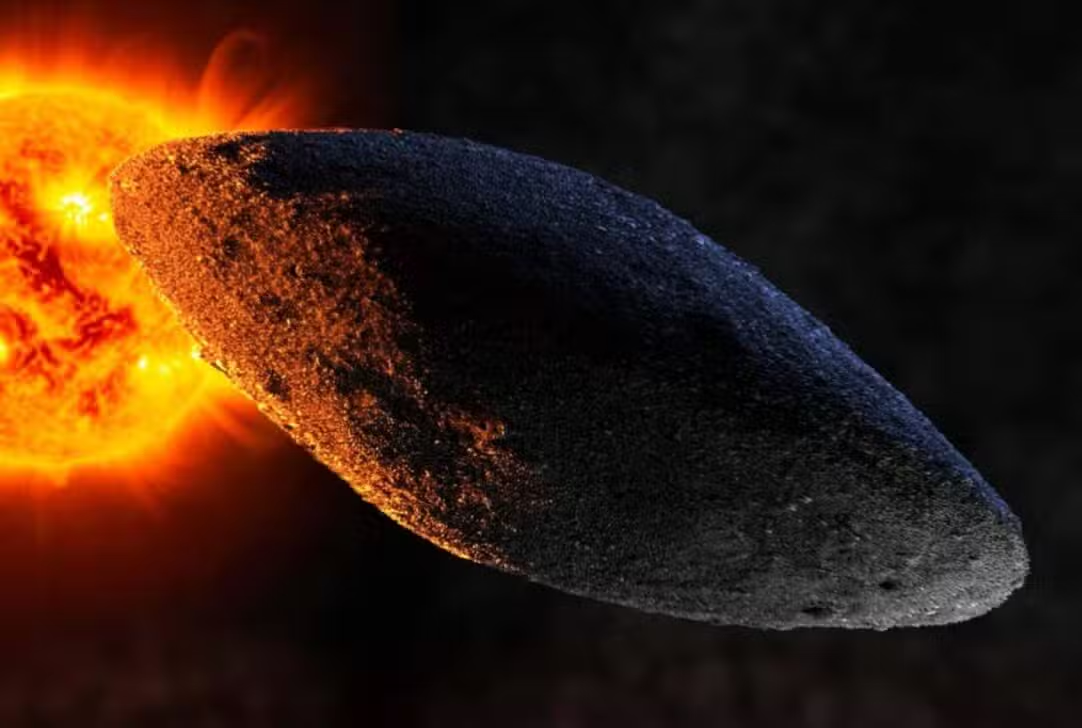
A celestial object of interstellar origin, called 3I/Atlas, is crossing Sistema Solar at an impressive speed of 57 kilometers per second. Sua trajectory, classified as hyperbolic, guarantees that it will not be captured by the gravity of Sol, continuing its journey through deep space after its passage. Este event marks the third confirmation of a body coming from outside our star system.
The recent discovery of 3I/Atlas by astronomers adds a new chapter to the understanding of cosmic visitors. Observações detailed telescopic views were essential to confirm its origins from another star system, differentiating it from the comets and asteroids that orbit Sol. Sua velocidade inicial excede em muito a necessária para escapar da atração solar, resultando em um desvio de rota que se assemelha a uma espécie de “estilingue” gravitacional.
Sol exerts gravitational influence on objects at considerable distances, reaching approximately 3.8 light years, but this force is not enough to trap 3I/Atlas in an orbit. The object maintains its speed and direction, only being “bent” by the solar gravitational field before moving away.
– The speed of the 3I/Atlas is 57 km/s.
– In comparison, Oumuamua reached 26 km/s in its passage.
– Já Borisov, another interstellar comet, recorded 33 km/s.
The visitor’s interstellar origin
Celestial bodies like 3I/Atlas often form and orbit distant stars in their home systems. However, complex gravitational interactions or stellar cataclysmic events such as explosions can eject them into vast interstellar space. Essa expulsion turns them into solitary travelers, roaming galaxies for millions of years.
These wandering objects navigate the cosmos until, by chance, they come across other star systems, like ours. Advanced Telescópios are crucial for identifying trajectories that do not align with the orbits of local celestial bodies, providing the evidence needed to confirm their extrasolar nature.
The dynamics of the hyperbolic trajectory
A hyperbolic trajectory is characterized by a velocity that, at any point, exceeds the local escape velocity of the gravitational field. The 3I/Atlas enters Sistema Solar, suffers a deflection due to solar gravity, but does not slow down enough to be captured, continuing its journey outwards.
The gravity of Sol changes the direction of the object, but cannot reduce its kinetic energy to the point of trapping it in an elliptical or parabolic orbit. Current observations are essential for monitoring the exact path of 3I/Atlas as it heads into deep space, far from our star.
Astronomical calculations predict the point of closest approach between 3I/Atlas and Sol, and the gravitational interaction, although brief, will last a few weeks. Modelos computational complexes accurately simulate the gravitational “slingshot” effect, helping scientists understand the dynamics of this cosmic encounter.
Speed and distinctiveness of local comets
Comets belonging to Sistema Solar typically reach speeds of tens of kilometers per second as they approach perihelion, the closest point to Sol. Contudo, interstellar objects such as 3I/Atlas retain the velocities they inherited from their original galactic environment, which can be significantly different.
This striking difference in orbital speed is one of the main indicators that underline the external origin of 3I/Atlas. Spectroscopy, a technique that analyzes the light emitted or absorbed by an object, is used to study the chemical composition of these visitors.
Through spectroscopy, it is possible to determine the unique proportions of elements present in 3I/Atlas, which may not correspond to those found in comets formed within Sistema Solar. Esse method provides crucial data to confirm its classification as an interstellar object.
The phenomenon of outgassing in interstellar objects
Oumuamua, the first confirmed interstellar object, exhibited unexpected acceleration in 2017 during its passage through Sol. Este phenomenon was later explained by the degassing of hydrogen trapped inside, a natural process that propels the object.
Solar heat falls on the object, causing the sublimation and release of gases from its interior. Although other hypotheses have been raised to explain the acceleration of Oumuamua, the degassing explanation is the one with the greatest support in concrete evidence to date.
Observation and monitoring of the celestial body
The passage of 3I/Atlas through Sistema Solar causes a curvature in its trajectory, at an angle that can be precisely calculated by astronomers. Observatórios around the world are monitoring the object in real time, continually refining orbital data to track its movement.
The vast kinetic energy of 3I/Atlas is dominant over the gravitational pull of Sol, ensuring that it will not be captured. Após its exit from Sistema Solar, the object will continue its perpetual movement through space, without being tied to any specific star.
Chemical composition: evidence from the distant past
Preliminary studies and spectral analyzes revealed the presence of common elements in different proportions, typical of other solar systems. Esta characteristic is essential to corroborate its classification as an interstellar body.
High-resolution telescopes record light spectra from 3I/Atlas to make detailed comparisons with materials found in our own system. The results obtained so far reinforce the conclusion that the object has no connection with the formation of Sol and its planets.