

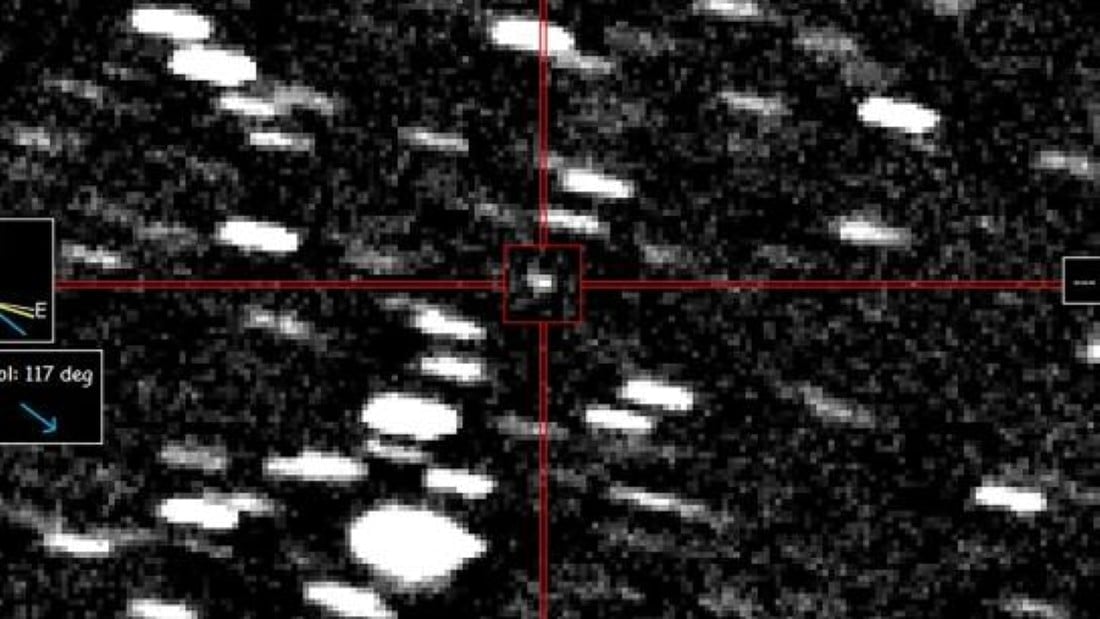
Comet 3I/ATLAS, the third confirmed interstellar object in the history of astronomical observation, is currently on its approach path, crossing Earth’s orbit and will approach Terra on December 19, 2025, at a safe distance of about 270 million kilometers. Este event, of great interest to the scientific community, allows the analysis of a celestial body originating outside our solar system, offering precious data on the formation of other stellar systems. Sua hyperbolic trajectory, with an eccentricity greater than 6, unequivocally confirms its interstellar origin, differentiating it from comets orbiting Sol.
Discovered on July 1, 2025 by the ATLAS system (Asteroid Terrestrial-impact Last Alert System) in Chile, the comet has already had its initial trajectory confirmed by detailed observations. Modelos numerics indicate that 3I/ATLAS reached its perihelion in October and is currently on a trajectory that gradually moves it away from Sol.

More recent observations, including those of Telescópio Espacial Hubble, have captured clear images of its coma and tail, revealing intense activity.
Discovery and classification
Astronomers initially identified comet 3I/ATLAS using the ATLAS telescope, located at an observation station on Chile. The detection was a milestone, as it represented the third time that an object with clearly interstellar characteristics had been observed in our solar system.
Subsequent observations were crucial to confirm the formation of a coma and a tail, characteristics that allowed it to be classified as an active comet. Analysis of its orbit, with an eccentricity greater than 6, provided irrefutable proof of its interstellar origin, distinguishing it from comets native to our system.
New observations and images
Telescópio Espacial Hubble made new observations of this comet on November 30, 2025, when it was 286 million kilometers away from Terra. Essas images were fundamental to understanding the morphology and activity of 3I/ATLAS.
Images captured by Hubble revealed a bluish coma and a well-defined dust tail. The Voos Espaciais Tripulados division of Agência Espacial Europeia (ESA) managed to record the comet with a tail that suggests fragmentation in its central nucleus.
Multiple space missions, such as Psyche, Lucy, and MAVEN, have also recorded out-of-orbit data related to the comet, contributing to a robust set of information.
Chemical composition and revelations
Observations carried out with the ALMA telescope (Atacama Large Millimeter/submillimeter Array) revealed the presence of large amounts of methanol and hydrogen cyanide in the center of the comet’s coma. Essa discovery is vital to understanding its composition.
These organic compounds are clear indicators that the comet formed in an environment outside our solar system. The presence of these elements on an interstellar celestial body offers new clues about the primordial chemistry of other regions of the galaxy.
Since the comet is moving at a great distance from Sol, it has a richer source of carbon dioxide ice than water ice. Isso suggests formation conditions distinct from those found in comets in the inner solar system.
The existence of volatile organic compounds in objects such as 3I/ATLAS is recognized by scientists as a possible link with the origin of primitive life on Terra, transporting essential elements to our planet.
Comet’s route and speed
Comet 3I/ATLAS entered the solar system at an impressive speed of 58 km per second, a speed greater than that of previously observed interstellar comets. Essa high velocity is indicative of its extrasolar origin.
On October 29, 2025, the comet reached its perihelion, the closest point to Sol, at a distance of 1.4 astronomical units. Após its passage through Terra on December 19, it will follow its trajectory out of the solar system.
Ground monitoring and visibility
[[_0]
Astronomers from different parts of the world, including those operating in places with dark skies like Monte Everest, carried out observations of the comet in November 2025. The clarity of the sky at high altitudes allowed detailed recordings of its appearance.
Telescopes like the Smithsonian allow long-term monitoring of the northern part of the hemisphere, making it easier to follow its trajectory. Para amateur observers, the comet may appear as a blurred dot with a small tail, depending on atmospheric conditions and the equipment used. Sua visibility will extend until January 2026, when its luminosity will begin to progressively decrease.
Significance for planetary science
This comet provides crucial data to improve our knowledge of the chemical composition of other comets, both interstellar and those originating in our own solar system. Cada observation contributes to a more complete picture of planetary formation.
Observations conducted by NASA and ESA are key to refining existing orbital models, enabling more accurate predictions. Projeções initials indicate that there will be no collision with space probes or other human equipment in orbit.
Unusual core activity
The comet’s nucleus, whose diameter is estimated to be between 440 meters and 5.6 kilometers, has been releasing gas at varying speeds. Essa activity is a focus of study to understand the dynamics of celestial bodies in extreme environments.
Deepening the interstellar study
3I/ATLAS represents a unique opportunity to deepen studies on the origins of other stellar systems. As the comet moves away from Sol, observations will continue for several months. The data collected will be crucial to expanding our understanding of interstellar objects and their evolution.