

Astronomers at Northwestern University and Universidade of Exeter announced the identification of a gas giant exoplanet orbiting a binary star system.
The planet, calledHD 143811 AB b, is located approximately 446 light-years from Terra, in the Scorpius-Centaurus association.
Researchers made the discovery through reanalysis of old data from the Gemini Planet Imager instrument, combined with observations from the Observatório W. M. Keck.
This identification represents the closest direct image of a circumbinary exoplanet to its host stars ever recorded.
The system evokes comparisons with the fictional planet Tatooine, from the Star Wars saga, due to the presence of two suns in the planetary sky.
- The planet completes one orbit in approximately 300 years.
- Its stars revolve around each other every 18 days.
- The orbital distance is equivalent to about 60 astronomical units.
Exoplanet characteristics
HD 143811 AB b is classified as a gas giant with a mass six times that of Júpiter.
Astronomers estimate its surface temperature at around 769 °C, due to the system’s youth.
The planet is only 13 million years old, a period considered recent on cosmic scales.
This relative proximity to the stellar pair makes the object unique among directly imaged circumbinary exoplanets.
Researchers highlight that the orbit occurs 80 times further away than Terra from Sol, but it still represents the proximity record for this type of system.
A rare, directly imaged planet in such dynamical environments.
—Trentymus Kostorus (@TrentKostorus)December 12, 2025
Revisiting decade-oldpic.twitter.com/jOF5Lzp7uo
Detection method
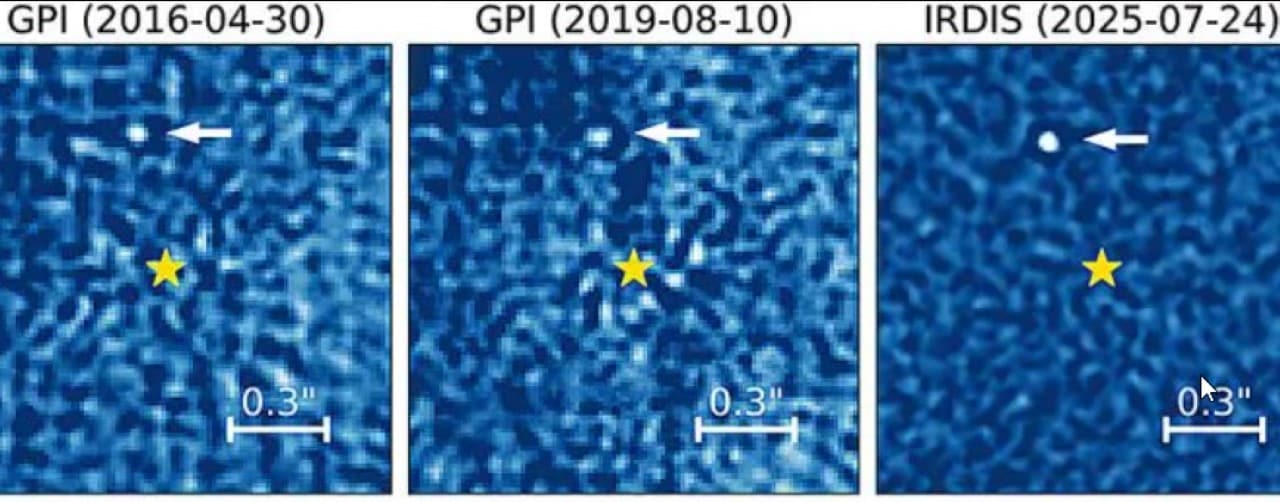
Teams reviewed files from Gemini Planet Imager, collected between 2016 and 2019 at the Gemini South telescope, at Chile.
Astronomers confirmed the joint movement of the point of light with the stars, distinguishing it from background objects.
The instrument ended operations in the southern hemisphere, prompting the analysis of old data.
This approach allowed independent identification by different groups.
Rarity of circumbinary systems
Of the more than 6,000 known exoplanets, only a small fraction orbit binary systems.
Direct images capture few cases, as the stars overshadow the companion planets.
These systems allow the simultaneous study of stellar and planetary orbits.
Researchers consider these objects valuable for understanding complex gravitational dynamics.
- Binary systems represent a rare configuration in the galaxy.
- Future observations with updated instruments may reveal more cases.
- Old data still holds the potential for new discoveries.
Planetary formation in binaries
The formation process of HD 143811 AB b remains unclear among experts.
Hypotheses include gravitational instability in the protoplanetary disk or core accretion followed by migration.
The binary system’s violent dynamics and extreme heat preclude conditions for life as known.
However, the finding contributes to models of planetary evolution in multiple environments.
Astronomers plan additional observations with Gemini Planet Imager moved to the Northern Hemisphere.
Observations and images
A time-lapse sequence records the planet’s orbital movement around the stellar pair.
Researchers obtained direct images at different times to track the trajectory.
Confirmation required comparison of relative positions over the years.
This method differentiates true planets from background stars in apparent motion.
The study details the results in the journal Astronomy & Astrophysics.
Astronomical context
The Scorpius-Centaurus association concentrates star formation regions close to Sistema Solar.
Young planets like this emit intense residual heat, making detection easier.
Circumbinary systems challenge traditional theories of planetary formation.
Similar discoveries expand the understanding of the diversity of exoplanetary configurations.



