
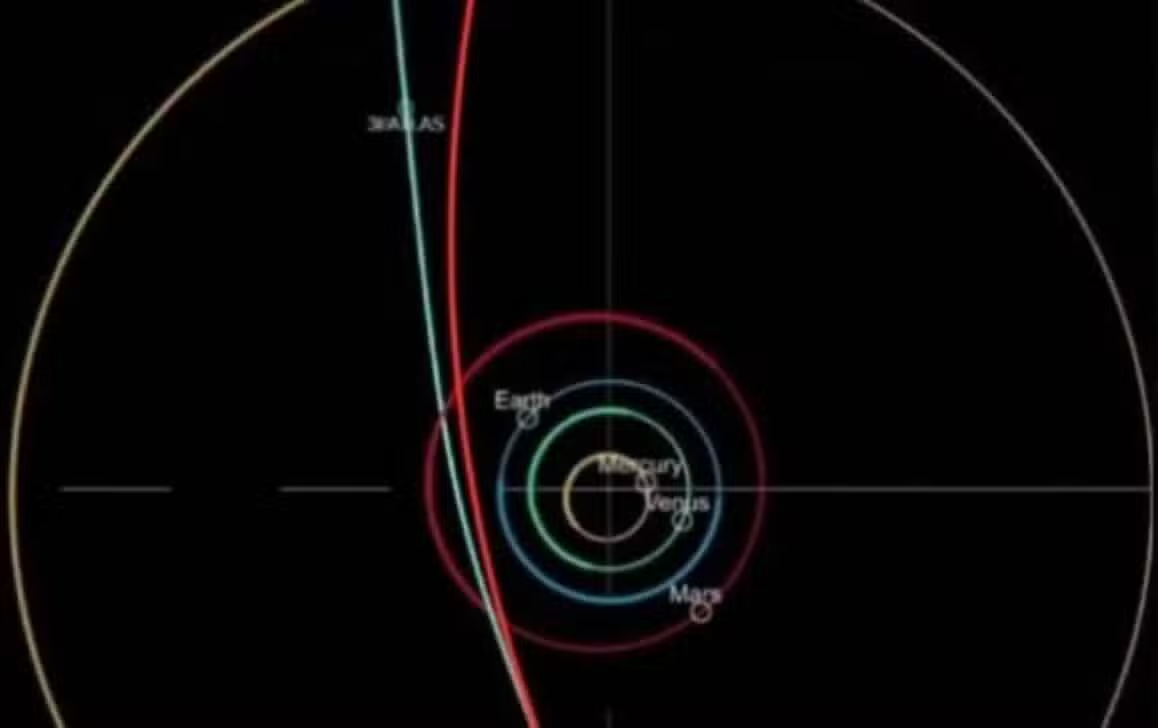
A new study published this Friday, December 19, 2025, analyzes updated observations of the interstellar comet 3I/ATLAS carried out in November. The data indicate the presence of anomalies that do not completely fit traditional comet models based on ice sublimation.
Researchers identified features such as straight and coherent jets, as well as stable non-gravitational acceleration over months. Essas observations suggest mechanisms different from the classical volatile evaporation processes.
Comet 3I/ATLAS, the third confirmed interstellar object, continues to be monitored by ground- and space-based telescopes as it moves away from Sol after perihelion in October.
Features of rotation and jets
The comet’s rotation period was estimated to be about 16 hours. However, the images do not show the spiral structure expected for jets on rotating comets.
The jets remain straight and stable for hours, without significant curvature. Essa directional coherence differs from the typical behavior observed in Sistema Solar comets.
- Jets maintain fixed direction despite rotation.
- Absence of spiral patterns in long exposures.
- Stability observed at multiple telescopic sites.
These traces indicate possible emission controlled by global factors in the nucleus.

Dark band in internal coma
A linear dark line persists in the comet’s inner coma. Essa feature remains invariant to the object’s rotation.
The structure does not vary with rotational movement, suggesting alignment with the axis of rotation. Observações of November confirm their continued presence.
This characteristic low intensity contrasts with the surrounding bright coma. Ela may indicate regions of lower dust or gas emission.
Stable non-gravitational acceleration
The comet’s non-gravitational term A₃ showed no decline in approximately 180 days. Essa prolonged stability exceeds expectations for conventional sublimation.
Orbital data refined by Minor Planet Center reinforces the constancy of the acceleration. The value remains consistent from initial observations.
This persistence suggests sources of strength beyond the evaporation of surface volatiles. Modelos pattern predicts decline with distance to Sol.
Deep negative bias
Measurements reveal deep negative polarization in the comet. The minimum value reaches about -2.7% at low phase angle.
This deep negative branch indicates unusual light scattering. Superfícies typical comets show less extreme values.
Polarization suggests grains of dust or material with specific optical properties. Comparações with known comets highlight the difference.
Spectral band at 4.3 μm
Spectroscopy identifies broadband at 4.3 micrometers. Essa feature is associated with complex organic or carbonyl resonances.
The band width and depth differ from simple gaseous emissions. Observações infrared confirms the presence of rich organic compounds.
This spectral signature reinforces atypical chemical composition. Ela aligns with hypotheses of preserved interstellar material.
Predictions for future observations
The study includes testable predictions for nearby images and spectra. Espera maintains the coherent morphology of the jets.
Absence of spiral structure should persist in new exposures. Perfil elongated core may appear at high resolutions.
Stability of the A₃ term will continue to be monitored. Spectral Complexidade in the 4.3 μm region should be confirmed.
These expectations are based on a global conservation of energy and momentum framework. NASA’s Observações and other telescopes will be able to validate them in the coming months.
Comet 3I/ATLAS follows a hyperbolic trajectory, moving away from Sistema Solar. Sua passage offers unique opportunity to study material from another star system.