

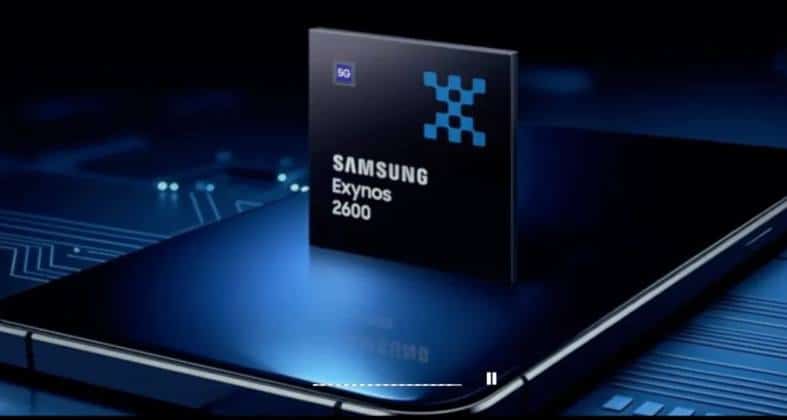
Samsung officially announced the Exynos 2600, marking a significant advancement in semiconductor technology for mobile devices. Este chipset establishes itself as the first SoC for smartphones manufactured with the 2 nanometer (nm) process and Gate-All-Around (GAA) technology, promising substantial improvements in performance, energy efficiency and thermal management. The new processor, which has already entered mass production, is expected to equip selected models of the Galaxy S26 line, with launch scheduled for the beginning of 2026.
The Exynos 2600 represents an evolution over its predecessor, the Exynos 2500, focusing on intensive tasks such as artificial intelligence (AI) and gaming. The company highlights significant benefits in areas where previous versions faced criticism, such as overheating. With this introduction, Samsung positions itself ahead of the competition in the use of the 2nm node in mobile devices.

The transition to the 2 nm process allows for greater transistor density, contributing to reduced power consumption and increased processing speed. Especialistas industry experts note that this innovation could redefine the high-performance smartphone market next year.
Advanced architecture and performance
The Exynos 2600 adopts a 10-core architecture based on Arm v9.3, which eliminates traditional low-power cores. The configuration includes a high-performance C1-Ultra core clocked at 3.8 GHz, three high-performance C1-Pro cores operating at 3.25 GHz, and six efficiency-optimized C1-Pro cores clocked at 2.75 GHz.
Samsung reports that this framework increases overall CPU performance by up to 39% compared to the Exynos 2500.
Graphics optimization and gaming experience
The Xclipse 960 graphics processor, integrated into the Exynos 2600, offers twice the computing power compared to the previous generation. The company reports improvements of up to 50% in ray tracing, an essential technology for realistic graphics in games for mobile devices.
This chipset debuts Exynos Neural Super Sampling (ENSS) technology, which uses artificial intelligence to increase resolution and generate frames. Isso guarantees smoother gameplay with a notable increase in frame rate per second, without a significant impact on battery consumption.
These enhancements aim to prolong immersive experiences by refining the structure of energy domains for greater efficiency.
[[_0]
Strengthening on-device artificial intelligence
The Exynos 2600’s enhanced neural processing unit (NPU) delivers a 113% increase in generative artificial intelligence performance over the previous model. Isso allows you to run complex models directly on the device, improving privacy and speed in functions such as image editing and smart assistants.
The chipset incorporates advanced security features, including hardware-assisted post-quantum hybrid encryption. Essas features protect sensitive data against future threats.
Enhanced camera and video features
The integrated image signal processor (ISP) supports sensors up to 320 MP, with zero shutter lag for 108 MP photos. Video capabilities include 8K recording at 30 frames per second (fps) and 4K at 120 fps with HDR, plus APV codec support for higher quality.
A new visual perception system detects subtle details in real time, while reducing ISP becomes up to 50% more energy efficient.
These tools optimize multimedia processing on smartphones equipped with the chip.
Innovation in thermal management
The Samsung introduces the Heat Path Block (HPB), which uses High-k EMC materials to optimize heat exchange. Essa solution lowers thermal resistance by up to 16%, enabling consistent performance under heavy loads without excessive throttling.
This technology directly addresses the heating concerns seen in previous generations of the Exynos. The result is the maintenance of stability during long sessions of intense use, such as gaming or artificial intelligence processing.
Compatibility and the future of the Galaxy S line
The Exynos 2600 supports LPDDR5X memory, UFS 4.1 storage, and 4K displays at 120 Hz with HDR10+. Connectivity is based on a separate modem, which allows flexibility in device design.
Although Samsung has not confirmed specific models, the chipset is set to integrate Galaxy S26 and S26 Plus variants in select markets. Mass production has already begun, aligning with the company’s 2026 launch schedule.
This strategy reinforces the use of its own chips in part of its high-end smartphone line.
Additional technical details and enhancements
The architecture eliminates traditional small cores, prioritizing a mix of large and mid-size cores to balance peak performance and everyday efficiency. Rich Arm instruction support optimizes on-device artificial intelligence workloads.