
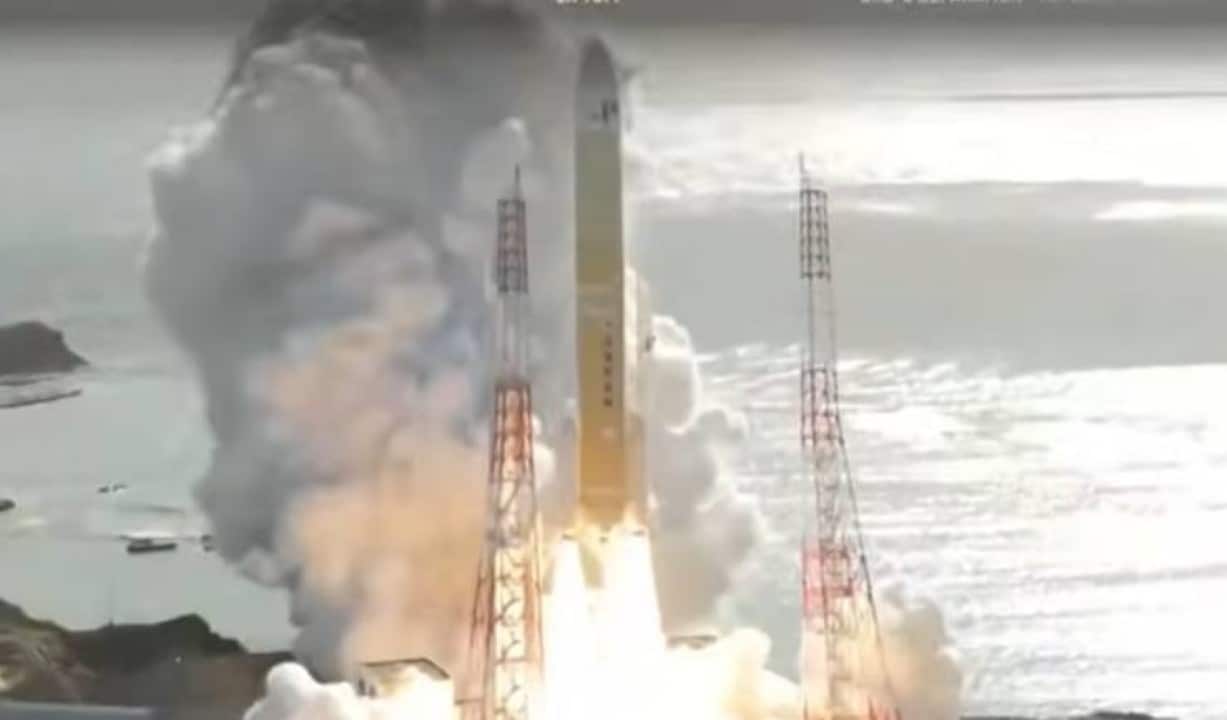
Agência of Exploração Aeroespacial of Japão (JAXA) recorded a failed launch of the H3 rocket, which took off from Centro Espacial of Satellite System (QZSS). The first stage operated normally, but the second stage engine did not ignite properly and shut down prematurely.
Essa anomaly prevented the satellite from being inserted into the planned geosynchronous transfer orbit. JAXA lost communication with the rocket and confirmed that the mission did not reach its objective. This was the H3’s second failure in eight flights, following the initial problem in 2023.
The launch followed previous postponements, including an attempt canceled on December 16 due to countdown problems and another on December 17 due to irregular cooling equipment. The mission aimed to expand QZSS, which improves GPS accuracy in the Ásia-Pacific region.
- QZSS operates with satellites in quasi-zenithal orbits for constant coverage over Japão.
- Currently, the system has five active satellites after previous successful launches.
- The Michibiki 5 would be the sixth, strengthening services for smartphones, autonomous vehicles and maritime navigation.
Mission details
The H3 rocket, in its H3-22S configuration for the eighth mission, lifted off with initial success from the launch complex at Tanegashima. Equipes from JAXA monitored the flight in real time, but detected the failure in the second stage shortly after separation from the first. The LE-9 engine, responsible for the upper phase, presented an abnormal ignition.
JAXA formed a task force led by President Hiroshi Yamakawa to investigate the causes. Especialistas analyze telemetry data to identify the exact problem in the propulsion system. Essa failure represents a setback for the Japanese space program, which seeks global competitiveness with reduced costs.
The Michibiki 5 satellite, manufactured by Mitsubishi Electric, incorporated advanced technologies for centimeter precision in positioning. Sua loss affects QZSS expansion plans to seven satellites by 2026.
History of the H3 rocket
The H3 succeeded the veteran H-2A, retired after decades of reliable service. The new vehicle failed on its debut in March 2023, when the second stage failed to ignite, resulting in the destruction of the payload. It then scored five consecutive hits, including the release of Michibiki 6 in February 2025.
These successful flights restored confidence in the project, developed by Mitsubishi Heavy Industries in partnership with JAXA. The H3 utilizes advanced cryogenic engines and solid boosters for greater efficiency. The configuration varies depending on the load, with options for two or zero side boosters.
How the QZSS system works
The Quasi-Zenith Satellite System complements the American GPS, offering stronger signals in dense urban and mountainous areas than the Japão. Satélites remain visible for long periods at the zenith, guaranteeing almost 100% coverage of the territory. The system began operations in 2018 with four initial satellites.
Applications include precise navigation for drones, precision agriculture and natural disaster response. The expansion to more satellites aims for greater autonomy in positioning, reducing dependence on foreign systems. Países neighbors in Ásia-Oceania also benefit from the signals.
Technical characteristics of the satellite
The Michibiki 5 weighed around 4,800 kilograms and incorporated antennas for measuring distances between satellites. Essa technology improves real-time orbital determination, increasing the overall accuracy of the constellation. The satellite would operate in an inclined orbit, tracing a figure 8 over the region.
Manufacturers tested the equipment extensively before integrating it into the rocket. The loss represents not only a financial cost, but a delay in planned operational capabilities.
Previous launch attempts
The mission faced multiple postponements in December 2025. An initial attempt was interrupted minutes before takeoff due to an anomaly in the countdown system. Outra, scheduled for December 17th, was canceled due to a problem with the cooling water injection equipment.
A rescheduling took place for December 22, with an adjusted release window. Apesar of the corrections implemented, the flight failure persisted in the second stage.
Investigation procedures
JAXA collected sensor and telemetry data during the flight for detailed analysis. Especialistas examine components of the LE-9 engine, including ignition and fueling systems. Testes on the ground will replicate conditions to identify potential failures.
Results of the investigation will determine corrective measures before future flights. The H3 program has missions scheduled, including another QZSS satellite.
Planned constellation expansion
Japão plans to reach seven satellites in the QZSS by the end of the decade, with a vision for 11 in the future. Essa configuration will provide independent positioning services with high accuracy. Subsequent Lançamentos will use the H3 or alternative vehicles depending on the investigations.
The system has already demonstrated usefulness in civil and government applications, with compatibility on modern devices.
