

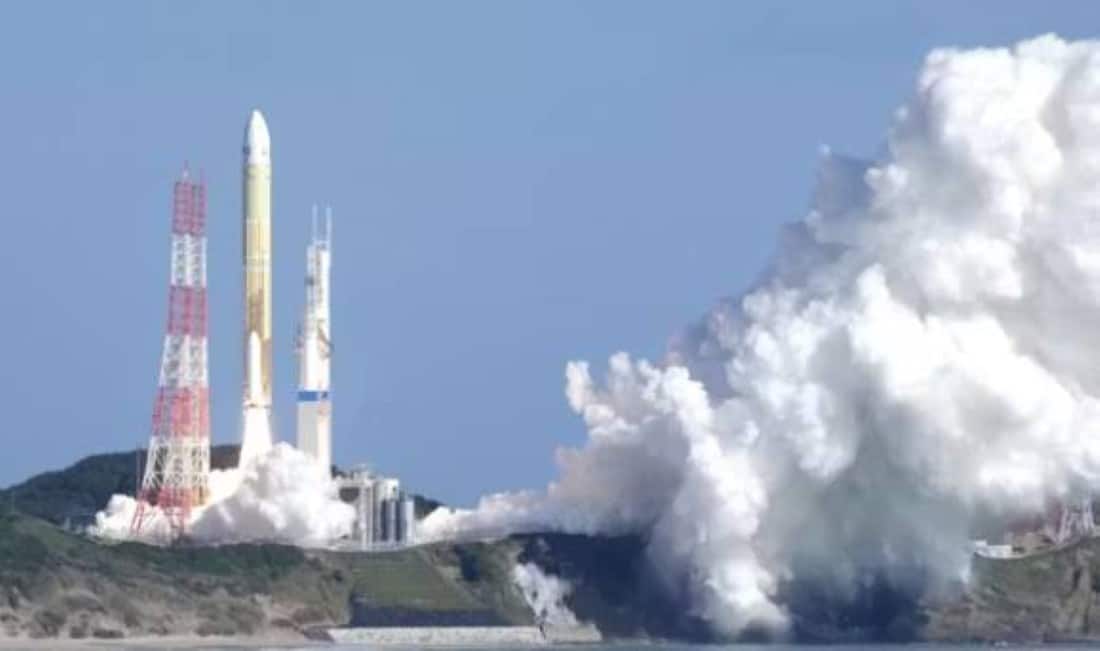
Agência Japonesa of The vehicle carried the Mihibiki 5号機 quasi-zenithal positioning satellite, intended to reinforce the Japanese satellite navigation system. However, shortly after takeoff, JAXA announced that the second stage engine terminated combustion prematurely.
The launch took place after two previous postponements. Inicialmente scheduled for December 7th was postponed due to a failure detected in second stage components. A second attempt, on December 17, was interrupted seconds before ignition due to a problem with the platform’s cooling system.
Despite the successful takeoff, with normal separation of the first stage and solid boosters, the problem in the second stage compromised the mission. JAXA immediately began data analysis to determine whether the mihibiki 5号機 satellite could be separated and inserted into its planned orbit.
- The H3 is the main rocket of the Japão, successor to the H2A.
- Developed by JAXA and Mitsubishi Heavy Industries since 2014, with a total cost of around 240 billion yen.
- Configuration used: H3-22, with two main engines in the first stage and two auxiliary solid boosters.
History of mission postponements
The path to the December 22 launch was marked by technical challenges. The first date, December 7, was canceled after an anomaly was identified in the inertial sensor unit in the second stage, responsible for attitude control. Defective components were replaced, allowing rescheduling for December 17th.
On that occasion, the countdown advanced to seconds before ignition, but the system detected insufficient flow in the cooling water injection equipment. Essa structure protects the platform and rocket from hot gases and vibrations. The cause was attributed to inadequate valve adjustment during maintenance, leading to a return to the standard procedure.
These incidents did not damage the rocket or the satellite. JAXA performed additional testing, confirming integrity before transporting the vehicle back to the platform on December 21.
Problem details in the second stage
JAXA’s announcement came about 30 minutes after liftoff. The second stage engine, responsible for final acceleration and orbital insertion, stopped combustion before the programmed time. In similar configurations, H3 performs two second stage ignitions to reach high orbits.
Experts monitor telemetry to assess the speed and altitude reached. Caso orbital speed has not been reached, the michibiki 5号機 may remain in a ballistic trajectory or lower orbit, compromising its operability.
The H3-22 configuration has already recorded five consecutive successes prior to this mission. The H3 has accumulated successes since 2023, after an initial failure in 2023 due to a similar problem in the second stage.
Importance of the mihibiki satellite 5号機
The michibiki 5号機, manufactured by Mitsubishi Electric, integrates the quasi-zenithal positioning system (QZSS), known as Japanese GPS. Atualmente, five satellites operate, including replacements, with 6号機 launched in February 2025.
With the addition of 5号機 and the planned 7号機 in February 2026, the system will reach seven satellites by the end of fiscal year 2026. Essa constellation will allow independent positioning of foreign systems, such as American GPS, in Japanese territory.
- Current accuracy: reduces error from 10 meters to up to 6 centimeters with compatible receivers.
- Applications: autonomous vehicle navigation, remote control of agricultural machinery, disaster safety confirmation.
- Benefits: Greater coverage in urban areas with tall buildings and mountainous regions.
The system contributes to critical infrastructure, including transportation and precision agriculture.
Development and role of the H3 rocket
H3 was designed to replace H2A and H2B, with a focus on cost reduction and flexibility. Três main configurations meet varying payload demands. The total investment of approximately 240 billion yen included a new LE-9 engine in the first stage, which is more efficient and economical.
After the 1号機 failed in 2023, with the second stage not igniting, corrective measures ensured subsequent successes. The H3 positions the Japão in the commercial launch market, competing with international reusable vehicles.
This mission represents the eighth flight of the H3. JAXA prioritizes detailed analysis to identify causes and prevent recurrences, maintaining program reliability.
Features of the mihibiki system
QZSS operates in quasi-zenithal inclined orbits, ensuring constant visibility over Japão and Ásia-Oceania.
- Main services: GPS signal supplementation, error correction, emergency messages.
- Centimeter accuracy: essential for autonomous vehicles and detailed mapping.
- Expansion to seven satellites: complete autonomy in national positioning, reducing external dependence.
- Operation: managed by Gabinete of the Japanese Governo, with satellites built by Mitsubishi Electric since the first in 2010.
With seven units, the system will offer continuous coverage and high precision across the entire Japanese archipelago.
JAXA’s next steps
The agency collects data from telemetry and tracking stations to assess the satellite’s status. Updated Comunicados will be issued as the investigation progresses. Caso confirms orbital insertion failure, impacts will include postponement of expansion to seven satellites.
The next launch, H3 9号機 with michibiki 7号機, is scheduled for February 1, 2026. JAXA maintains a schedule for increasing the annual flight rate.