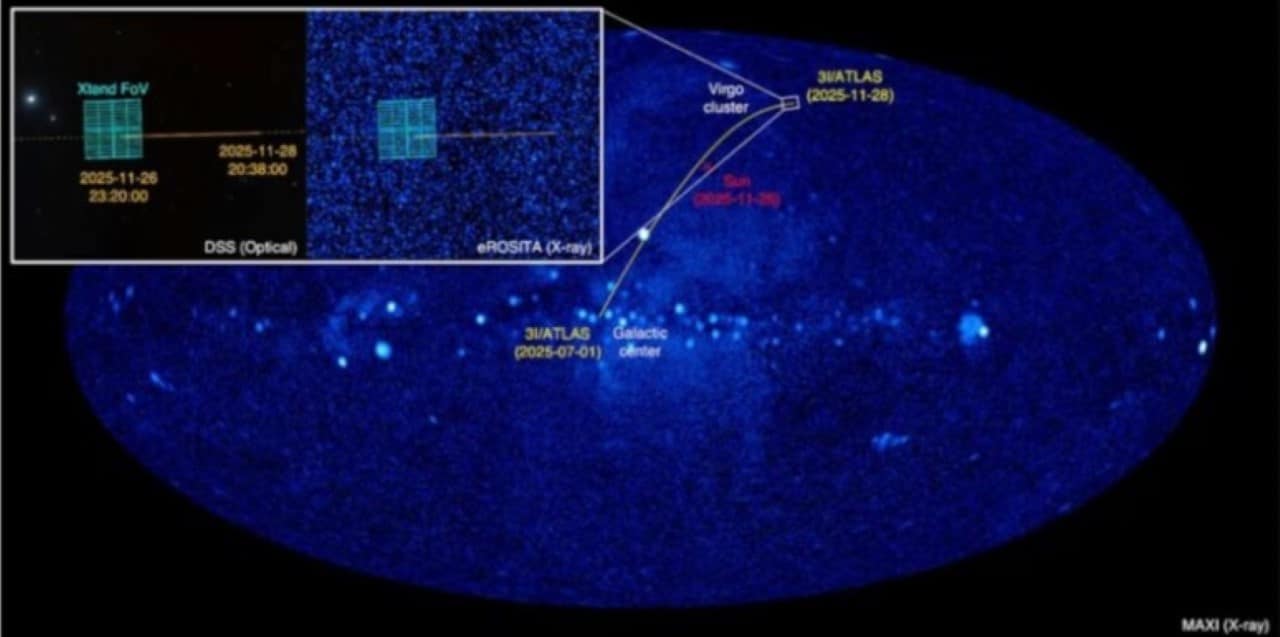
The scientific community is buzzing with anticipation as Nasa gears up for a critical observation campaign in early 2025, focusing on the recently designated interstellar comet 3I Atlas. This celestial visitor, identified through advanced telescopic surveys, presents a rare opportunity for astronomers to study material from beyond our solar system, offering unique insights into the composition of other star systems. Its trajectory indicates a close, yet safe, passage through the inner solar system, making it an ideal candidate for detailed examination by multiple ground-based and space-borne instruments. Researchers at various institutions are already developing refined models to predict its behavior and potential outbursts, hoping to capture data that could redefine our understanding of cosmic origins. The sheer speed and unusual orbital path of 3I Atlas confirm its interstellar nature, distinguishing it from comets originating in the Oort Cloud or Kuiper Belt.
Initial observations indicate that 3I Atlas exhibits characteristics similar to previous interstellar objects, yet with distinct spectral signatures suggesting a different origin point. Scientists are particularly interested in its volatile content, which could reveal clues about the conditions in its home stellar nursery.
The comet’s closest approach is projected for early March 2025, offering a narrow window for intensive study. Nasa’s deep space network and orbital telescopes are being recalibrated to ensure optimal data capture during this brief but crucial period, maximizing the scientific return from this fleeting visitor.
Discovery and preliminary trajectory analysis
The detection of 3I Atlas occurred unexpectedly in late 2024 by an international team utilizing the Pan-STARRS telescope in Hawaii, quickly confirmed by follow-up observations from observatories worldwide. Its highly eccentric and hyperbolic orbit instantly flagged it as an interstellar object, a designation only given to a handful of celestial bodies previously.
Further analysis by Nasa’s Jet Propulsion Laboratory (JPL) refined the comet’s projected path, confirming it would not pose any threat to Earth but would offer excellent viewing opportunities. The team at JPL highlighted the object’s relatively large size compared to 2I/Borisov, indicating a potentially more active outgassing phase as it approaches the sun.
Unraveling interstellar origins
Understanding the origin of 3I Atlas is a primary goal for Nasa and its collaborators, who aim to trace its journey across vast interstellar distances. Researchers are employing sophisticated simulations to model its likely ejection from a distant star system, potentially providing clues about stellar dynamics and planetary formation processes beyond our own. The chemical fingerprints locked within its ice and dust will be meticulously analyzed for unique isotopes and molecular structures, which could point to specific types of stars or nebulae.
This unprecedented opportunity allows for a direct comparison between cometary material formed in our solar system and that from another, potentially shedding light on universal processes of planetesimal formation. Early spectroscopic readings have already hinted at unusual trace elements, fueling excitement among astrochemical researchers. The mission aims to gather enough data to determine if 3I Atlas originated from a binary star system or a more isolated stellar environment.
Technological readiness for 2025 observations
Nasa’s preparatory efforts for 3I Atlas involve a comprehensive array of technological upgrades and strategic deployments for 2025. The James Webb Space Telescope (JWST) is scheduled for dedicated observation slots, leveraging its infrared capabilities to pierce through the comet’s dust coma and analyze its core composition. Ground-based observatories, including the Atacama Large Millimeter/submillimeter Array (ALMA), will complement these efforts by studying the comet’s molecular emissions.
Scientists are also developing new data processing algorithms to handle the immense volume of information expected from these advanced instruments. The challenge lies not only in capturing the data but also in rapidly interpreting it to guide subsequent observations. This coordinated approach ensures that every available resource is optimized for this fleeting astronomical event.
Key scientific objectives for the mission
The observation campaign for 3I Atlas has several critical scientific objectives designed to maximize the return from this rare interstellar visitor. These objectives span a broad range of astrophysical and astrochemical inquiries.
– Elemental and isotopic composition: Detailed analysis of the comet’s ice, dust, and gas to determine its elemental and isotopic ratios, comparing them to solar system standards.
– Volatile content: Quantifying the types and abundances of volatile compounds, such as water, carbon monoxide, and complex organic molecules, to infer formation conditions.
– Physical characteristics: Measuring the comet’s size, shape, rotation, and surface features as it outgasses, providing insight into its structural integrity.
– Orbital dynamics: Precisely tracking its trajectory to understand its interstellar origin and potential interactions with gravitational fields during its journey.
Comparative analysis with past interstellar visitors
The study of 3I Atlas will inherently involve a comparative analysis with previous interstellar objects like ‘Oumuamua and 2I/Borisov, but with significant advancements in observational technology. While ‘Oumuamua was detected post-perihelion and provided limited compositional data due to its lack of cometary activity, 2I/Borisov offered valuable insights into interstellar cometary volatiles. 3I Atlas, with its predicted activity and more favorable viewing geometry for 2025, promises to bridge the data gaps left by its predecessors. This comparison will help refine models of interstellar object populations and their potential role in distributing matter throughout the galaxy.
Implications for exoplanetary science
The data collected from 3I Atlas holds profound implications for exoplanetary science, offering a tangible link to other star systems. Studying the composition of this interstellar comet provides a direct sample of building blocks from another planetary nursery. This information can constrain models of planet formation around other stars, helping scientists understand the diversity of exoplanetary systems. It could also reveal if the raw materials for life are universally distributed across the galaxy, or if our solar system’s unique mix is an outlier. The insights gained will inform future missions aimed at characterizing exoplanet atmospheres and surfaces.
Public engagement and astronomical excitement
Nasa and other astronomical organizations are planning extensive public engagement initiatives around the 2025 observation of 3I Atlas. Educational programs, live streams from observatories, and interactive online resources will be launched to share the excitement and scientific discoveries with a global audience. The rare nature of an interstellar comet visible through advanced telescopes provides an unparalleled opportunity to inspire the next generation of scientists and space enthusiasts.
Observing a cosmic messenger
As 2025 approaches, the scientific community eagerly awaits the close passage of interstellar comet 3I Atlas. This object represents more than just a passing rock; it is a messenger from another star system, carrying invaluable information about cosmic environments far beyond our reach. The concerted efforts by Nasa and international partners underscore the global commitment to pushing the frontiers of astronomical discovery.
Future prospects for interstellar object research
The successful observation of 3I Atlas in 2025 will pave the way for future dedicated missions aimed at studying interstellar objects. Scientists are already discussing concepts for interceptor probes that could potentially rendezvous with future interstellar visitors, offering even more detailed, in-situ analysis. Such missions would represent the ultimate frontier in astrobiology and planetary science, allowing humanity to directly sample material from other star systems. The insights gleaned from 3I Atlas will be crucial in refining the scientific goals and technological requirements for these ambitious future endeavors, accelerating our journey towards understanding the universe’s vast cosmic tapestry.
