


The passage of the interstellar comet 3I/ATLAS through Sistema Solar reached its closest point to Terra on December 19, 2025, marking the beginning of its journey away. The object, which crossed space at a safe distance of approximately 270 million kilometers, did not pose any threat of collision, but offered a unique opportunity for science. Descoberto in July 2025 by the ATLAS system, this is the third interstellar visitor confirmed to cross our cosmic region, arousing great interest in the global astronomical community.
Scientists have closely monitored 3I/ATLAS, employing a vast network of ground- and space-based telescopes to detail its composition and behavior. Observações revealed robust cometary activity, with emission of gases and dust, allowing in-depth studies into its nature. The data collected confirmed crucial features of its orbit:
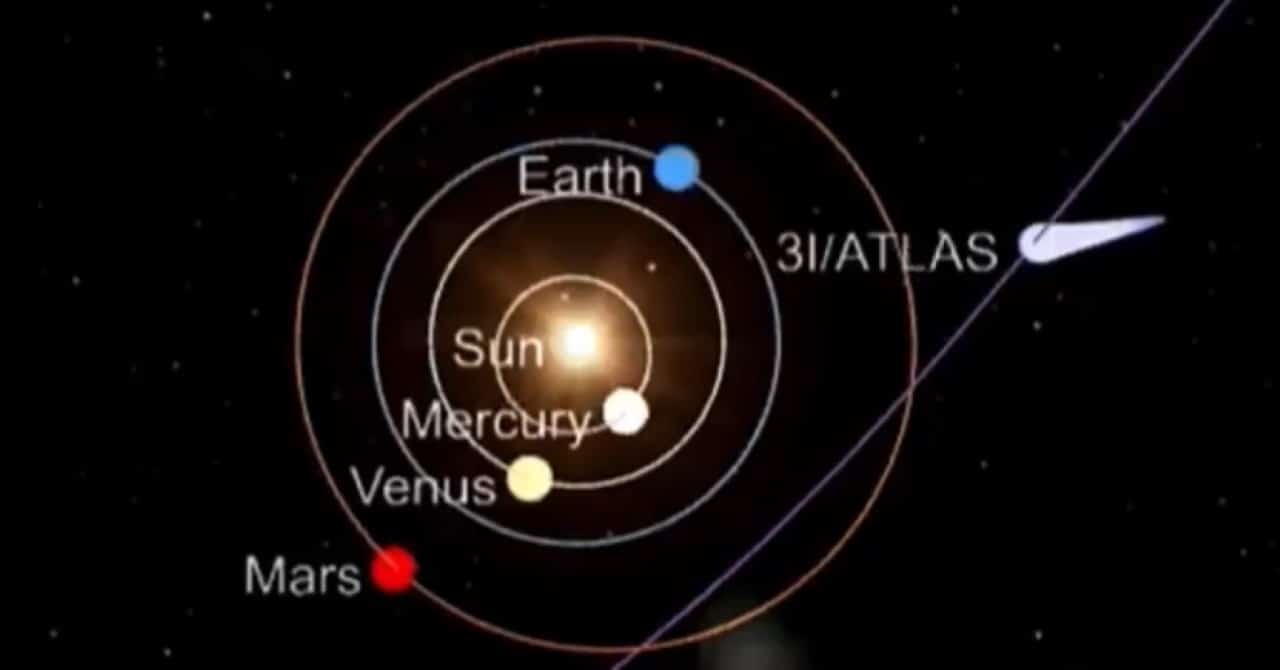
Such parameters are consistent with a hyperbolic trajectory, which is the signature of cosmic objects that are not gravitationally bound to our Sol, confirming their origin in another star.
Discovery and initial trajectory
The ATLAS telescope system, an initiative funded by NASA and strategically located at Chile, was responsible for detecting the comet on July 1, 2025. Early observations indicated a highly unusual trajectory, leading researchers to suspect an extrasolar origin, which was quickly validated by international analyzes and collaborations.
Receiving the designation 3I/ATLAS, the object was officially recognized as the third interstellar comet ever observed, following in the footsteps of 1I/’Oumuamua (recorded in 2017) and 2I/Borisov (identified in 2019). Sua impressive speed and an orbital eccentricity greater than 1 were the definitive indicators for this classification. Registros of pre-discoveries in archived images, dating back to June 2025, contributed significantly to the early refinement of its orbit.
The journey through the solar system
Comet 3I/ATLAS entered Sistema Solar from the constellation of Sagitário, tracing a path that took it into the orbit of Marte. Sua closest approach to Sol, known as perihelion, occurred in October 2025, at a distance of approximately 210 million kilometers. During this period, the object demonstrated an unexpected increase in brightness, attributed to the intense sublimation of ice on its surface.
After this phase of maximum solar activity, the comet continued in its orbit towards Terra towards December, always maintaining a safe distance and without presenting any risks. Atualmente, 3I/ATLAS is on course for a distant encounter with Júpiter, expected in 2026, before beginning its definitive exit from Sistema Solar, expected in the 2030s.
The hyperbolic nature of its trajectory guarantees that this cosmic visitor will not return, making current observations absolutely unique. Essa opportunity allows scientists to study primordial material from another star system, offering valuable insights into the formation of distant worlds. The comet’s passage also enabled detailed comparisons with comets native to our Sistema Solar, revealing both similarities and subtle differences in their activity and composition.
Details of scientific observations
Advanced equipment like Telescópio Espacial Hubble was crucial in capturing high-resolution images of the nucleus and coma of comet 3I/ATLAS. Essas images made it possible to estimate the diameter of the nucleus in a range that varies between 440 meters and 5.6 kilometers, offering fundamental data on its size. Missões like Parker Solar Probe and probes orbiting Marte have also recorded information at multiple wavelengths, including the first-ever detection of X-rays from an interstellar object.
The comet exhibited a dust tail and an ion tail, common phenomena in comets that approach Sol, in addition to an anti-tail at certain phases of its trajectory, a rarer event. Análises spectroscopic measurements indicate the presence of water, carbon dioxide and other volatile compounds, revealing a composition that shares similarities with comets originating from Sistema Solar.
In-depth studies of 3I/ATLAS suggest that its age may exceed 7 billion years, indicating a likely origin in the thick disk of Via Láctea. Essas observations substantially enrich the scientific community’s understanding of the processes of formation of planetary systems in distant regions of our galaxy.
Composition and recorded phenomena
3I/ATLAS presented a coma with a reddish hue, a clear indication of the presence of dust in its structure, and a notable release of gases as it approached Sol. Detailed spectral Observações revealed a relative excess of certain elements, such as nickel, which differentiates it slightly from comets formed within our Sistema Solar.
Evidence of cryovolcanic activity has been suggested by recent images, showing possible eruptions of subterranean ice that contributed to its luminosity. The comet’s brightness exceeded expectations during perihelion, allowing its detection by specialized solar satellites such as SOHO and STEREO.
Additional spectroscopic data confirm the abundant presence of carbon monoxide and other volatiles in its composition. Esses chemical traces provide valuable clues about the physical and chemical conditions prevailing in ancient star systems, where the comet likely originated.
Scientific legacy of the visit
The passage of comet 3I/ATLAS by our Sistema Solar mobilized an extensive global network of instruments, including Telescópio Espacial James Webb and several planetary missions. The data meticulously collected during his visit will continue to be analyzed by scientists around the world for years to come, contributing significantly to the development and refinement of theoretical models about interstellar objects.
Current estimates indicate that the occurrence of cosmic visitors like 3I/ATLAS is relatively rare, however, continued advances in tracking and detection programs considerably increase the chances of future discoveries. The 3I/ATLAS analysis reinforces the scientific community’s understanding of the chemical diversity present in interstellar space, expanding our knowledge.
The rarity of interstellar visitors
The 3I/ATLAS observation represents a milestone in astronomy, given the rarity of objects originating outside of Sistema Solar. Estudar these celestial bodies allow us to glimpse the composition of other regions of Via Láctea, offering a unique perspective on star and planetary formation in different cosmic environments.



