


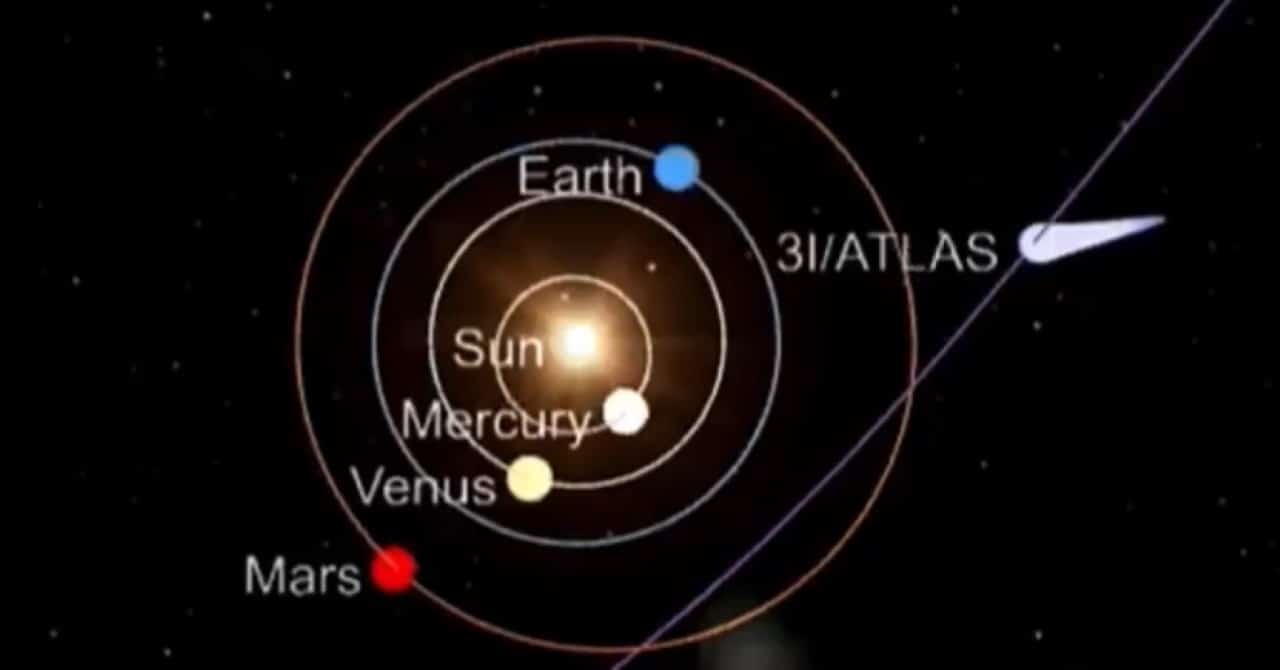
The interstellar comet 3I/ATLAS, one of the rare visitors from outside our solar system, completed its closest approach to Terra on December 19, 2025. The object passed at a safe distance of 270 million kilometers, about 1.8 astronomical units, without posing any risk of collision.
This event marked the end point of its closest passage through the planet, beginning its return journey to the outer regions of Sistema Solar. The scientific community intensively monitored the comet, taking advantage of the unique opportunity to collect valuable data.
Discovered in July 2025 by the ATLAS system, this comet is the third confirmed object of interstellar origin to cross our cosmic neighborhood. Sua journey offers crucial information about the composition and dynamics of celestial bodies in other star systems.
Farewell to the interstellar cosmic visitor
3I/ATLAS now begins its journey away, heading towards the borders of Sistema Solar after its closest passage. Essa hyperbolic trajectory guarantees that the comet will not return, making current observations extremely important for the study of primordial material from other stars and for understanding distant cosmic phenomena.
Discovery and classification of 3I/ATLAS
The NASA-funded ATLAS telescope system located at Chile was responsible for detecting the comet on July 1, 2025. Initial observations quickly indicated an unusual trajectory, suggesting an origin outside of Sistema Solar.
Subsequent global analyzes confirmed this suspicion, designating it as 3I/ATLAS. Este is the third known interstellar object, following 1I/’Oumuamua (2017) and 2I/Borisov (2019), with its high speed and orbital eccentricity greater than 1 reinforcing its classification.
The journey through the solar system in 2025
3I/ATLAS entered our system from the Sagitário constellation, tracing a path that took it into the Marte orbit. Sua closest approach to Sol, or perihelion, occurred on October 29, 2025, approximately 210 million kilometers from the star.
During this phase, the comet exhibited an unexpected increase in brightness, attributed to the sublimation of ice on its surface. Esse phenomenon allowed more detailed observations of its activity and composition.
After passing through perihelion, the comet headed towards Terra for the December approach, remaining at a safe distance. Ele is now heading for a distant rendezvous with Júpiter in 2026, before definitively leaving Sistema Solar in the 2030s.
Scientific observations and data revealed
Telescopes such as the Hubble were used to capture detailed images of the comet’s nucleus and coma, allowing estimates of its diameter to be between 440 meters and 5.6 kilometers. The mobilization of a vast network of global instruments was fundamental for this data collection phase.
Space missions, including Parker Solar Probe and probes at Marte, have recorded information at multiple wavelengths. Pela for the first time, it was possible to detect X-rays in an interstellar object, opening new windows for the study of its composition.
Composition and activity recorded in the space
3I/ATLAS presented a reddish coma, indicative of the presence of dust, and a significant release of gases as it approached Sol. Observações spectroscopy revealed a relative excess of certain elements, such as nickel, which subtly differentiates it from comets native to our Sistema Solar.
Recent images have suggested the occurrence of cryovolcanic activity, with possible eruptions of underground ice. The comet’s brightness exceeded expectations during perihelion, enabling detections by solar satellites such as SOHO and STEREO.
Spectroscopic analyzes confirmed the presence of carbon monoxide and other volatiles. Preliminary Estudos suggests that the comet may be more than 7 billion years old, with a likely origin in the thick disk of Via Láctea.
Orbital characteristics and parameters
The hyperbolic trajectory of 3I/ATLAS, with an orbital eccentricity greater than 1, confirmed its nature not gravitationally bound to Sol. The Essa feature is an essential marker for identifying interstellar objects, distinguishing them from the comets and asteroids that orbit our star. The rarity of such visitors makes the current observations unique to science.
The passage of 3I/ATLAS allowed detailed comparisons with local comets, revealing similarities in their activity but also subtle differences in their chemical composition. Essas comparisons enrich the understanding of the conditions and materials present in distant star systems.
Legacy of observations and future studies
The passage of comet 3I/ATLAS mobilized a global network of instruments, including Telescópio Espacial James Webb and several planetary missions. The data collected will continue to be analyzed in the coming years, significantly contributing to the improvement of theoretical models on the formation and evolution of interstellar objects.
These cosmic visitors, although rare, are crucial to expanding our knowledge of chemical diversity in interstellar space and the conditions for the formation of planetary systems in other regions of Via Láctea. The global collaboration and engagement of amateur astronomers was also notable.
The future of interstellar studies
3I/ATLAS monitoring continued until the comet became too faint for observation, marking the end of a valuable scientific opportunity. Advances in celestial survey systems increase the chances of future detections of similar objects, allowing continued study of these messengers from other stellar systems.



