


Telescópio Espacial James Webb carried out detailed observations of the systemTRAPPIST-1, located about 40 light years fromEarth. Esse system, made up of seven rocky planets similar in size to ours, generated great expectations for harboring worlds in the habitable zone.
Scientists hoped that at least one of them, especially theTRAPPIST-1e, could be a version ofEarth, with conditions for liquid water and an adequate atmosphere. However, recent data indicates that several inner planets lack significant atmospheres.
Analysis shows that the worlds closest to the red dwarf star have lost gas due to intense stellar activity. Isso reduces the chances of habitability in the system as a whole.
- TRAPPIST-1b e TRAPPIST-1c→ Aparecem as bare rocks, with no detectable gas layers.
- TRAPPIST-1d→ Não presents molecules such as carbon dioxide or water vapor.
- TRAPPIST-1e→ Exclui thick atmospheres of hydrogen or CO2 similar to Vênus.
System discoveryTRAPPIST-1
Astronomers identified the systemTRAPPIST-1in 2016, using ground-based telescopes. The central star is classified as an ultracool red dwarf, with seven rocky planets orbiting nearby.
Three of them, including theTRAPPIST-1e, are positioned in the habitable zone, where temperatures allow liquid water on the surface. Modelos initials suggested that a moderate atmosphere would be enough to maintain favorable conditions.
The proximity of the planets facilitates observations of transits, when they pass in front of the star. Isso makes the system a priority target for studies of rocky exoplanets.
Initial observations with James Webb
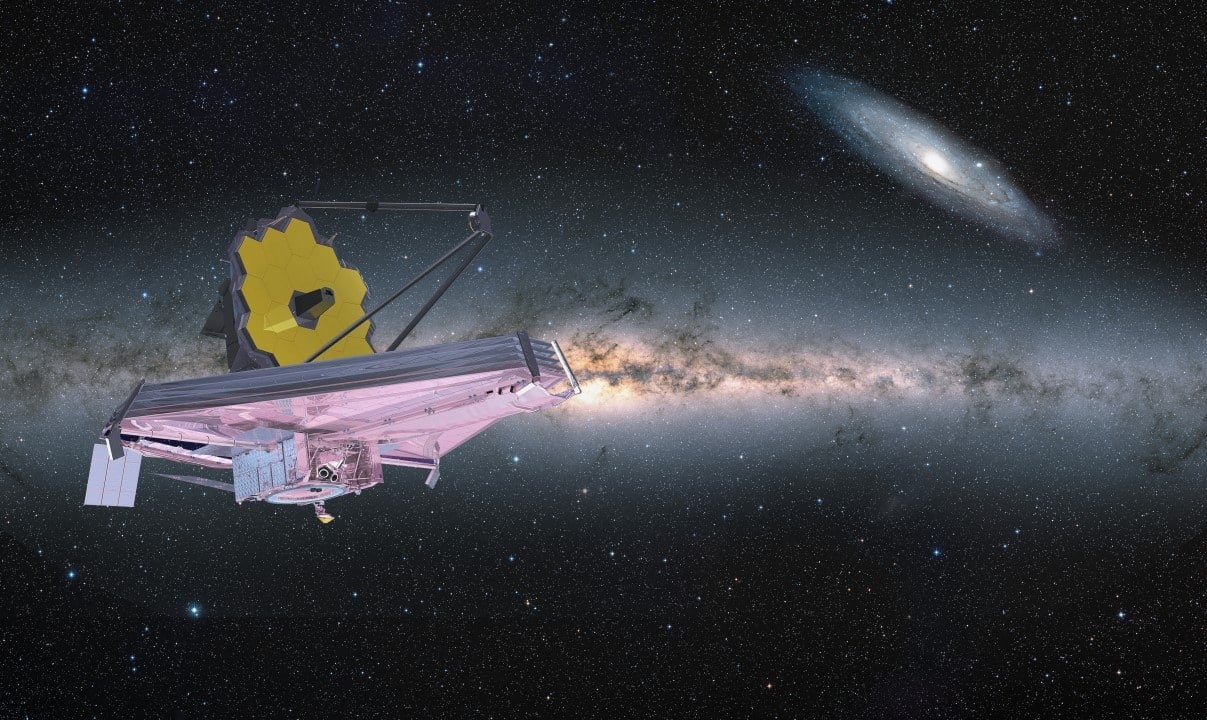
James Webb began analysis of the system in 2023, using instruments such as NIRSpec for transmission spectroscopy. Essa technique captures starlight filtered by possible atmospheres during transits.
Results for inner planets revealed an absence of strong atmospheric signals. The star displays frequent flares and spots, complicating separation of planetary signals.
Observations fromTRAPPIST-1bindicated hot surface without trapped gases. Estudos similar toTRAPPIST-1c e TRAPPIST-1dconfirmed exposed rock patterns.
Details about the planetTRAPPIST-1e
O TRAPPIST-1estands out as the most promising, with size and density close to terrestrial ones. Dados of four transits in 2023 and 2024 excluded hydrogen-rich primary atmospheres.
Analysis ruled out scenarios with dense CO2, such as in Vênus or Marte. Remaining Possibilidades include bare surface or thin nitrogen atmosphere with traces of methane.
Stellar contamination interferes with measurements, requiring additional observations. Programas plan more transits to refine corrections.
Challenges of the red dwarf star
Stars likeTRAPPIST-1they emit intense radiation in the early stages, removing atmospheres from nearby planets. Flares and stellar wind contribute to the loss of volatile gases.
Planets in the habitable zone orbit close by, exposing themselves to these conditions. Muitos systems with red dwarfs face similar barriers to atmospheric retention.
Despite this, red dwarfs represent the majority of stars in Via Láctea. Compreender its planets assist in the search for habitable worlds on a galactic scale.
Advances in transmission spectroscopy
The James Webb allows you to detect molecules in distant atmospheres with unprecedented precision. Instrumentos infrared captures faint chemical signatures during transits.
Techniques correct stellar contamination using consecutive transits of known planets. Isso improves detection of thin atmospheres on rocky worlds.
Results ofTRAPPIST-1validate methods for future targets. Telescópios like Extremely Large Telescope will complement spatial data.
Next steps in observations
Teams plan 15 additional transits ofTRAPPIST-1ein the next cycles of James Webb. Observações combined withTRAPPIST-1b, considered without atmosphere, will serve as a reference.
Bayesianas analyzes refine atmospheric models versus bare rock scenarios. Accumulated Dados will clarify composition and potential for oceans or ice.
Studies extend toTRAPPIST-1f e TRAPPIST-1g, others in the habitable zone. The system remains central to the exploration of temperate exoplanets.
Implications for the search for life
Absence of thick atmospheres on inner planets sets expectations for similar systems. Atmosferas secondary sources, formed by volcanism, remain viable on distant worlds.
Discoveries highlight resilience necessary for habitability in red dwarfs. Pesquisas future prioritize detection of biosignatures in robust candidates.
James Webb opens era of detailed characterization of rocky exoplanets. Avanços accumulate knowledge about planetary formation and evolution.



