

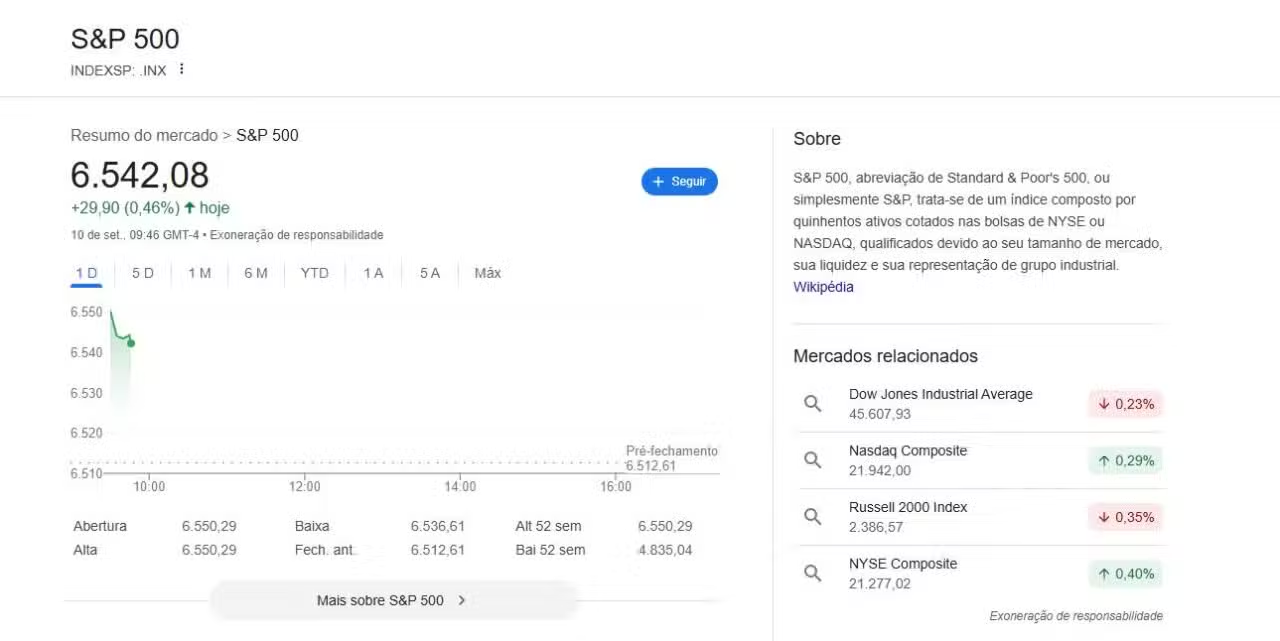
Wall Street is grappling with a pivotal question as the S&P 500 concludes an extraordinary run of triple-digit gains, marking three consecutive years of robust performance. The debate intensifies whether 2026 can deliver a fourth consecutive year of such impressive growth.
Following this period of substantial appreciation, market participants largely anticipate continued positive momentum in 2026. However, there is a clear divergence in expectations regarding the magnitude of future equity gains.

Projections from various strategists across Wall Street, as analyzed by CNN, reveal a wide spectrum of targets, yet all forecasts uniformly point towards positive returns for the upcoming year. This blend of optimism and caution sets the stage for a dynamic investment landscape.
The unprecedented rally of 2025
The S&P 500 wrapped up 2025 at 6,845.5 points, achieving a gain of over 16% despite significant market volatility throughout the year. The benchmark index registered 39 new all-time highs, showcasing remarkable resilience in the face of numerous challenges.
American equities surged even amidst fluctuations caused by tariff announcements, escalating geopolitical tensions, concerns over Federal Reserve independence, and fears of an AI bubble. Notably, the S&P 500 experienced a dip of up to 19% in April following aggressive tariff implementations by President Donald Trump but rebounded strongly after severe trade threats were suspended.
The market’s upward trajectory was predominantly fueled by intense enthusiasm for technology and artificial intelligence, coupled with a de-escalation of trade tensions. Optimism surrounding anticipated Federal Reserve rate cuts and robust corporate earnings also played critical roles in sustaining the rally through 2025.
Divergent forecasts for 2026 equity performance
Analysts at the Bank of America project the S&P 500 to reach 7,100 points by the close of 2026. This target suggests a more moderate gain of approximately 3.72% from current levels, reflecting a tempered outlook following recent high-growth years.
In contrast, strategists at Deutsche Bank maintain a more bullish stance, forecasting the S&P 500 to hit 8,000 points by the end of 2026. This projection implies a substantial appreciation of 16.87%, suggesting confidence in sustained strong market performance.
Historical patterns and market volatility
According to Adam Turnquist, chief technical strategist at LPL Financial, historical data reveals a nuanced pattern for market returns following years of significant gains. When the S&P 500 achieves at least a 15% increase in a given year, subsequent year returns have historically averaged around 8%.
Turnquist also highlights that the S&P 500 typically experiences an average decline of approximately 14% at some point during these years before ultimately recovering and moving higher. This serves as an important reminder that equity market gains are not always linear and can be accompanied by notable pullbacks.
Optimism driven by AI and economic resilience
Optimistic voices on Wall Street frequently point to artificial intelligence as a transformative force. Analysts believe that this technology has ushered in a new era of growth for American stocks, presenting substantial future earnings opportunities.
“The US should continue to be the world’s growth engine, driven by a resilient economy and an AI-powered supercycle that is fueling record investment levels and rapid earnings expansion,” analysts at JPMorgan Chase stated in a recent note. Hardika Singh, economic strategist at Fundstrat, asserts, “This year’s gains showed the bull market is full throttle, with no brakes. And there’s little solid reason to believe this run can’t extend into next year.”
Key stocks and market breadth expansion
Dan Ives, a technology specialist and global head of technology research at Wedbush Securities, has identified his top five stock recommendations for 2026. These include Nvidia (NVDA), Microsoft (MSFT), Apple (AAPL), Tesla (TSLA), and Palantir (PLTR), reflecting a continued focus on innovation.
The market rally is also showing signs of broadening beyond just AI-driven large-cap technology. The Dow Jones Industrial Average began to outperform the Nasdaq in November, indicating that the uptrend is spreading to companies that had previously lagged.
Key factors supporting the overall market gains include:
– Inflation largely under control.
– Interest rates trending downward.
– Corporate earnings consistently on the rise.
Terry Sandven, chief equity strategist at US Bank Asset Management, describes this combination as “perfect for equities.”
Corporate earnings defy valuation concerns
American companies continue to report earnings that impress Wall Street, providing a fundamental underpinning for rising stock prices. In the context of a K-shaped economic recovery, wealthier consumers maintain strong spending habits, which significantly bolsters corporate profits.
Hardika Singh of Fundstrat acknowledges concerns about high stock valuations and claims of an AI bubble. However, she asserts, “Yes, stocks are expensive and AI bubble claims are natural, but that doesn’t worry me because corporate earnings continue to grow.” Ed Yardeni, president of Yardeni Research, anticipates the S&P 500 climbing to 7,700 points by the end of 2026, implying an almost 12.5% gain. “Our year-end 2026 S&P 500 target assumes that the economy and earnings will remain resilient,” Yardeni noted, maintaining a low 20% probability for a severe correction or bear market.
Headwinds and persistent risks for the new year
Despite the recent celebratory gains on Wall Street, the global economic outlook remains shadowed by considerable uncertainties, presenting a range of potential risks for financial markets. Analysts are keen to emphasize that while optimism prevails, caution is warranted.
One prominent area of concern revolves around existing geopolitical uncertainties. The robust performance of gold in 2025, recording its best year since 1979 as investors sought safe-haven assets, underscores a prevailing nervousness about potential disruptions in the global economy or financial markets. This flight to safety reflects an underlying apprehension.
Geopolitical tensions and inflation challenges
In recent months, stock markets have benefited significantly from optimism surrounding potential Federal Reserve interest rate cuts. However, if inflation proves more persistent than anticipated in the new year, it could complicate the Fed’s path toward easing monetary policy. Such a scenario could lead to renewed challenges for equity markets.
The American consumer has demonstrated resilience, yet data suggests that spending is predominantly sustained by affluent households. These households have seen their investments appreciate substantially over recent years, providing them with greater purchasing power. Meanwhile, wage-dependent individuals often perceive the economy as considerably weaker. The continued stability of the labor market will be crucial for assessing overall consumer spending health and its subsequent impact on corporate earnings. Additionally, while Fed rate cuts could weaken the U.S. dollar, underlying concerns about the central bank potentially losing its independence from political agendas persist.
Analyst warnings and lingering structural issues
Christopher Harvey, chief equity strategist at CIBC Capital Markets, projects the S&P 500 to rise approximately 8.8% in 2026. Harvey has highlighted several risks investors should monitor closely, including concerns within the credit market and apprehension regarding the return on investments in artificial intelligence. He also points to potential turbulence related to the expiration of the U.S.-Mexico-Canada trade agreement this year, along with ongoing questions about the Federal Reserve’s credibility.
Furthermore, several unresolved issues from 2025 are likely to re-emerge as significant challenges in 2026. These include persistently rising long-term borrowing costs across the globe and sustained high government deficits. “Overall, the market environment remains fragile, and investors need to navigate a landscape where risk and resilience coexist,” stated Fabio Bassi, head of cross-asset strategy at JPMorgan Chase, underscoring the complex dynamics facing market participants.