
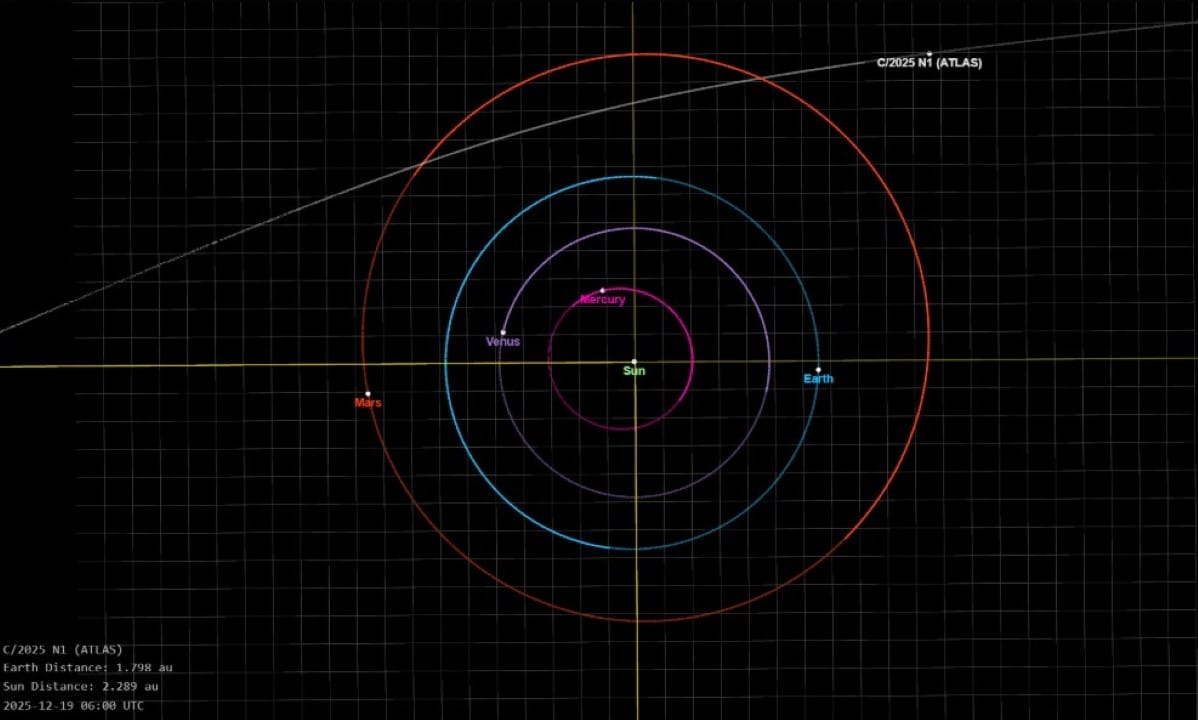
The interstellar comet 3I/ATLAS, discovered in July 2025 by the ATLAS system, passed its closest approach to Terra on December 19, 2025. Astronomer Avi Loeb, from Universidade Harvard, highlighted eight anomalies observed in the object that, according to him, could indicate an extraterrestrial technological origin.
These features include an aligned trajectory, unusual chemical composition, and structures in the tail that defy conventional natural explanations. NASA classifies 3I/ATLAS as a natural comet, the third confirmed interstellar object after ‘Oumuamua and Borisov.
Observations from Telescópio Espacial Hubble and international planetary defense campaigns collected data between November 2025 and January 2026. Loeb maintains the alien probe hypothesis, although scientific consensus points to natural processes.
Discovery and trajectory of the object
3I/ATLAS was identified on July 1, 2025 by ATLAS project telescopes on Chile. Inicialmente cataloged as C/2025 N1, the object received the designation 3I when confirming origin outside of Sistema Solar.
Its high speed and hyperbolic trajectory indicated interstellar origin from the first analyses. Imagens of Hubble captured in July 2025 revealed a nucleus larger than previous objects of the same type.
The approach to perihelion occurred in October 2025, followed by the passage close to Terra in December. In March 2026, the comet will approach Júpiter to about 53 million kilometers.
Main characteristics observed
The nucleus of 3I/ATLAS has a larger size and speed than those of ‘Oumuamua and 2I/Borisov. Sua gaseous plume contains excess nickel in relation to iron, similar to industrial metal alloys.
The nickel/cyanide ratio detected exceeds by orders of magnitude the values recorded in thousands of known comets. Durante perihelion, the object exhibited a blue glow more intense than the sun’s.
- Trajectory aligned at 5 degrees with the ecliptic plane;
- Collimated anti-tail extending over 600,000 miles;
- Jet directed to Sol with an angle of 8 degrees in relation to the rotation poles.
These observations occurred during a campaign coordinated by International Asteroid Warning Network.
Anomalies highlighted by Avi Loeb
Avi Loeb classified 3I/ATLAS with a score of 4 on its technological probability scale, where zero represents a natural comet. Ele listed eight points that, in his view, deserve consideration for an artificial hypothesis.
The trajectory aligned with the ecliptic plane has a statistical probability of only 0.2% in a natural occurrence. The direction of arrival coincides within 9 degrees with the radio signal “Wow!” recorded by the SETI project in 1977.
The collimated anti-tail facing Sol is unparalleled in common comets. Loeb suggests it could act as a shield against solar particles.
The nickel-rich composition reinforces comparison with industrially produced materials. The accelerated blue glow during perihelion may indicate ionization or an artificial thermal signature.
List of eight anomalies highlighted
Loeb detailed the following characteristics in analyzes published in 2025:
- Precise alignment of the trajectory with the ecliptic plane of the planets;
- Planned approach to Júpiter within its sphere of gravitational influence;
- Presence of collimated anti-tail directed to Sol;
- Specific angle of the jet in relation to the axis of rotation;
- Directional coincidence with the “Wow!” from SETI;
- Excess nickel in the gas plume;
- Size and speed greater than previous interstellar objects;
- Intense blue glow during perihelion passage.
Each item has low probabilities of an exclusively natural explanation, according to the astronomer.
Position of the scientific community
Most astronomers maintain that 3I/ATLAS is classified as a natural comet. Observações indicate sublimation of ices explaining the tail and the observed glow.
Researchers point out that varied chemical compositions occur in objects far from Sistema Solar. The aligned trajectory may result from gravitational interactions at its origin.
Observation campaigns continue to analyze data collected until January 2026. Novos studies should clarify the remaining anomalies.
Context of previous interstellar objects
‘Oumuamua, the first interstellar object detected in 2017, also generated similar debate for non-gravitational acceleration. 2I/Borisov, identified in 2019, presented characteristics more typical of a comet.
3I/ATLAS represents the third confirmed external visitor case. Sua passage allowed more detailed data collection than in previous ones.
Comparisons between the three objects help to understand the formation of distant planetary systems. Diferenças chemistry and dynamics enrich current astronomical knowledge.
Recent Observations and Analysis
Measurements taken in December 2025 confirmed the symmetrical anti-tail. Telescópios terrestrial and space scientists recorded brightness variations consistent with cometary models.
The speed of 58 km/s at perihelion aligned with orbital predictions. Dados spectroscopic tests indicate the presence of ionized carbon monoxide.
Analyzes published in January 2026 should bring definitive conclusions about composition. The community awaits results from the international campaign.
Debates about technological origin
Hypotheses of artificial origin gained media attention in 2025. Loeb defends an open approach to extraterrestrial possibilities based on evidence.
Critics argue that natural explanations meet all current observations. Ausência from radio signals or controlled movement reinforces cometary classification.
The case reinforces discussion about the search for extraterrestrial intelligence. Projetos as SETI continues to monitor similar objects.
Current perspective of the phenomenon
The 3I/ATLAS follows the exit trajectory of Sistema Solar after passing through Júpiter. Observações future ones will depend on new generation telescopes.
The episode encourages research into interstellar visitors. Additional Descobertas may clarify persistent anomalies.
Data collected in 2025-2026 contributes to external objects catalogue. Estudos comparatives advance understanding of cosmic chemistry.
